10 Wealth-Building Principles: How Indians Build Generational Wealth
Essential wealth-building principles that work across different income levels. Learn from successful investors and build lasting wealth systematically.
Software Developer · Creator of calculox.in · Formulas verified per RBI, Finance Act 2025-26 & SEBI
Learn about my expertise →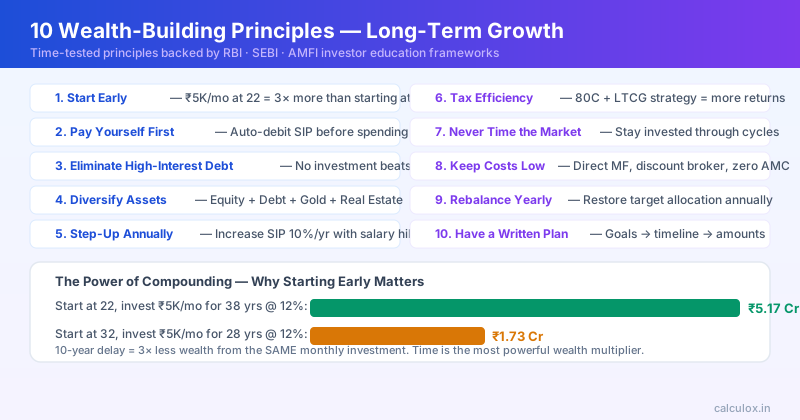
Try it yourself →
Use our free SIP Calculator for instant results
Principle 1: Start Early & Leverage Time
Time is your best investment asset. ₹5K/month SIP age 25 to 60 = ₹21L invested → ₹1.5Cr at 12% return. Same SIP age 35 to 60 = ₹15L invested → ₹42L at 12% return. 10-year head start = 3.5x more wealth! Every year delayed costs ₹20-30L in final corpus. Wealth isn't about how much you earn, it's about how much time your money compounds.
Principle 2: Live Below Your Means
Income ₹50K, expenses ₹40K = ₹10K surplus. Over 30 years at 12% = ₹1.5Cr wealth. Income ₹50K, expenses ₹48K = ₹2K surplus. Over 30 years = ₹30L wealth. 80% of wealth is determined by savings rate, not income. Millionaires succeed not by earning ₹1Cr but by spending ₹50L. Most high-income Indians struggle because they increase spending with every salary hike (lifestyle inflation trap).
Principle 3: Diversify Income Streams
Don't depend on single salary. Build: (1) Active income (salary ₹50K/month), (2) Passive income (FD interest ₹10K/month), (3) Portfolio income (stock dividends ₹5K/month), (4) Business income (side hustle ₹10K/month). Total ₹75K/month with 40% redundancy. If job lost, you still have 50% income. Diversification reduces financial stress and accelerates wealth creation.
Principle 4: Invest in Assets, Not Liabilities
Asset: Something earning money for you (stock, rental property, business, mutual fund). Liability: Something costing money (car, gadgets, luxury goods). Example: ₹10L car (depreciates 10%/year) vs ₹10L real estate property (appreciates 7%/year) = ₹34L difference over 20 years! Every rupee in assets compounds long-term. Every rupee in liabilities compounds losses.
Principle 5: Automate Everything
Automation removes emotion and willpower. Set up: Auto-SIP on salary day (₹5K equity, ₹1K FD, ₹500 insurance). Automatic payment: Bills, EMI, insurance. This discipline ensures consistent investing even during market downturns. Manual investing fails because people skip during volatility (exactly when they should invest more, buying cheaper units).
Principle 6: Tax Planning is Wealth Planning
Saving ₹50K in taxes = earning ₹50K extra (in after-tax terms). Utilize: Section 80C (₹1.5L deduction → ₹50K tax saved at 30% bracket), 80D (₹75K deduction → ₹22.5K saved), HRA (₹30-50K/month exemption → ₹1.5-2L saved annually). Over 30 working years, tax planning saves ₹30-50L! Most Indian rich people are not high earners, they are smart tax planners.
Principle 7: Educate Yourself Continuously
Financial education compounds like money. Spend 1 hour/week reading, 30 minutes watching financial videos. Learning costs ₹0. This education directly translates to better decisions (choosing 10% fund instead of 8% = ₹50L difference). Most Indians lose money due to ignorance, not bad luck. Knowledge is the best investment.
Principle 8: Stay Disciplined During Market Volatility
Market crashes are wealth-building opportunities, not disasters. During 2020 COVID crash, Sensex fell 30%. Those who continued SIP bought 30% more units at cheaper prices. By end-2021, those units tripled in value. Total return: 130% (vs normal 20% in stable markets). Discipline during crashes = wealth during recovery. Panic = permanent losses.
Principle 9: Build Multiple Properties/Assets
Wealth = portfolio of assets. Don't put all eggs in single basket. Recommended: (1) Primary home (housing need), (2) Rental property (cash flow), (3) Stock/mutual fund portfolio (liquid growth), (4) Fixed deposits (safety), (5) Gold (inflation hedge). Diversification protects against single-asset crash while generating multiple income streams.
Principle 10: Plan for Generational Wealth Transfer
Ultimate goal: ₹1Cr today → ₹10Cr next generation → ₹100Cr generation after. This happens when: (1) You build wealth, (2) You gift/transfer wisely (gift tax planning), (3) Your children continue compounding. Will planning, trust setup, insurance (cover inheritance taxation) are crucial. Wealth doubles every 8 years at 9% returns - compound across 2-3 generations and ₹1Cr becomes family legacy.
Your 90-Day Wealth-Building Action Plan
Week 1: Calculate your wealth goal. Use our retirement calculator - input current age, target retirement age, current savings, expenses. See exact corpus needed.
Week 2: Audit spending. Track every rupee for 7 days using Money Manager app. Identify waste (premium subscriptions you don't use, dining that's discretionary).
Potential savings: ₹5-15K/month. Week 3: Set up automation. Open mutual fund account (MoneControl, Kuvera, or bank).
Set up auto-SIP on salary date (₹5-20K depending on surplus). Set up auto-FD ladder (₹2-5K to FD monthly). Week 4: Optimize taxes.
Calculate 80C deduction (can you invest ₹1.5L?), HRA exemption, health insurance 80D. Potential tax saving: ₹20-60K annually. Month 2: Start investing surplus (after emergencies, debt, taxes).
Don't wait for perfect market - invest regardless. Month 3: Review and adjust. Are you on pace for goals? If savings lower than planned, cut one lifestyle expense.
If higher, increase SIP. This simple 90-day plan transforms your financial life. You go from broke → emergency fund → SIP started → taxes optimized.
Frequently Asked Questions
At what income level can I become a millionaire?▸
Even at ₹20K/month income (₹2.4L annually), save ₹5K/month (₹60K yearly) for 30 years = ₹18L invested → ₹1Cr at 12% return. So yes, ANY income level can create ₹1Cr if disciplined. Wealth isn't about income, it's about savings rate.
How long does it take to build ₹1 crore?▸
Depends on monthly investment: ₹10K/month = 25 years (at 12% return). ₹20K/month = 18 years. ₹50K/month = 12 years. ₹100K/month = 8 years. Most Indians (₹10-20K/month investment) = 15-25 years to first ₹1Cr. Then wealth accelerates (₹1Cr earns ₹12L/year at 12% return).
What if I start wealth-building at age 40?▸
Still possible but requires higher savings rate. ₹20K/month SIP age 40-60 (20 years at 12%) = ₹4.8L invested → ₹1.15Cr final. Less than starting at 25, but still achieves ₹1Cr. Key: Start immediately, don't delay further.
Can I become wealthy without property/real estate?▸
Yes! Pure stock/mutual fund portfolio: ₹10K/month SIP for 25 years = ₹1.5Cr final value. Real estate adds diversification but not necessary. Many successful Indian investors built ₹100Cr+ purely through equity markets. Property is insurance + leverage, not requirement.
What is the biggest mistake wealthy people's children make?▸
Lifestyle inflation + entitlement. Parents build ₹10Cr, children spend like ₹50Cr lifetime income, wealth depletes in 20 years. Solution: Teach financial discipline early, involve children in investment decisions, create trusts with spending limits. Wealth transfer without financial education = wealth destruction.
How do I balance lifestyle spending with wealth building?▸
Perfect balance: 50-30-20 rule. 50% essential (rent, food, utilities), 30% discretionary (dining, movies, shopping), 20% savings/investment. If earning ₹70K/month: ₹35K essentials, ₹21K fun, ₹14K investing. This lets you enjoy life NOW while building ₹1Cr for future. Extreme frugality (5% spending) = miserable present. Extreme spending (95%) = miserable future. Balance is key.
Should I use credit card for buying expenses or avoid it?▸
Credit cards are tools, not evil. Smart usage: (1) Buy necessities on card (earn 1-2% cashback), (2) Pay full balance same month (avoid interest), (3) Build credit score (750+). Cashback ₹100/month = ₹1,200/year = ₹30,000 over 25 years. Bad usage: Carrying balance (24% interest), buying things you can't afford. Discipline = credit cards give free interest-free loan + cashback.
What is the safest wealth-building strategy for risk-averse people?▸
Conservative approach: 50% FD (5-6% return), 30% balanced funds (10% return), 20% gold (7% return) = blended 7.9% return. Slower than 70% equity (12%) but more sleep-friendly. Example: ₹10K/month conservative = ₹1.5Cr in 20 years. Equity = ₹2.2Cr but with volatility. Choose based on personality - consistency matters more than returns.
Can I achieve generational wealth with limited income?▸
Yes, mathematically possible. Example: ₹15K/month SIP age 25-60 = ₹27L invested → ₹1.5Cr (first generation). At 9% conservative return (safer for next generation), ₹1.5Cr compounds to ₹10Cr by third generation (60 years later). This is the power of compounding across generations - nothing exotic needed, just consistency. Key: Start now (time is irreplaceable asset), stay consistent through market cycles, teach your children the same principles, and make sure they understand: inherited wealth without financial discipline disappears fast. The best inheritance is not money, it's the knowledge and discipline to build it. Start investing today - every year of delay costs millions in compounding power by retirement.
What is the biggest obstacle to wealth building for most Indians?▸
Lifestyle inflation (also called lifestyle creep). Pattern: Earn ₹50K/month, spend ₹48K (save ₹2K). Get raise to ₹60K, spend ₹58K (save ₹2K). Next raise ₹75K, spend ₹73K (still save ₹2K!). After 20 raises your salary 4x but savings unchanged because spending increased with every salary bump. This destroys wealth-building. Solution: When you get salary increase, increase SAVINGS first (50% of raise to investments), keep lifestyle expenses same or increase only 10-20%. Example: ₹50K salary, ₹8K SIP. Get raise to ₹60K, increase SIP to ₹13K (keep other expenses same). Next raise ₹75K, increase SIP to ₹18K. After 10 years of raises: salary 2-3x but SIP amount 5-6x = exponential wealth building! This discipline separates millionaires from broke high-earners.
Related Articles
Try Our Free SIP Calculator
Get instant, accurate results without any registration required.
Open SIP Calculator →