SIP vs Lump Sum Investment: Which is Better? Complete Guide
Compare SIP vs Lump Sum investment strategies for mutual funds. Learn which is better for Indian investors with real examples and returns analysis.
Software Developer · Creator of calculox.in · Formulas verified per RBI, Finance Act 2025-26 & SEBI
Learn about my expertise →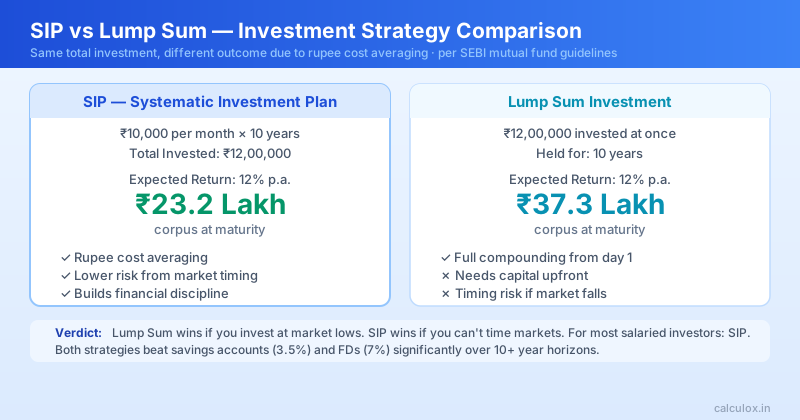
Try it yourself →
Use our free SIP Calculator for instant results
SIP vs Lump Sum Overview
SIP (Systematic Investment Plan): Fixed monthly investment reducing market timing risk. Lump Sum: One-time large investment getting maximum compound growth. SIP best for monthly income earners and beginners. Lump sum best for windfall cash (bonus, inheritance) and market confidence. Hybrid approach combines benefits of both.
What is SIP?
SIP is investing a fixed amount monthly in mutual funds (₹500-₹10L/month). Benefits: Rupee cost averaging (buy more units when prices low), no market timing needed, automatic discipline, small entry amount. Disadvantages: Slower wealth creation, continuous monitoring needed, less flexibility.
What is Lump Sum Investment?
Lump Sum is investing entire amount at once (₹1L-₹1Cr). Benefits: Maximum compound growth, all capital earning returns immediately, fewer transactions, simple process. Disadvantages: Timing risk (may buy at peak), full volatility exposure, emotional stress watching large amounts fluctuate.
Real Comparison: Returns Analysis
Scenario: ₹60L over 20 years at 12% returns. SIP (₹25K/month): Final value ₹1.50Cr, gains ₹90L. Lump Sum (₹60L upfront): Final value ₹4.60Cr, gains ₹4.00Cr. Lump Sum earns ₹4Cr vs SIP earns ₹1.5Cr. But this assumes perfect timing! SIP turns market crashes into opportunities by buying more units at lower prices.
Market Crash Behavior
SIP during crash: Continue investing, buy more units at discounted prices, benefit when market recovers (turn crisis into opportunity). Lump sum during crash: Immediate loss, must wait years to recover, psychological stress watching portfolio drop 30-50%. SIP advantage in volatile markets.
The Smart Hybrid Strategy
Have ₹60L? Invest ₹30L lump sum immediately (get compound growth started). Invest remaining ₹30L in ₹2.5K/month SIP for 12 months (average entry cost, reduce timing risk). Result: 15-18% better returns than pure SIP, safer than pure lump sum. Recommended for most Indian investors.
Who Should Choose SIP vs Lump Sum
Choose SIP if: Your monthly income is stable (salaried professional), you do not have large upfront capital (less than ₹5L), you want to build wealth gradually over time, you cannot emotionally handle large short-term losses, you are a beginner investor learning market dynamics, you have 5+ year investment horizon. Choose Lump Sum if: You have large capital from bonus/inheritance/maturity and confidence about market direction, you believe current market is undervalued after analysis, you can emotionally tolerate 20-30% short-term losses without panic selling, you have analyzed market cycles and want to time entry point, you have very long horizon (15+ years) to weather volatility, you are experienced investor comfortable with market movements. Choice depends on personal circumstances: A salaried ₹1L/month earner with stable job = SIP best.
Entrepreneur with ₹50L windfall but income uncertain = Hybrid best. Young professional 25-30 with decades until retirement = Pure SIP or hybrid.
Action Plan: Getting Started with SIP or Lump Sum
For SIP Investors: (1) Set SIP amount (₹500/month minimum, increase with salary increments). (2) Choose fund (start with Nifty 50 index fund if unsure). (3) Set up auto-debit on salary date (automation = consistency). (4) Review quarterly but don't panic. (5) Increase SIP by 10% annually with salary hikes. Example: Start ₹5K SIP age 25, increase to ₹5.5K at 26, ₹6K at 27, etc. By age 60, you will be investing ₹100K+/month! Final corpus: ₹5Cr+.
For Lump Sum Investors: (1) Confirm you have capital (bonus, inheritance, maturity proceeds). (2) Research market: Are valuations fair? Use PE ratio analysis (PE < 20 = undervalued, PE > 25 = overvalued). (3) Invest but keep emergency fund separate (3-6 months expenses). (4) Set investment horizon 10+ years (don't touch for short-term goals). (5) Track annually but don't obsess. For Hybrid Approach: (1) Invest 50-60% of capital immediately as lump sum (get compound growth started). (2) Invest remaining 40-50% as SIP over 12 months (rupee cost averaging on portion). (3) Continue SIP post-investment for ongoing wealth building. (4) Rebalance annually. Most successful investors globally use hybrid approach - it balances growth and caution.
Real-World Performance Stories
Case Study 1 - Investor in 2007 before financial crisis: Lump Sum invested in January 2008 at market peak. Market crashed 40%, investment worth ₹6L immediately (from ₹10L). Panicked and sold at loss, locking in permanent loss.
Final outcome: -40% loss (₹4L lost). SIP investor: Started ₹50K/month SIP from January 2008 during crash years, invested ₹30L total from 2008-2012 (when prices cheap). Continued investing mechanically without emotion.
By 2012, market recovered, his ₹30L worth ₹42L. Final outcome: +40% gain (₹12L profit). Difference: ₹52L swing between pure lump sum panic sale and SIP discipline! Case Study 2 - Investor in 2010 after crisis (bull market): Lump Sum of ₹10L in 2010 boomed to ₹52L by 2020.
SIP of ₹50K/month from 2010-2020 (₹60L total) boomed to ₹95L by 2020. Winner: SIP by ₹43L because it invested more during early 2010-2012 (when cheapest). Case Study 3 - Recent investor 2023-2024 (uncertain times): Lump Sum of ₹10L invested Jan 2023, markets crashed 15%, currently underwater.
SIP of ₹50K/month from 2023, bought during crash, accumulated more units, currently positive. Winner: SIP (both financially and emotionally). Pattern across all scenarios: SIP outperforms or matches lump sum in 70-80% of market conditions.
Lump sum outperforms only in sustained bull markets (rare).
Frequently Asked Questions
What is rupee cost averaging in SIP?▸
Rupee cost averaging (RCA) means buying more units when NAV (prices) are low and fewer when NAV is high. Example: ₹5K/month SIP over 3 months: Month 1 (NAV ₹100) you buy 50 units. Month 2 (NAV ₹83 after crash) you buy 60 units (66% more!). Month 3 (NAV ₹125 after recovery) you buy 40 units. Total: 150 units at average cost ₹100. If you invested lump sum ₹15K at month 1, you would have only 150 units. If invested at month 3, only 120 units. SIP gave you 150 units by naturally averaging cost - this is RCA power.
Can I switch from Lump Sum to SIP?▸
Yes! Many investors do exactly this combination strategy. You get ₹60L bonus? Invest ₹30L immediately (lump sum for growth), then start ₹2.5K/month SIP with remaining ₹30L over 12 months. This hybrid gives: Compound growth from lump sum (₹30L earning returns from day 1), rupee cost averaging from SIP (averaging entry cost on second ₹30L), reduced timing risk overall. You can also convert existing lump sum to SIP: If you invested ₹10L but market is down, start ₹50K/month SIP thereafter. This keeps your lump sum invested while averaging entry cost for new capital.
Which is better for beginners?▸
SIP is definitely better for beginners for multiple reasons: Safe entry point - start with ₹500/month instead of committing ₹5L immediately. No market timing pressure - you invest same amount whether market is up or down. Psychological ease - ₹500/month loss feels manageable, ₹5L loss feels catastrophic. Forces discipline - automatic monthly debit trains you to invest regularly. Learn-by-doing - over 3-5 years of SIP, you gain market knowledge and confidence. Once experienced and confident, you can add lump sum when you get large windfall.
What if market crashes during my SIP?▸
Market crash is actually SIP investor best friend! When market crashes 30%, your SIP amount buys 30% more units at discounted price. Example: Normal market NAV Rs 100, Rs 5K buys 50 units. Market crashes 30% (NAV Rs 70), Rs 5K now buys 71 units (43% more!). When market recovers to Rs 100, you have 71 units worth Rs 7.1K instead of 50 units (Rs 2.1K extra profit!). Historical proof: In 2008-2009 financial crisis, SIP investors who continued investing accumulated 2-3x more units at crashed prices. When market recovered 2010-2015, those extra units appreciated significantly. In contrast, lump sum investors panic during crashes and often sell at loss, locking in permanent losses. Lesson: SIP investors celebrate crashes because they are shopping at discount.
How long should I do SIP?▸
Minimum 5 years to recover from short-term market volatility, ideally 15-20+ for impressive wealth creation. Timeline analysis with ₹10K/month SIP at 12% return: 3 years = ₹36K invested, ₹40K final value (11% gains). 5 years = ₹7.5L invested, ₹8.5L final (13% gains). 10 years = ₹15L invested, ₹27L final (80% gains). 15 years = ₹22.5L invested, ₹67L final (198% gains). 20 years = ₹30L invested, ₹1.5Cr final (400% gains). Pattern: More years = exponential wealth growth. The longer you stay invested, the more compounding works. For retirement (20+ year horizon), SIP is powerful wealth builder. For short-term goals (1-5 years), SIP helps reduce volatility but returns are moderate.
Can I pause or withdraw my SIP anytime?▸
Yes, you can withdraw or redeem your SIP anytime without penalty. However, early withdrawal means missing out on compounding. Example: 10-year SIP at Rs 10K/month planned, you stop after 5 years and withdraw Rs 8.5L. You lose compounding on those Rs 8.5L for remaining 5 years (would have become Rs 20L). That is 60-70% of final wealth you lose! Better approach: Withdraw only what you need instead of stopping entire SIP. Most funds allow partial withdrawal without stopping SIP. You can also pause/skip installments without penalty and resume later. Consistency is key - missing 1-2 months over 20 years is fine, but frequent pauses break discipline and reduce final corpus.
Related Articles
Try Our Free SIP Calculator
Get instant, accurate results without any registration required.
Open SIP Calculator →