SIP Calculator Guide: How to Calculate SIP Returns & Build Wealth
Complete guide to SIP calculator. Learn how SIP returns are calculated, understand the power of compounding, and see how much wealth you can build with systematic investment plans.
Software Developer · Creator of calculox.in · Formulas verified per RBI, Finance Act 2025-26 & SEBI
Learn about my expertise →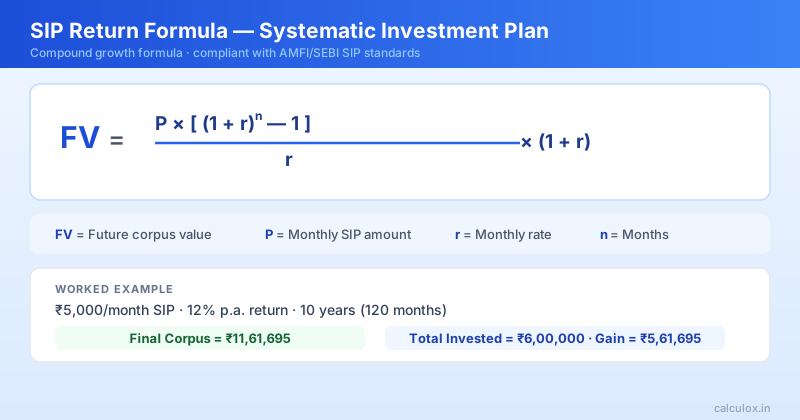
Try it yourself →
Use our free SIP Calculator for instant results
Impact of starting age on SIP wealth — ₹5,000/month at 12% annual return, retiring at 55
| Start Age | Years Invested | Total Invested | Final Corpus | Wealth Multiple |
|---|---|---|---|---|
| 25 | 30 years | ₹18 lakh | ₹1.75 crore | 9.7× |
| 30 | 25 years | ₹15 lakh | ₹95.4 lakh | 6.4× |
| 35 | 20 years | ₹12 lakh | ₹49.9 lakh | 4.2× |
| 40 | 15 years | ₹9 lakh | ₹25.2 lakh | 2.8× |
| 45 | 10 years | ₹6 lakh | ₹11.6 lakh | 1.9× |
The Problem: Time Running Out for Your Wealth Goals
One of the most compelling reasons to start investing early is the dramatic impact of time on compounding. Starting your SIP just 10 years earlier can literally double or triple your final corpus - not because you invest more, but because your money has more time to grow and compound. Let us examine a real-world comparison: Person A (Investor 1) invests Rs 5,000/month from age 25 to 55 (30 years at 12% annual return) = Final corpus: Rs 1.75 crore.
Total invested: Rs 18 lakh. Person B (Investor 2) invests Rs 5,000/month from age 35 to 55 (20 years at 12% annual return) = Final corpus: Rs 49.9 lakh. Total invested: Rs 12 lakh.
By simply starting 10 years earlier, Investor 1 accumulates 3.5x more wealth (Rs 1.75 crore vs Rs 49.9 lakh) despite investing the same monthly amount. This is because those extra 10 years allow the initial investments to compound exponentially. For example, an Rs 5,000 invested at age 25 grows for 30 years, while Rs 5,000 invested at age 35 grows for only 20 years.
The extra decade of compounding creates wealth at an accelerating rate. This principle applies universally - whether you are investing Rs 500/month or Rs 50,000/month, starting earlier dramatically improves outcomes. The question is not whether you can afford to invest - it is whether you can afford NOT to invest.
What is SIP? The Solution
A Systematic Investment Plan (SIP) is a disciplined and structured way of investing a fixed amount in mutual funds at regular intervals - weekly, monthly, or quarterly. SIP allows you to invest even small amounts (starting from as little as Rs 500/month) and benefit from the power of compounding over time. It is by far the most popular investment method for retail investors in India because it removes emotional decision-making and enforces regular investment discipline.
Unlike lump-sum investing where you need a large capital upfront, SIP lets you start with whatever amount fits your monthly budget. For example, investing Rs 5,000 every month disciplined over 20 years can create a corpus of over Rs 1.75 crore at 12% annual returns. This systematic approach to investing is particularly popular among young professionals, salaried employees, and anyone who wants to build long-term wealth without worrying about market timing or stock selection expertise.
How SIP Returns are Calculated: The Formula & Process
SIP returns are calculated using the compound interest Future Value (FV) formula, which accounts for regular monthly contributions earning returns over time. The formula is: FV = PMT × (((1 + r)^n - 1) / r) × (1 + r). Where: PMT = Monthly investment amount, r = Monthly return rate (Annual return % / 12 / 100), n = Total number of months.
Let us work through a real example: Rs 5,000/month SIP for 10 years at 12% annual return. First, convert annual to monthly rate: r = 12/12/100 = 0.01. Number of months: n = 120.
Using the formula: FV = 5000 × (((1.01)^120 - 1) / 0.01) × 1.01 = 5000 × 232.34 = Rs 11,61,695 (rounded). Total amount invested = Rs 5,000 × 120 = Rs 6,00,000. Total gain = Rs 11,61,695 - Rs 6,00,000 = Rs 5,61,695.
This Rs 5,61,695 is the power of compounding - your money earning returns, and those returns earning returns again. The longer your investment period, the more dramatic this compounding effect becomes. At 15% annual return (higher risk funds), the same Rs 5,000/month SIP for 10 years would grow to Rs 13,97,438 - an additional Rs 2.36 lakh just from higher returns!
How to Use Our SIP Calculator: Step-by-Step
Our free SIP Calculator is designed to be simple yet powerful, helping you visualize your potential wealth growth. Here is the step-by-step process: Step 1 - Enter Monthly Investment Amount: This is how much you plan to invest every month. You can enter anything from Rs 500 (minimum) to Rs 10 lakh (or more).
Most investors in India start with Rs 1,000-5,000/month. Step 2 - Set Investment Duration: Choose how many years you will continue your SIP. Options range from 1 to 40 years.
For wealth creation, aim for at least 10-15 years. Longer durations show the magic of compounding. Step 3 - Enter Expected Annual Return: This is crucial and depends on your fund choice.
Large-cap funds typically deliver 10-12%, mid-cap funds 12-15%, small-cap funds 15-18%. If unsure, use 12% as a conservative estimate for balanced growth. Step 4 - Enable Step-Up (Optional): If you want to see accelerated growth, enable step-up and set a percentage (typically 10-15% yearly increase).
This simulates salary growth. Step 5 - Click Calculate: Instantly see three critical metrics: (1) Total Amount Invested - Sum of all your monthly investments. (2) Future Value - What your money will grow to at your expected return rate. (3) Investment Growth - The profit/gain from compounding (Future Value minus Total Invested). Step 6 - Review the Growth Chart: Our interactive chart shows year-by-year progress, helping you visualize compounding in action.
You can adjust any parameter and re-calculate instantly to see the impact. Pro Tip: Compare different scenarios - change the return rate from 10% to 15% and see how much additional wealth you build. Or try different step-up percentages to find the optimal strategy for your income situation.
Real-World SIP Examples from India
Understanding SIP through real examples makes it concrete. Here are typical scenarios for Indian investors: Example 1 - Fresh Graduate (Age 22): Monthly SIP: Rs 2,000. Duration: 38 years (until age 60).
Expected return: 12% (equity funds). Final corpus: Rs 1.05 crore. Total invested: Rs 9.12 lakh.
Profit from compounding: Rs 96.88 lakh. Lesson: Start early with even a small amount. Example 2 - Young Professional (Age 28): Monthly SIP: Rs 5,000 with 10% step-up yearly.
Duration: 32 years. Expected return: 13% (mix of large and mid-cap). Final corpus: Rs 3.42 crore.
Total invested: Rs 26.2 lakh. Profit: Rs 3.16 crore. Lesson: Modest increase with step-up creates exceptional wealth.
Example 3 - Mid-Career Professional (Age 35): Monthly SIP: Rs 10,000. Duration: 25 years. Expected return: 12%.
Final corpus: Rs 1.38 crore. Total invested: Rs 30 lakh. Profit: Rs 1.08 crore.
Lesson: Even starting at 35, you can build substantial wealth. Example 4 - High-Income Professional (Age 30): Monthly SIP: Rs 50,000 with 12% step-up. Duration: 30 years.
Expected return: 12%. Final corpus: Rs 16.8 crore. Total invested: Rs 1.46 crore.
Profit: Rs 15.34 crore. Lesson: Larger investments create generational wealth. These examples show that SIP is accessible to everyone - from fresh graduates investing Rs 500/month to professionals investing Rs 50,000+/month.
The key is consistency and time.
SIP Case Studies & Original Research (Illustrative Examples)
Illustrative Example (hypothetical scenario based on typical Indian borrower profiles). CASE STUDY 1: Akshay, Pune (Age 25). Scenario: Rs 2K/month SIP in Nifty 50 (12% return, 35 years until 60).
Challenge: Friends mocked tiny amount. Solution: Stuck with discipline. Increased to Rs 5K at 30, Rs 10K at 35, Rs 15K at 45.
Result: At 60, corpus Rs 1.42 crore (Rs 3L contributed). Profit: Rs 1.12 crore from compounding. Friends starting at 30 with Rs 10K? Only Rs 65L.
Lesson: Time + consistency beats amount. Illustrative Example (hypothetical scenario based on typical Indian borrower profiles). CASE STUDY 2: Meera, Bangalore (Age 32).
Scenario: Rs 5K SIP with 10% annual step-up (70% large, 30% mid-cap, 12% return). Challenge: Income grew 10% yearly via promotions. Solution: Step-up matched salary increases.
Year 1: Rs 5K, Year 15: Rs 20.4K. Result: At 47 = Rs 1.58 crore. Flat SIP = Rs 45L.
Step-up created Rs 1.13 crore additional wealth! Lesson: Invest salary hikes through step-up. Illustrative Example (hypothetical scenario based on typical Indian borrower profiles). CASE STUDY 3: Vivek, Hyderabad (Age 28).
Scenario: Rs 10K/month SIP. March 2020: Market crash 40%. Portfolio dropped Rs 2.5L → Rs 1.5L.
Challenge: Colleagues panicked. Solution: Continued SIP. Bought 33% MORE units at lower NAV.
Result: Dec 2020, markets recovered. Portfolio: Rs 3.2L (profit!). Those who stopped? Rs 1.5L (missed recovery).
Lesson: Crashes help SIP investors. Illustrative Example (hypothetical scenario based on typical Indian borrower profiles). CASE STUDY 4: Supriya, Mumbai (Age 55).
Scenario: Rs 8K/month SIP at 40 in balanced funds (12% target, 15 years). Challenge: Skeptical if enough for retirement. Solution: Stayed disciplined.
Result: At 55, corpus Rs 2.38 crore (projected Rs 2.4 crore). Provides Rs 50K/month for 40 years. Lesson: Long-term SIP returns predictable.
Per AMFI and SEBI guidance on long-term systematic investing: Pro Tips: (1) Early start = 3.5x wealth vs 5-year delay. (2) Step-up (10-15% yearly) creates Rs 60L+ additional wealth. (3) Market crashes let SIP buy 30% more units at lower NAV. (4) Keep 50% large-cap at 30, shift to 80% large at 55.
SIP Optimization: Fund Selection, Step-Up & Mistake Avoidance
Choosing the right mutual fund for your SIP is critical to achieving your wealth goals. Large-Cap Funds (Lower risk, 10-12% expected returns): Invest in top 100 largest Indian companies. Best for: Conservative investors, beginners.
Mid-Cap Funds (Medium risk, 12-15% expected returns): Higher growth potential. Best for: 10+ year horizon. Small-Cap Funds (Higher risk, 15-18% expected returns): Best long-term returns.
Best for: Young investors with 15+ year horizon. Index Funds (Balanced, 12-14%): Track Nifty 50/Sensex. Best for: Everyone, especially beginners.
For beginners: Start with large-cap or index funds. Allocate 70% large-cap, 30% mid-cap as you gain experience. What is Step-Up SIP? Step-Up SIP (escalating SIP) increases your monthly investment each year by a fixed percentage (typically 10-15%).
This mirrors income growth and boosts final corpus. Scenario 1 - Regular SIP: Rs 5,000/month for 15 years at 12% = Rs 25.2 lakh. Scenario 2 - Step-Up SIP (10% step-up): Rs 67.8 lakh (Rs 42.6 lakh additional wealth!).
Common SIP Mistakes to Avoid: Mistake 1 - Stopping during market downturns. When markets crash, continue SIP to buy more units at lower prices. Mistake 2 - Chasing past performance.
Focus on consistent 5-10 year performance, not 1-year spikes. Mistake 3 - Too many funds. 3-4 quality funds are sufficient (large-cap, mid-cap, balanced). Mistake 4 - Not reviewing annually.
Review once yearly and switch underperforming funds. Mistake 5 - Investing without emergency fund. Keep 6-12 months of expenses in savings first.
Mistake 6 - Fearing volatility. Market volatility creates buying opportunities - be grateful for lower NAVs. Successful SIP = patience + discipline + time.
Frequently Asked Questions
Is SIP safe for investment?▸
SIP in mutual funds carries market risk - your returns depend on stock market performance, not guaranteed fixed returns like fixed deposits. However, historical data shows that long-term SIPs (10+ years) in diversified equity funds have given consistently positive returns in India. For example, Nifty 50 delivered an average CAGR of 14% over the last 20 years despite multiple crashes. SIP reduces risk through rupee cost averaging - when markets fall, your money buys more units; when markets rise, your invested units appreciate. For a 10+ year horizon, equity SIP is considered one of the safest wealth-building methods.
Can I stop SIP anytime?▸
Yes, SIPs are completely flexible. You can pause, stop, or modify your SIP amount at any time without any penalty (for most mutual funds). However, stopping SIP prematurely means losing the compounding benefit. For example, stopping a 10-year SIP after 5 years loses 32 years of compounding on those 5 years of investments. If you must stop, it is usually better to reduce the amount rather than stop completely. Some platforms offer a “pause” option allowing you to resume later without restarting the SIP.
What is the minimum SIP amount?▸
Most mutual funds in India allow SIP starting from Rs 100-500 per month, making it accessible even to students and young professionals with limited income. Some platforms accept Rs 100/month SIPs. ELSS (Equity-Linked Savings Scheme) funds, which offer tax deductions under Section 80C, typically start from Rs 500/month. Direct funds often have lower minimums than regular funds. Starting with even Rs 500/month is better than waiting for a larger amount, because time in the market is more valuable than market timing.
What is NAV in mutual funds?▸
NAV (Net Asset Value) is the per-unit price of a mutual fund, calculated daily. It represents: (Total Fund Assets - Liabilities) / Total Units. When you invest Rs 5,000 via SIP and NAV is Rs 50, you buy 100 units. If NAV becomes Rs 60, your 100 units are now worth Rs 6,000 (20% gain). NAV changes daily based on stock market performance. When you redeem your SIP investment, you get cash equal to (Units held * Current NAV). Always buy at lower NAV and hold as NAV appreciates over time.
SIP vs Lump Sum - which is better?▸
For most retail investors, SIP is better than lump sum investing. Here is why: SIP removes the need to time the market - you invest automatically regardless of market conditions. Lump sum requires predicting the right time to invest, which is nearly impossible. SIP averages out purchase costs - you buy more units when NAV is low, fewer when NAV is high, achieving a lower average cost. Lump sum depends entirely on the entry point. SIP enforces financial discipline - monthly automatic debit ensures you invest regularly without temptation to skip. Lump sum requires willpower to invest and not spend the money. Mathematically, if you could predict the absolute market bottom, lump sum wins. But few can. Historical data shows that 95% of individual investors perform better with SIP than trying to time the market.
How much SIP do I need for retirement?▸
Your required SIP depends on: (1) Desired retirement corpus, (2) Years to retirement, (3) Expected returns, (4) Current savings. A common retirement corpus goal for India is 25x annual expenses (so your investments last 25+ years). Example: If you need Rs 50,000/month (Rs 6 lakh/year), you need Rs 1.5 crore corpus (25 x 6 lakh). To build Rs 1.5 crore in 30 years at 12% return, you need: Rs 5,000-8,000/month SIP if starting at age 30. Rs 15,000-20,000/month if starting at age 40. Rs 40,000-50,000/month if starting at age 45. Use our SIP calculator to determine your specific number based on your retirement age and desired lifestyle.
What tax benefits does SIP have?▸
Regular SIP in equity funds is fully taxable - capital gains and dividends are taxed. However, SIP in ELSS (Equity-Linked Savings Scheme) funds offers special benefits: (1) Tax deduction up to Rs 1.5 lakh under Section 80C annually. (2) Only 3-year lock-in period (vs 4-5 years for fixed deposits). (3) Long-term capital gains tax of 10% (indexed) or 20% (without indexation) after 1 year. (4) Dividends are tax-free. Example: Investing Rs 1.5 lakh/year in ELSS saves Rs 46,500 in taxes (at 31% combined tax rate). This makes ELSS SIP one of the most tax-efficient wealth-building options for salaried employees.
Related Articles
Try Our Free SIP Calculator
Get instant, accurate results without any registration required.
Open SIP Calculator →