Tax-Saving Strategies for Salaried Employees 2025-26 - Save ₹50K+ Annually
Complete tax-saving guide for salaried employees in India. Learn best Section 80 deductions, HRA exemption, home loan interest, investment strategies, and save ₹50,000+ in taxes.
Software Developer · Creator of calculox.in · Formulas verified per RBI, Finance Act 2025-26 & SEBI
Learn about my expertise →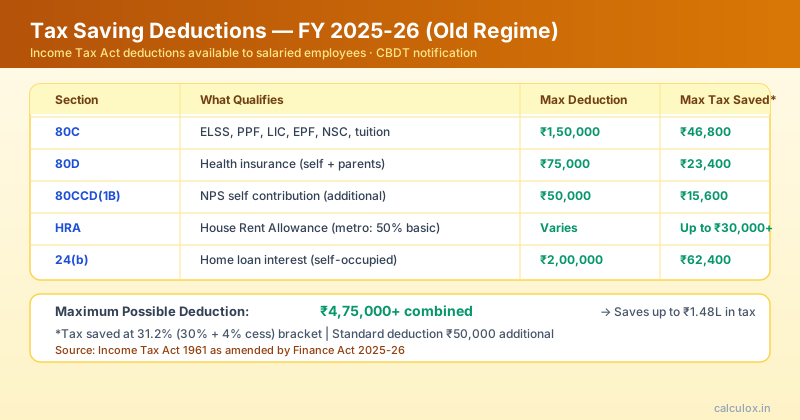
Try it yourself →
Use our free Tax Calculator for instant results
Why Tax Planning Matters
Tax planning is legal, ethical, and essential wealth management. Indians overpay taxes by ₹20-50K annually by not utilizing available deductions! Key insight: You earn post-tax money, so reducing tax directly increases take-home. A ₹1 lakh tax saving at 30% bracket = needing ₹1.43 lakh additional salary to achieve same take-home. Plan annually to keep maximum earnings.
Tax-Saving Hierarchy for Salaried Employees
Step 1 (Urgent): Maximize HRA exemption (₹30-50K/month savings). Step 2: Claim home loan interest (₹1.5L/year if applicable). Step 3: Section 80C investments (₹1.5L limit). Step 4: Health insurance 80D (₹75K/year). Step 5: Other deductions (NPS, donations, LTA). Execute in priority order to maximize total deductions (aim for ₹3-5L total deductions).
Strategy 1: HRA Exemption Maximization
HRA (House Rent Allowance) exemption = Minimum of: (1) Actual HRA received, (2) 40% of basic salary (metro), 30% (non-metro), (3) Rent paid - 10% of basic. Example: Basic ₹75,000, HRA ₹40,000, Rent ₹50,000 = Min(40000, 30000, 40000) = ₹30,000 HRA exemption. Over 40 years, this ₹30K/month = ₹14.4 lakh cumulative tax saving! Must file Form 12BB with employer and maintain rent receipts.
Strategy 2: Home Loan Interest Deduction
Section 24(b): Interest on home loan up to ₹2L deduction (principal repayment not deductible). Example: ₹40L loan at 8.5% for 20 years = year 1 interest ₹3.2L. Deductible: ₹2L. Tax saved at 30% = ₹60K annually! Years 1-10 typically exceed ₹2L interest, so this is valuable every year. After 10 years, interest drops below ₹2L. Keep loan documents, get annual statement from bank.
Strategy 3: Section 80C Investments (₹1.5L Limit)
Options: PPF (tax-free growth, 9 years), ELSS (tax-free capital gains, 3-year lock), life insurance premium, FD 5-year lock-in, children education scheme. Optimal: ₹75K/year → PPF (safe, tax-free) + ₹75K/year → ELSS (growth potential). This ₹1.5L deduction at 30% bracket = ₹45K annual tax saving. Over 10 years = ₹4.5L tax saved, plus ₹15L corpus built!
Strategy 4: Health Insurance 80D (₹75K)
Deduction: ₹75K for self+family health insurance premium (increase to ₹1L if senior citizen parent). Example: ₹50K annual premium on self+spouse → deductible, saves ₹15K tax. Most Indians miss this entirely! Buy comprehensive family health insurance (₹10L coverage) for ₹40-60K/year.
Strategy 5: National Pension Scheme 80CCD(1B)
Deduction: ₹2L additional beyond 80C limit (₹3.5L total with 80C + 80CCD). Employer contribution under 80CCD(2) = no limit (but usually 10-15% of salary). NPS gives tax-free income in retirement + immediate deduction. ₹2L annual contribution → ₹60K tax saving at 30% bracket, PLUS ₹2L compounds tax-free until retirement!
Strategy 6: Other Lesser-Known Deductions
Section 80TTA: Savings account interest (₹10K deduction). Section 80D Dependent parents: Additional ₹50K if parent 60+ (total 80D = ₹1.25L). Donations: Section 80G allows 50-100% deduction on donations to approved charities. Education loan interest: ₹1.5L deduction for self/children education loan (up to 8 years). Professional membership/course fees for self-improvement.
Implementation Timeline: When to Execute Tax-Saving Strategy
Month Jan-Mar (Post-salary increment): Review current deductions achieved, identify gaps (Did you invest full ₹1.5L in 80C? Do you need to file health insurance?). Month Apr-Jun: Set up remaining investments for current FY. For 80C, can start SIP (even starting in June is better than nothing).
For HRA, file Form 12BB with employer immediately (retroactive from April). Month Jul-Aug: File ITR by July 31 to claim refund by August 31 (get interest at 7.5% p.a.). Month Sep-Dec: Plan next FY strategy.
Calculate current year tax to forecast next year. If expecting surplus, increase SIP. If shortfall expected, adjust strategy early.
Mid-year review (Oct): Check if on pace for full ₹1.5L 80C investment. If not, plan lump-sum investment by March 31. This timing ensures you maximize deductions and avoid last-minute rush.
Frequently Asked Questions
How much tax can a salaried employee save?▸
Real example: ₹12L annual income with HRA ₹30K/month (₹3.6L/year), home loan interest ₹2L/year (₹1.67L/month at 8.5% on ₹40L), Section 80C ₹1.5L/year (PPF ₹75K + ELSS ₹75K), health insurance ₹50K = total deductions ₹6.6L. Old regime tax = ₹1.65L, New regime tax = ₹2.3L. Savings = ₹65,000 annually just by choosing Old Regime! Over 30 years to retirement = ₹19.5 lakh total savings.
Can I claim both HRA and house loan interest?▸
Yes, but with conditions. HRA exemption: If you rent and employer gives HRA. Home loan interest: If you own. Rule 1: Cannot claim both on SAME property (can't claim HRA on house you own). Rule 2: Can claim HRA on rent + home loan interest on different property (e.g., living in rented apartment, claiming HRA, AND have second property under mortgage claiming interest). Rule 3: If you own your home (fully paid or mortgaged), you cannot claim HRA on ANY rent payment. Only claim home loan interest. Practical scenario: Buy home at age 35, still paying mortgage at 45 = claim home loan interest. Meanwhile rent out portion = cannot claim HRA, but can claim interest. Consult CA if situations complex.
Is PPF or ELSS better for 80C?▸
PPF (Public Provident Fund): Characteristics: Safest option, guaranteed 7.5-8% return (fixed annually), 15-year lock-in (but can withdraw after 7 years at 50% of balance), tax-free interest, interest compounds. Best for: Conservative investors, those nearing retirement needing safety. ELSS (Equity-Linked Saving Scheme): Characteristics: Growth potential 12-15% CAGR (based on market), 3-year lock-in only (shortest), short-term capital gains tax zero if held 1+ year, dividend reinvestment. Best for: Younger investors (20+ year horizon), can tolerate volatility. Recommendation: Split ₹1.5L as ₹75K PPF (stability) + ₹75K ELSS (growth) = blended safety. ₹75K PPF matures to ₹1.5L in 15 years. ₹75K ELSS grows to ₹4-5L in 15 years at 12-15%. Total ₹5.5-6.5L from ₹1.5L invested = 10-year compounding magic.
When should I file ITR to get maximum refund?▸
Timeline matters: File by July 31st: Government processes refund by August 31st, adds 7.5% interest p.a. on refund amount. Example: ₹50K refund filed July 31 = earn ₹3,125 interest by September. File by December 31st: Refund processed but no interest. File by February 28th: Avoids 5% penalty on unpaid tax (if you overpaid, refund still processes, just no interest). File after February 28: Incur 5% penalty on underpaid amount + interest at 12% p.a. Best practice: File by June 30 itself (gives one month cushion before July 31, ensures smooth processing, get interest). Use AIS (Annual Information Statement) pre-filled data from employer to file instantly.
Can I carry forward unused 80C deduction to next year?▸
Strictly NO - 80C deduction does NOT carry forward. If limit ₹1.5L and you invest only ₹75K: In current FY: Get ₹75K deduction only, lose ₹75K deduction forever. Next FY: Can invest ₹1.5L fresh, but previous year's ₹75K cannot be used. This is common mistake costing taxpayers ₹15-30K annually. Prevention: Plan investments by December, invest any remaining amount in January/February/March before FY ends March 31. Alternative: If cash flow tight, calculate which ₹1.5L mix is achievable (e.g., ₹50K PPF + ₹50K insurance + ₹50K FD = exactly ₹1.5L) rather than over-committing. Last-minute rush (March 25-31): Invest in low-lock FD (less than 5 years penalties), or lump sum ELSS fund purchase.
How can I maximize tax deductions as my salary grows?▸
Challenge: As you earn more, tax rate goes from 20% to 30% bracket = each ₹1L deduction saves ₹30K (vs ₹20K in lower bracket). Strategy: (1) Auto-increase: Link salary increments to SIP/80C increases. Every 10% raise = increase PPF by ₹5K, ELSS by ₹5K automatically. (2) NPS boost: At ₹20L+ income, add Section 80CCD(1B) NPS ₹2L deduction (extra ₹60K saving at 30% bracket). (3) Home loan timing: Try to have maximum home loan interest (first 10 years) during highest-earning years (age 45-55). (4) Parent dependency: Add elderly parent health insurance (₹1L deduction) when parent turns 60. (5) Spouse investing: If spouse doesn't work, redirect your investment to their name (if income low, they get refund instead of paying tax). Track deduction usage: In January, audit last year deductions. Plan increases for coming year.
What is the best time of year to make 80C investments?▸
Best time: January 1st (start of calendar year) for maximum compounding, but practically any time works. Tax year: Financial year ends March 31st. Deadline: Invest by March 31st end-of-day to claim current FY benefit. Tactical timing for funds: (1) Lump-sum investing: Invest January-March if expecting refund (capture market, get interest on refund July). (2) SIP investing: Automatic monthly better than lump-sum (dollar-cost averaging handles market volatility). (3) Last-minute: If March 31st approaching and haven't invested ₹1.5L, quick options = lump-sum ELSS, 5-year FD, insurance premium payment. (4) Tax-loss harvesting: December-January, rebalance portfolio (sell losing investments for tax loss), rebuy in December/January for fresh tax year benefit. Practical: Set auto-SIP ₹12.5K/month on 1st of every month (₹1.5L annual, set-and-forget).
Related Articles
Try Our Free Tax Calculator
Get instant, accurate results without any registration required.
Open Tax Calculator →