How to Calculate Income Tax in India 2025-26 - Complete Guide
Step-by-step guide to calculate income tax in India FY 2025-26. Learn tax slabs, deductions, rebates, and use our free calculator.
Software Developer · Creator of calculox.in · Formulas verified per RBI, Finance Act 2025-26 & SEBI
Learn about my expertise →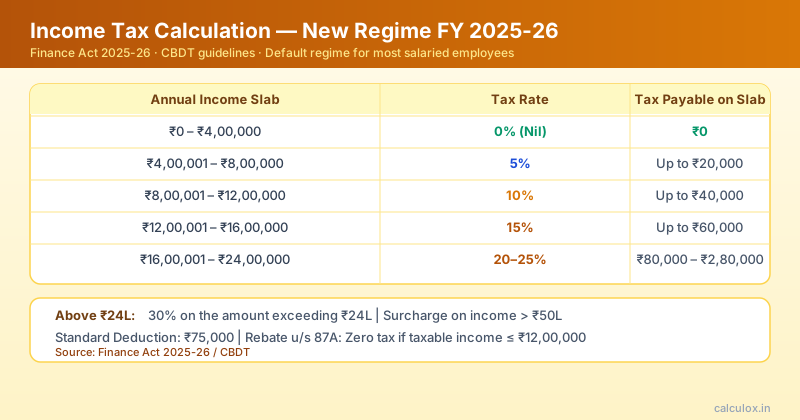
Try it yourself →
Use our free Tax Calculator for instant results
Income Tax Calculation Overview
Income Tax is a direct tax on your income (salary, business, investments) in India. Understanding tax calculation saves thousands through smart deductions and tax planning. Two regimes available: New Regime (lower rates, no deductions) and Old Regime (higher rates, allows deductions).
Choose the regime giving lower tax. In India, approximately 65% of salaried employees overpay taxes by 15-25% annually simply by not understanding these calculations. This guide walks you through step-by-step calculation, practical examples, and proven strategies to minimize your tax burden legally and ethically.
New Tax Regime Slabs FY 2025-26
Up to ₹4L: Nil (0% tax). ₹4-8L: 5% tax. ₹8-12L: 10% tax. ₹12-16L: 15% tax. ₹16-20L: 20% tax. ₹20-24L: 25% tax. Above ₹24L: 30% tax. Standard Deduction: ₹75,000 allowed in New Regime (deducted from gross income before applying slabs).
Rebate 87A: if taxable income is ≤ ₹12L you pay ZERO tax — the rebate (up to ₹60,000) wipes out the liability, so a salaried person earning up to about ₹12.75L (after the ₹75,000 standard deduction) owes no tax at all, even without any investments. A 4% health & education cess applies on top of the tax. With these wider slabs and the ₹12L rebate, the New Regime is now the cheaper choice for the large majority of salaried employees.
Old Tax Regime Slabs FY 2025-26
Up to ₹2.5L: Nil (0% tax). ₹2.5-5L: 5% tax. ₹5-10L: 20% tax (much higher than New Regime!). ₹10-20L: 30% tax. Above ₹20L: 30% tax. Deductions allowed: Section 80C (₹1.5L limit), Section 80D (₹75K health insurance), HRA exemption, home loan interest (₹2L), Section 80CCD NPS (₹2L additional).
Standard Deduction: ₹50,000 (the ₹75,000 standard deduction applies to the New Regime only). The Old Regime has higher base rates, but its deductions can produce lower net tax — though only for high earners who genuinely stack very large deductions (roughly ₹8L or more) together.
Step-by-Step Calculation Example
Example: ₹12,20,000 annual salary. NEW REGIME: Gross income ₹12,20,000, minus the ₹75,000 standard deduction = ₹11,45,000 taxable. That is below the ₹12L rebate ceiling, so Section 87A makes the tax ZERO.
New Regime tax = ₹0. OLD REGIME: Claim deductions — Standard ₹50,000 + HRA ₹1,80,000 + Section 80C ₹1,50,000 + Section 80D ₹50,000 + home loan interest ₹1,50,000 = ₹5,80,000. Taxable income = ₹12,20,000 - ₹5,80,000 = ₹6,40,000.
Apply Old slabs: ₹2.5-5L at 5% = ₹12,500; ₹5-6.4L at 20% = ₹28,000; total ₹40,500 + 4% cess = ₹42,120. Result: the New Regime wins by ₹42,120 — because a ₹12.2L salary is effectively tax-free under the New Regime, even a ₹5.8L deduction stack in the Old Regime cannot beat it. This is the big shift in FY 2025-26.
Key Deductions to Maximize
Section 80C (₹1.5L annual limit): Invest in Public Provident Fund (PPF = safest, tax-free growth), ELSS mutual funds (tax-free capital gains after 3 years, 12-15% returns), Life Insurance premiums, Fixed Deposits with 5-year lock-in, Children education scheme. Section 80D (₹75K for self+family, ₹1L if senior parent): Health insurance premium for you, spouse, children, dependent parents. HRA (House Rent Allowance): 40% of basic salary in metro (Delhi, Mumbai, Bangalore, Chennai), 30% in non-metro cities.
Claim via Form 12BB with employer + rent receipts. Home Loan Interest (₹2L Section 24): Deductible only if property is let out or self-occupied (not both). Principal repayment is NOT deductible.
Section 80CCD (₹2L additional): National Pension Scheme contributions. Total deductions can reach ₹3-4L annually for aggressive savers.
Rebate 87A & Tax Planning
Rebate 87A gives full tax relief (zero tax) for taxable income ≤ ₹12L in the New Regime, or ≤ ₹5L in the Old Regime. In the New Regime the rebate is up to ₹60,000, so a salaried person earning up to about ₹12.75L (after the ₹75,000 standard deduction) pays no tax at all — with or without investments. Example: taxable income ₹11L in the New Regime = calculated tax ₹60,000, but Rebate 87A wipes it to zero.
Only above ₹12L taxable does tax actually start; from there, a high earner may find the Old Regime cheaper if they can stack very large deductions (₹1.5L 80C + ₹75K 80D + high HRA + ₹2L home loan interest + ₹50K NPS ≈ ₹8L, usable mainly at ₹20L+ income). File ITR by July 31 for refund processing by August 31 (with refund interest at 7.5% p.a.). File by February 28 if only paying tax to avoid 5% penalty.
Best practice: File by June 30 to finalize early.
Common Tax Calculation Mistakes to Avoid
Mistake 1: Not claiming HRA even though you pay rent - costs ₹30-50K annually. Solution: Always file Form 12BB with employer if you pay rent. Mistake 2: Confusing HRA with home loan interest (both cannot be claimed on same property).
Mistake 3: Forgetting health insurance deduction (₹75K saved tax = ₹22,500 at 30% bracket). Mistake 4: Not maximizing Section 80C - only investing ₹50K instead of ₹1.5L limit = losing ₹45K deduction = ₹13,500 tax. Mistake 5: Missing NPS deduction (₹2L = ₹60K tax saving at 30% bracket).
Mistake 6: Filing ITR late and missing refunds (July 31 deadline). Mistake 7: Choosing wrong regime - not comparing both and selecting based on your specific situation. Avoid these by using our free Tax Calculator to model both regimes with your actual numbers.
Frequently Asked Questions
What is the difference between old and new tax regime?▸
New Regime: lower rates (5% starts only above ₹4L taxable) plus a large ₹12L rebate ceiling, but NO deductions except the ₹75K standard deduction. You cannot claim HRA, home loan interest, 80C, or health insurance. Old Regime: higher rates (20% at ₹5-10L) BUT allows ₹1.5L+ deductions (80C, HRA, home loan interest, health insurance, NPS). Under FY 2025-26 the New Regime wins for most people: salary up to about ₹12.75L is tax-free, and it usually stays ahead up to ₹20L unless your total deductions are very large (₹6-8L+). The Old Regime mainly wins for high earners (₹20L+) with a big deduction stack. Use the calculator to compare both with your actual numbers.
How much tax can I save with Section 80C?▸
Section 80C allows ₹1.5L deduction (maximum). Tax saving = ₹1.5L × your tax bracket percentage. Example: At 5% bracket = ₹7,500 saving. At 20% bracket = ₹30,000 saving annually. At 30% bracket = ₹45,000 saving annually! Over 10 years, consistent ₹1.5L investment in PPF or ELSS = ₹1.5 crore corpus built PLUS ₹150,000+ in taxes saved. This is one of the most powerful deductions - always maximize it.
Can I claim HRA exemption if I pay rent?▸
Yes! HRA exemption = Minimum of three amounts: (1) Actual HRA received from employer, (2) 40% of basic salary (metro cities), 30% (non-metro), (3) Rent paid minus 10% of basic salary. Example: Basic ₹75,000, HRA ₹50,000, Rent ₹60,000 = Min(50000, 30000, 50000) = ₹30,000 HRA exemption. File Form 12BB with employer and maintain rent receipts (landlord agreement + 12 monthly receipts). Saves ₹30,000 × 20% = ₹6,000 to ₹30,000 × 30% = ₹9,000 annually. Over 40-year career = ₹2.4-3.6 lakh total tax savings!
Is income tax filed automatically or do I need to file ITR?▸
Tax is NOT automatically filed by the government. You must file ITR (Income Tax Return) by July 31st (if expecting refund) or February 28th (if paying tax). Filing ITR is now simplified - takes 30 minutes online using pre-filled AIS (Annual Information Statement) data from employer and banks. Benefits of filing: Secure refund if tax overpaid, maintain ITR history for loan approvals, claim deductions, avoid 5% penalty, become eligible for exemption from TDS in future. Even if no tax payable, file if income exceeds ₹2.5L to maintain ITR record.
What happens if I miss the ITR filing deadline?▸
Consequence 1 (refund deadline - July 31): If you overpaid tax and miss deadline, your refund is stuck with government indefinitely. You lose that cash and cannot access it. Consequence 2 (tax payment deadline - February 28): If you underpaid tax, filing after Feb 28 incurs 5% penalty on unpaid tax. Example: ₹10,000 unpaid tax = ₹500 penalty = ₹10,500 total. Consequence 3 (no ITR history): Missing ITR filings affects loan approvals (banks need 3-year ITR history for credibility). Best practice: File by June 30 itself - gives buffer time before July 31 refund deadline and ensures early receipt of refund money for reinvestment.
Can I claim both HRA and home loan deduction in same year?▸
Yes, you can claim both HRA and home loan deduction, BUT on different properties only. Example: Currently renting (claim HRA on rent paid) AND have an under-construction home loan (claim interest on that loan). But you cannot claim HRA on a property AND home loan deduction on the SAME property. If you own your home, you cannot claim HRA on rent for a different property unless HRA is explicitly allowed under your employment agreement. Consult CA for your specific situation to avoid penalties and maximize both deductions properly.
Related Articles
Try Our Free Tax Calculator
Get instant, accurate results without any registration required.
Open Tax Calculator →