GST Calculator Guide: Calculate Tax Instantly
Free GST calculator to add or remove GST from any amount. Learn GST slabs, types (SGST/CGST/IGST), and see instant tax breakdowns.
Software Developer · Creator of calculox.in · Formulas verified per RBI, Finance Act 2025-26 & SEBI
Learn about my expertise →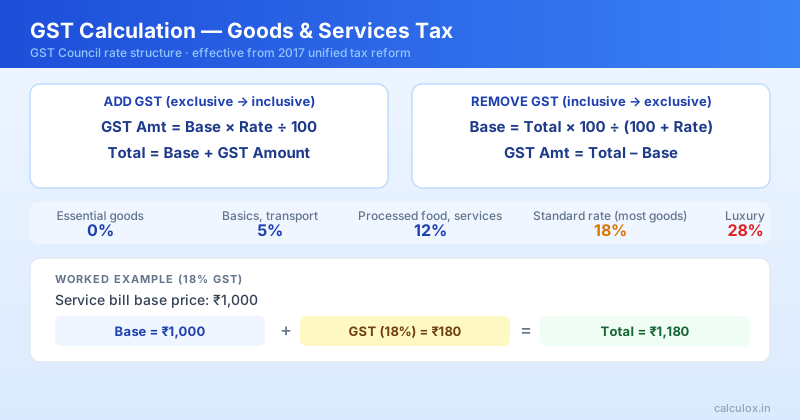
Try it yourself →
Use our free GST Calculator for instant results
What is GST?
GST (Goods and Services Tax) is a single indirect tax levied on the supply of goods and services in India. Implemented on July 1, 2017, it replaced the complex system of multiple overlapping taxes like excise duty, sales tax, VAT, and service tax. GST is a consumption-based, destination-based tax, meaning the tax is payable in the state where goods are consumed, not where they are produced.
Before GST, a product would be taxed multiple times at different stages - manufacturing, wholesale, and retail - creating “tax-on-tax” scenarios. GST eliminated this cascading effect by introducing input tax credits. Current GST rates in India are structured at four levels: 5%, 12%, 18%, and 28% depending on the type of product or service.
A 0% GST rate also exists for certain essential items and exports. Registering for GST is mandatory for businesses with turnover exceeding ₹40 lakhs (₹20 lakhs for service providers in specific states). GST is administered by the Goods and Services Tax Network (GSTN), a digital platform that maintains a centralized database of all GST-registered entities and their returns.
GST Slabs Explained (5%, 12%, 18%, 28%)
5% GST - Essential items: This lowest slab covers items deemed essential for daily living. Examples include groceries (wheat, rice, pulses, vegetables), medicines and medical supplies, non-branded packaged foods, books and newspapers, milk and milk products, edible oils, salt, flour, and certain food products. The idea is to make essential items affordable while still maintaining tax revenue. 12% GST - Mid-range items: This slab applies to semi-processed foods, electronics components, textiles and fabrics, some appliances, and intermediate goods.
Examples include processed foods, tea, coffee, jam, butter, some electronic components like chargers and cables, and certain machinery parts. 18% GST - Most common items and services: The 18% slab is the most widely used and applies to most goods and services. Examples include ready-made garments and apparel, electrical appliances like refrigerators and washing machines, restaurant dining (eating on premises), salon and spa services, hotel accommodations, insurance products, air travel, and most professional services like CA and legal consultancy. 28% GST - Luxury items: This highest slab applies to premium and luxury goods considered non-essential. Examples include automobiles priced above ₹10 lakhs, premium alcoholic beverages, high-end cosmetics, jewelry and precious metals, specific electronic devices, and certain luxury goods.
The government uses this slab to generate higher revenue from luxury segment purchases. Most GST registrations need to maintain careful records of which slab applies to each product they sell, as mis-classification can lead to tax notices and penalties.
SGST vs CGST vs IGST Explained
GST is split into three components based on whether the supply is intra-state or inter-state: SGST (State GST): This is the tax collected by the state government. It is 50% of the applicable GST rate. Example: 18% GST comprises 9% SGST + 9% CGST.
CGST (Central GST): This is the tax collected by the central government. It is also 50% of the applicable GST rate. So for an 18% GST item, the central government receives 9% and the state government receives 9%.
IGST (Integrated GST): When goods or services cross state boundaries (inter-state supply), IGST is applied instead of SGST + CGST. IGST equals the full GST rate. Example for inter-state supply: An item with 18% GST attracts 18% IGST (not split into SGST/CGST).
Practical example: You buy a shirt for ₹1000 from a local retailer in your state at 18% GST. The breakdown is: Base price = ₹1000. SGST = ₹1000 × 9% = ₹90 (goes to state government).
CGST = ₹1000 × 9% = ₹90 (goes to central government). Total GST = ₹180. You pay = ₹1180.
Same shirt ordered online from a retailer in a different state: The seller charges 18% IGST instead. IGST = ₹1000 × 18% = ₹180. You still pay ₹1180 total.
The difference: The ₹180 is sent to the central government first, which then distributes it to the destination state (your state), based on consumption-based taxation principle. This structure incentivizes businesses to keep their supply chains transparent and GST-compliant.
How to Calculate GST: Step-by-Step
Calculating GST is straightforward using basic math formulas: Adding GST to a price (exclusive to inclusive): Formula: Final Price = Original Price × (1 + GST Rate/100). Example: A product costs ₹1000 and GST rate is 18%. Final price = 1000 × (1 + 18/100) = 1000 × 1.18 = ₹1180.
The customer pays ₹1180 total. The GST amount paid = 1180 - 1000 = ₹180. Removing GST from a price (inclusive to exclusive): Formula: Original Price = Inclusive Price / (1 + GST Rate/100).
Example: A restaurant bill shows ₹590 inclusive of 18% GST. What is the pre-GST amount? Original = 590 / 1.18 = ₹500. GST included = 590 - 500 = ₹90.
Finding GST amount when you know rates: Formula: GST Amount = Price × (GST Rate / 100). Example: ₹50,000 car with 28% GST. GST amount = 50,000 × (28/100) = ₹14,000.
Customer pays = ₹50,000 + ₹14,000 = ₹64,000. Bulk transactions: If you are buying 100 items at ₹500 each with 12% GST. Total cost = 50,000 × 1.12 = ₹56,000.
GST paid = 56,000 - 50,000 = ₹6,000. These calculations become second nature with our GST calculator, which does them instantly and also shows SGST/CGST splits for intra-state supplies.
GST Exemptions & Special Cases
Understanding what is and is not taxed is crucial: Completely exempt from GST: Agricultural products sold directly by farmers (but processed versions are taxed), education services from schools and colleges (but coaching centers are taxed), healthcare services (consultations by registered medical practitioners, but diagnostic tests may be taxed), financial services (banking, insurance, lending), activities of government bodies, and certain religious services. Zero-rated items (0% GST): Exports of goods and services (zero rate encourages exports), but the exporter can still claim input tax credits on their purchases. International travel, air cargo, and seafaring.
Small business exemption: If your annual turnover is less than ₹40 lakhs (₹20 lakhs for service providers in specific states), you are not mandated to register for GST, though you can opt for voluntary registration. This exemption helps small businesses avoid compliance burden. E-commerce entity responsibilities: Platforms like Amazon and Flipkart are considered e-commerce aggregators and must collect and remit IGST if the seller is not registered for GST.
This rule protects tax collection on online sales. Reverse charge mechanism: For certain services, the recipient of the service (instead of the service provider) is responsible for paying GST. Examples include transportation services by road, works contract, and imports of specific goods.
Composition scheme: Small businesses with turnover between ₹20-40 lakhs can opt for a simplified composition scheme, paying a lower GST rate (2-5%) instead of the standard rates, if they meet certain conditions.
Real-World GST Examples for Indians
Example 1 - Restaurant bill: You dine at a restaurant for ₹2000. The bill shows 18% GST. Breakdown: Food cost = ₹2000.
SGST = ₹2000 × 9% = ₹180. CGST = ₹2000 × 9% = ₹180. You pay = ₹2000 + ₹180 + ₹180 = ₹2360.
Example 2 - Online shopping: You buy a shirt online for ₹1500 from a seller in a different state. IGST = 18%. Cost = ₹1500 + (1500 × 18%) = ₹1500 + ₹270 = ₹1770.
Example 3 - Automobile purchase: A car costs ₹20 lakhs. With 28% GST, GST amount = 20,00,000 × 28% = ₹5,60,000. Total cost = ₹20,00,000 + ₹5,60,000 = ₹25,60,000.
Example 4 - Grocery shopping: You buy groceries for ₹5000 at 5% GST. Cost = ₹5000 × 1.05 = ₹5250. GST paid = ₹250.
Example 5 - Professional services: A consultant charges ₹1,00,000 for a consulting project at 18% GST. Client pays = 1,00,000 + 18,000 = ₹1,18,000. The consultant remits SGST (₹9000) and CGST (₹9000) to respective authorities.
Common GST Mistakes & Compliance Tips
Mistake 1 - Not maintaining proper invoices: Businesses must issue proper GST invoices with GSTIN details. Not doing so can result in penalties and disallowance of input tax credits. Solution: Use proper billing software that generates GST-compliant invoices.
Mistake 2 - Not claiming available input tax credits: Registered businesses can claim GST paid on purchases against GST collected on sales. Many miss this opportunity, overpaying tax. Solution: Maintain all bills and invoices, and claim input tax credits in GST returns.
Mistake 3 - Delaying GST returns: Monthly GST returns must be filed by the due date. Late filing incurs penalties and blocks e-way bills. Solution: Set calendar reminders and file returns on time using GSTN portal.
Mistake 4 - Misclassifying products under wrong GST slab: Putting a product under wrong slab (e.g., calling a luxury item as mid-range) can trigger tax notices. Solution: Research the correct HSN/SAC code and GST slab for each product category. Mistake 5 - Not generating e-way bills for goods movement: For goods exceeding ₹50,000, an e-way bill must be generated before movement.
Not doing so results in seizure of goods. Solution: Generate e-way bills on the GSTN portal before dispatching goods. Mistake 6 - Confusing input tax credit eligibility: Not all GST can be claimed as input tax credit.
Personal expenses, entertainment, and vehicles (except when purchased as trade inventory) cannot have input tax credit claimed. Solution: Carefully track business vs personal expenses.
Frequently Asked Questions
What is the difference between GST-exclusive and GST-inclusive prices?▸
GST-exclusive price (also called “exclusive of GST”): The base price before tax is added. Example: A shirt marked “₹1000 + GST” means the actual price is ₹1000, and 18% GST = ₹180 is added on top. You pay ₹1180 total. GST-inclusive price (also called “inclusive of GST”): The price already includes GST. Example: A shirt marked “₹1000 inclusive of 18% GST” means ₹1000 is the final price you pay, with GST already embedded. The actual product cost is ₹1000 / 1.18 = ₹847, and ₹153 is GST. As a consumer, GST-inclusive prices are clearer because they show exactly what you will pay. As a business selling to other businesses, GST-exclusive is common because B2B purchases involve input tax credits.
Can I claim GST refund?▸
It depends on whether you are a consumer or a business: Registered businesses: Yes, you can claim Input Tax Credit (ITC). Any GST you paid on business purchases can be claimed against GST you collected from customers. Example: If you bought inventory for ₹100,000 + 18% GST = ₹118,000, and you sold it for ₹150,000 + 18% GST = ₹177,000, you only pay GST on the profit (₹50,000), not the full ₹150,000 revenue. Consumers: Generally, no refund available. However, exporters and persons making zero-rated supplies can claim refunds of input tax paid. Businesses operating under composition scheme: Cannot claim input tax credit - they pay a fixed percentage of turnover as GST instead. Foreign tourists: Some states offer refund schemes for foreign visitors on certain purchases, though this is not standard across India. Non-residents engaged in business: If you are a non-resident providing services in India, you may claim refunds on specific GST paid, subject to reciprocal tax treaties. The key is proper documentation - maintain all invoices and file returns correctly to claim the tax credits or refunds you are entitled to.
What items have 5% GST?▸
The 5% GST slab is for essential items meant to be affordable for common people: Food items: Vegetables (fresh, frozen, dried), fruits, grains (wheat, rice, pulses), salt, edible oils, spices, sugar, honey, jaggery, biscuits (non-premium), bread, milk, butter, cheese, eggs, and chicken. Books and media: Non-branded books (including e-books), newspapers, magazines, and educational materials for schools. Medicines: Most prescribed medicines and medical supplies, contraceptives (condoms). Personal care: Specified cosmetics and toiletries. Other items: Certain footwear, textiles fabrics, sacks used for agricultural goods. Notable exceptions (higher GST): Branded packaged foods (12% or 18%), premium cosmetics (18%), premium footwear (18%), alcohol and cigarettes (28-40%). This 5% slab is designed to keep everyday essential items affordable while still maintaining tax collection. Small businesses often focus on selling these items due to simpler accounting and potentially higher volume of customers willing to buy at lower final prices.
Is restaurant bill taxed at 18% GST?▸
It depends on the restaurant classification and your location: Standard rate (18% GST): Casual dining restaurants where you eat on premises. This includes all full-service restaurants, coffee shops, cafes, fine dining establishments, and similar venues. You will see 18% GST added to your bill. Lower rate (5% GST): Certain takeaway/delivery foods and specific restaurant categories. Some fast food chains classified as “Food served with or without seating” fall under 5% GST if they meet specific criteria. Pizza, burger, sandwich outlets and similar casual food stores often charge 5% if the service is primarily takeaway. 0% GST: Street food vendors and small food businesses below GST threshold are not charged GST. Packaged foods: If you buy packaged food from a supermarket (not eaten at a restaurant), GST depends on the type - 5% for basic items, 18% for ready-to-eat meals. Pro tip: Check your restaurant bill to see if 5% or 18% is charged. Some restaurants offer slightly lower prices because they operate under 5% GST classification. For customers, this means significant savings on large bills - a ₹1000 bill at 5% GST costs ₹1050 vs ₹1180 at 18% GST, a difference of ₹130!
How is GST calculated for services?▸
GST on services is calculated the same way as goods, but the rate depends on the type of service: High-tax services (18% GST): Most professional services like CA/audit services, legal consultancy, management consulting, hotels and accommodation, restaurant services, air travel, railway tickets, road transportation (passenger), entertainment services, salon and spa services, telecom services. Standard services (18% GST): Insurance premiums, financial advisory, real estate services, transportation. Lower-tax services (5% GST): Specific transportation (e.g., food delivery by restaurants), some insurance products, certain financial services, healthcare services by non-registered practitioners. Zero-rated (0% GST): Healthcare services by registered medical practitioners, education from schools/colleges, certain financial services. No GST (exempt): Government services, certain banking services, religious services. Example calculation: You hire an interior designer for ₹1,00,000. With 18% GST, total cost = ₹1,00,000 + ₹18,000 = ₹1,18,000. The designer is responsible for paying this ₹18,000 to the government (after claiming input credits on their own purchases like design software, transportation, etc.). Service providers must register for GST if their annual turnover exceeds the threshold (₹40 lakh for most, ₹20 lakh in some states), making professional service billing GST-compliant.
How do I use the calculator to remove GST from a bill?▸
To remove GST from an inclusive price (find the pre-GST amount): Know the inclusive price and the GST rate. Formula: Pre-GST Amount = Inclusive Price / (1 + GST Rate/100). Example: Your restaurant bill is ₹590 including 18% GST. Pre-GST amount = 590 / 1.18 = ₹500. GST paid = ₹590 - ₹500 = ₹90. In our calculator: Enter the inclusive price (₹590). Select “Remove GST” option. Choose the GST rate (18%). Click calculate. The calculator shows: Original price = ₹500. GST amount = ₹90. This is useful for: Business owners checking if they paid the correct GST on invoices. Consumers understanding what portion of their bill is tax. Accounting teams reconciling supplier invoices. Note: Always use the exact GST rate charged (5%, 12%, 18%, or 28%) for accurate results. Using the wrong rate will give incorrect figures.
What is the HSN/SAC code and why does it matter for GST?▸
HSN (Harmonized System of Nomenclature) code: An 8-digit code used to classify goods for GST purposes. SAC (Service Accounting Code): An 8-digit code used to classify services. Why it matters: Each HSN/SAC code is linked to a specific GST rate. Using the wrong code means charging the wrong GST rate, which can result in: Penalties imposed by tax authorities. Disallowance of input tax credits. E-way bill generation errors. Rejection of GST returns. Example: Cough syrup (children) has HSN code 3004 = 5% GST. Cough syrup (adult) has HSN code 3004 = 12% GST. Using the wrong code means over-paying or under-paying GST. Finding the correct code: Use the GST Council official website or GSTN portal. Consult your trade association (they often provide HSN lists). Ask your accountant or GST consultant. For businesses: Maintain an updated list of all product HSN codes with their GST rates. Train your billing team to use correct codes. Verify codes regularly as some rates change with new GST notifications. Proper HSN/SAC classification ensures compliance and avoids costly penalties.
Related Articles
Try Our Free GST Calculator
Get instant, accurate results without any registration required.
Open GST Calculator →