New vs Old Tax Regime 2025-26: Which is Better for You?
Complete comparison of New vs Old Tax Regime for FY 2025-26. Tax slabs, deductions, exemptions explained with examples. Find out which regime saves more tax for your income level.
Software Developer · Creator of calculox.in · Formulas verified per RBI, Finance Act 2025-26 & SEBI
Learn about my expertise →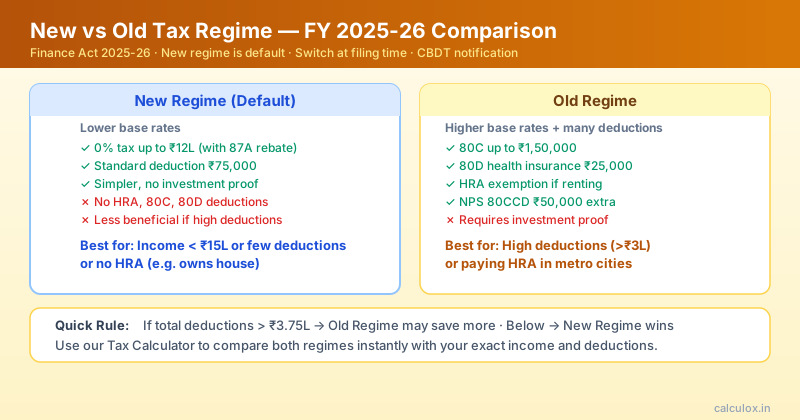
Try it yourself →
Use our free Tax Calculator for instant results
New Regime slab rates (FY 2025-26). A Section 87A rebate makes taxable income up to ₹12 lakh — about ₹12.75 lakh of salary after the ₹75,000 standard deduction — completely tax-free under the New Regime.
| Taxable Income Slab | New Regime Rate | Old Regime Rate |
|---|---|---|
| Up to ₹4 lakh | 0% | 0% |
| ₹4 – 8 lakh | 5% | 5–20% |
| ₹8 – 12 lakh | 10% | 20% |
| ₹12 – 16 lakh | 15% | 30% |
| ₹16 – 20 lakh | 20% | 30% |
| ₹20 – 24 lakh | 25% | 30% |
| Above ₹24 lakh | 30% | 30% |
The Decision: Which Tax Regime Saves You More?
India has two income tax regimes: the Old Regime (with deductions and exemptions) and the New Regime (lower tax rates but fewer deductions). From FY 2024-25, the New Regime is the default - you must specifically opt for the Old Regime when filing your ITR. The core question: Which regime is best for my specific income and deduction situation? The New Regime offers lower tax rates but removes deductions like 80C, HRA, and home loan interest.
The Old Regime has higher rates but allows various deductions that can save significant tax. Understanding both options and choosing correctly can save you ₹5,000 to ₹100,000+ annually.
Option A: New Tax Regime - Simpler, Lower Rates
New Regime slabs for FY 2025-26, applied to income after the ₹75,000 standard deduction: up to ₹4 lakh NIL, ₹4-8 lakh 5%, ₹8-12 lakh 10%, ₹12-16 lakh 15%, ₹16-20 lakh 20%, ₹20-24 lakh 25%, above ₹24 lakh 30%. Standard deduction: ₹75,000 for salaried (automatic, no documents needed). Section 87A rebate: taxable income up to ₹12 lakh pays ZERO tax — so a salaried person earning up to about ₹12.75 lakh (after the ₹75,000 standard deduction) owes no tax at all.
A 4% health & education cess applies on top of the computed tax. Key Features: Simpler filing (no deductions to track). Much wider slabs and a ₹12 lakh rebate ceiling introduced in Budget 2025.
Automatic ₹75K standard deduction (no proof needed). Best for: the large majority of salaried taxpayers — anyone with modest deductions, and especially anyone earning up to ₹12.75 lakh, whose entire salary is now tax-free. Renters without big 80C investments, fresh earners, and most middle-income employees.
Option B: Old Tax Regime - More Deductions, Higher Rates
Income up to ₹2.5 lakh: NIL. ₹2.5-5 lakh: 5%. ₹5-10 lakh: 20%. Above ₹10 lakh: 30%. Standard deduction: ₹50,000 (older than New Regime's ₹75K).
Available Deductions: Section 80C (₹1.5L): ELSS, PPF, LIC, tax-saving FDs. Section 80D (₹25,000-₹50,000): Health insurance premiums. HRA Exemption: House rent allowance (40-50% of salary in metro cities).
LTA Exemption: Leave travel allowance partially exempt. Section 24: Home loan interest (up to ₹2L deduction). Section 80CCD: NPS contributions.
Key Features: Much higher total deductions possible (₹4-6L combined). Covers family protection (insurance), home loan benefits, retirement savings (NPS/PPF). Best for: High earners with home loans, insurance, investments.
People in metro cities with high HRA. Anyone with ₹1.5L+ annual deductions.
Which Regime Saves More Tax? Side-by-Side Comparison
Under FY 2025-26 rules the New Regime wins for most people, because the ₹12 lakh rebate ceiling and much wider slabs are hard for deductions to beat. Clear decision rules: New Regime wins when — (1) your taxable income is at or below ₹12 lakh (it is simply tax-free), (2) your total deductions are modest (roughly below ₹6-8 lakh, depending on income), (3) you have no home loan or only small 80C investments, (4) you rent but your HRA is not very large. Old Regime wins only when — (1) you have a large stack of deductions used together (home loan interest ₹2L + full 80C ₹1.5L + high HRA + NPS + health insurance, typically ₹7-8 lakh or more), and (2) you are a high earner (₹20 lakh+) who can actually use all of them.
Real Examples (salaried, New Regime ₹75K standard deduction, Old Regime ₹50K): Example 1 (₹10 lakh income, minimal deductions): New tax ≈ ₹33,800; Old tax (no real deductions) ≈ ₹1,06,600. Winner: New by ~₹72,800. Example 2 (₹15 lakh income, ₹4.5 lakh deductions): New tax ≈ ₹97,500; Old tax ≈ ₹1,32,600.
Winner: New by ~₹35,100 — a solid ₹4.5L deduction stack is no longer enough to beat the New slabs. Example 3 (₹8 lakh income): New tax = ₹0 (below the ₹12L rebate ceiling); no deduction stack can beat zero. Winner: New.
The break-even has moved sharply in the New Regime's favour: at ₹15 lakh income you now need roughly ₹6 lakh of deductions before the Old Regime even draws level, and more above that. Always confirm with our Tax Calculator using your exact numbers.
Real Examples: Tax Savings Comparison for Real People
Example 1 - Single Professional (Age 26, No Home Loan): Income ₹12L. Deductions: ₹50K health insurance only. New Regime: 12L - 75K = 11.25L taxable, which is under the ₹12L rebate ceiling, so tax = ₹0.
Old Regime: 12L - (₹50K standard + ₹50K insurance) = 11L taxable. Tax ≈ ₹1,48,200. Winner: New by ₹1,48,200 — the salary is effectively tax-free.
Action: stay in New. Example 2 - Married with Home Loan (Age 35): Income ₹18L. Deductions: home loan interest ₹2L + ELSS ₹1.5L + health ₹75K + HRA ₹1.2L + ₹50K standard = ₹5.95L.
New Regime: 17.25L taxable. Tax ≈ ₹1,50,800. Old Regime: 12.05L taxable.
Tax ≈ ₹1,80,960. Winner: New by ~₹30,000 — under FY 2025-26 slabs even a ₹6L deduction stack does not beat the New Regime at ₹18L. Example 3 - Very High Earner, Maxed Deductions (Age 45): Income ₹30L.
Deductions: home loan ₹2L + 80C ₹1.5L + HRA ₹4L + NPS ₹50K + health ₹75K + ₹50K standard = ₹9.25L. New Regime: 29.25L taxable. Tax ≈ ₹4,75,800.
Old Regime: 20.75L taxable. Tax ≈ ₹4,52,400. Winner: Old by ~₹23,400 — this is the profile where the Old Regime still wins: a very high income combined with ₹9 lakh-plus of genuine deductions.
The takeaway for FY 2025-26: the New Regime is the default winner for most salaried Indians; the Old Regime pays off only when total deductions are very large (roughly ₹8 lakh or more) and income is high. Always verify with our Tax Calculator.
How to Decide & Switch Strategy for Maximum Savings
Decision Framework:
- Calculate your total eligible deductions (80C + 80D + HRA + Home Loan + others).
- Use our Tax Calculator to compute tax under both regimes.
- Choose the regime with lower tax.
- If difference is small (<₹5,000), choose New Regime for simplicity. Switching Strategy (For Salaried Employees): Salaried employees can SWITCH REGIMES EVERY YEAR - a huge advantage! Strategy: Calculate both regimes annually during tax season (May-June). Year 1: Default New Regime. If saves ₹20K tax, use it. Year 2: Made ELSS investments? Now Old Regime saves more - switch. Year 3: Home loan started? Bigger savings in Old Regime - switch back. This flexibility ensures you always pay minimum tax. Permanent switch to Old Regime only when deductions are very large — roughly ₹8 lakh or more: Home loan interest ₹2L + Section 80C ₹1.5L + HRA ₹3L + NPS ₹50K + Insurance ₹75K ≈ ₹8L total. Around that level the Old Regime starts to beat the New Regime, and mainly for incomes of ₹20 lakh and above. Critical Timing Points to Switch: Home loan started (saves ₹15-25K immediately). Marriage/children (opens HRA + insurance benefits). High HRA available (metro transfer = ₹2L+ HRA benefit). ELSS investments started (₹1.5L deduction benefit). Action: 15 minutes annually recalculating both regimes = potential ₹5-30K annual tax savings. Most people calculate once and never switch - losing thousands by not optimizing when circumstances change. Build a simple Excel: Income | All deductions | Old tax | New tax | Difference. Update yearly, switch when difference > ₹5K.
Tax Regime Case Studies & Original Insights (Illustrative Examples)
Illustrative Example (hypothetical scenario based on typical Indian profiles). CASE STUDY 1: Divya, Delhi (Age 35, Marketing Manager). Scenario: Income Rs 15L.
ELSS Rs 1.5L, Health Insurance Rs 50K, HRA Rs 1L (non-metro), no home loan. New Regime: Rs 15L - 75K = 14.25L taxable. Tax ≈ Rs 97,500.
Old Regime deductions (Rs 50K standard + 1.5L + 50K + 1L HRA = Rs 3.5L): Rs 11.5L taxable. Tax ≈ Rs 1,63,800. Result: New Regime better by ~Rs 66,300 — under FY 2025-26 slabs a ₹3.5L deduction stack is nowhere near enough to beat the New Regime.
Lesson: with the new wider slabs, moderate deductions rarely justify the Old Regime. Illustrative Example (hypothetical scenario based on typical Indian profiles). CASE STUDY 2: Rohit & Priya, Bangalore (Age 42, Power Couple).
Scenario: Rohit earns Rs 20L, Priya Rs 18L. Both have home loan interest Rs 2L, HRA Rs 2L (metro), ELSS Rs 1.5L, Insurance Rs 75K, plus Rs 50K standard = Rs 6.75L deductions each. Rohit New Regime: Rs 19.25L taxable, tax ≈ Rs 1,92,400.
Rohit Old Regime: Rs 13.25L taxable, tax ≈ Rs 2,18,400. Result: even with a ₹6.75L deduction stack, the New Regime is cheaper by ~Rs 26,000 for Rohit; Priya is similar. Lesson: under FY 2025-26 rules, high earners with big deductions can no longer assume the Old Regime wins — you must actually compare.
Illustrative Example (hypothetical scenario based on typical Indian profiles). CASE STUDY 3: Amit, Mumbai (Age 28, Freelancer). Scenario: Freelance income fluctuates: Year 1 Rs 8L, Year 2 Rs 15L, Year 3 Rs 12L.
ELSS Rs 1.5L consistently, no salaried standard deduction (freelance income). Year 1 (Rs 8L): New Regime tax Rs 0 (below the ₹12L rebate); Old ≈ Rs 44,200. New wins.
Year 2 (Rs 15L): New ≈ Rs 97,500; Old (Rs 13.5L taxable) ≈ Rs 2,26,200. New wins clearly. Year 3 (Rs 12L): New tax Rs 0; Old ≈ Rs 1,32,600.
New wins. Result: the New Regime won all three years — the ₹12L rebate makes low and mid freelance income effectively tax-free. Lesson: for most freelancers without large deductions, the New Regime is now the simple, cheaper default.
Per the Finance Act 2025 and CBDT guidance: the New Regime is the default from FY 2024-25 onward, and salaried employees who benefit from the Old Regime must opt in explicitly when filing their ITR. For FY 2025-26 the break-even has risen to roughly Rs 6-8 lakh of total deductions for middle-income earners, because taxable income up to Rs 12 lakh is now tax-free under the New Regime. Only individuals combining a home loan, high HRA and full 80C/NPS — very large total deductions — still pay less under the Old Regime, and mainly at higher incomes.
Pro Tips: (1) Check the ₹12.75L line - if your salary is at or below about Rs 12.75 lakh, the New Regime makes it tax-free; there is nothing to beat. (2) Annual Calculator Ritual - 15 minutes yearly recalculating both regimes = Rs 10-40K savings for those near the break-even. (3) Old Regime only pays with very large deductions - broadly Rs 8 lakh or more, at ₹20L+ income. (4) Threshold Strategy - Up to ~Rs 12.75L salary: New (tax-free). Rs 12.75-20L: usually New unless deductions exceed ~Rs 6L. Above Rs 20L: New unless you have very large (Rs 8L+) deductions.
Frequently Asked Questions
Can I switch between new and old tax regime every year?▸
Salaried Employees: YES, you can switch between regimes EVERY YEAR when filing ITR. Very flexible! If New Regime saves more tax this year, choose it. If Old Regime saves more next year, switch. No lock-in period. Business Owners/Self-Employed: Limited flexibility. You can switch from Old to New regime ONCE (in any year). Then you can switch back to Old regime ONCE more after that. After two switches, you are locked in the regime you last chose. So business owners must plan carefully before switching as flexibility is limited compared to salaried.
Is HRA exempt in the new tax regime and what about other allowances?▸
HRA (House Rent Allowance): Absolutely NOT exempt under New Tax Regime. If you receive Rs 2,00,000 annual HRA, entire amount is taxable in New Regime. This is MAJOR reason metro city employees (where HRA is 40-50% of salary) prefer Old Regime. Other Allowances: Leave Travel Allowance (LTA) - partially exempt in Old Regime, fully taxable in New. Standard Allowance - already counted in New Regime standard deduction. Best practice: Calculate total tax under both regimes including all allowances to compare actual savings. Employees with high HRA almost always benefit from Old Regime.
What is the standard deduction in FY 2025-26 and is it automatic?▸
Standard Deduction: FY 2025-26 increased to Rs 75,000 (from Rs 50,000) under NEW REGIME ONLY. This is automatically allowed to salaried employees earning from salary sources. No documents needed - banks don't ask for proof. OLD REGIME: Standard deduction is Rs 50,000 (it was not raised to Rs 75,000 — that increase applies to the New Regime only). However, the Old Regime allows ADDITIONAL deductions like 80C, 80D, HRA, which the New Regime doesn't. So total deductions in the Old Regime can reach Rs 4-8 lakhs versus just the Rs 75,000 standard deduction in the New Regime.
Can I claim HRA exemption under new tax regime and how is it calculated?▸
HRA is COMPLETELY EXEMPT in Old Regime but FULLY TAXABLE in New Regime. This is the biggest difference! Old Regime HRA exemption formula: Least of: (1) HRA received, (2) 40% of basic salary (metro) or 30% (non-metro), (3) Rent paid minus 10% of basic salary. Example: ₹1L salary, ₹40K HRA received, metro city. HRA exemption = Least of [₹40K, ₹40K (40% of salary), ₹40K-10K]. Result: ₹30K exempt. In New Regime: Same ₹40K HRA fully taxable at slab rate (0-30%). Difference: At 30% slab, lose ₹30K exemption benefit = ₹9K tax. For high-HRA employees (metros getting 40-50% HRA), Old Regime saves ₹15-25K annually just on HRA!
How do I file ITR (Income Tax Return) for New Regime vs Old Regime?▸
Filing process similar but critical difference: (1) Choose regime during ITR filing (select form ITR-1 for salaried employees). (2) Fill gross income. (3) If Old Regime: Enter all deductions (80C, HRA, 80D, etc.) with supporting documents. (4) If New Regime: Claim standard deduction only (no other deductions needed). (5) Calculate tax based on chosen regime. (6) File and pay balance due (if any). Deadline: July 31 for refunds by August 31, or February 28 if only paying tax (penalty applies if late). Pro-tip: Use tax software (ClearTax, EZtax) to calculate both regimes instantly, show comparison, then file under better regime. Most software auto-calculates both and recommends regime. Cost: Free for basic, ₹500-1000 for detailed returns.
Which deductions are NOT available in new regime?▸
NOT Available in New Regime: (1) Section 80C (Rs 1.5L) - PPF, ELSS, LIC, tax-saving FDs. (2) Section 80D (Rs 25-75K) - Health insurance premiums. (3) HRA Exemption - House rent allowance fully taxable. (4) LTA Exemption - Leave travel allowance fully taxable. (5) Section 80CCD(1) - NPS contributions (except employer contribution under 80CCD(2)). (6) Section 24 - Home loan interest (Rs 2L limit lost). AVAILABLE in New Regime: (1) Section 80CCD(2) - Employer NPS contribution (up to 10% of salary). (2) Standard Deduction - Rs 75,000 (automatic). This massive deduction loss is why high-income earners with insurance, home loans, and investments prefer Old Regime.
How do I calculate which regime saves more tax using the calculator?▸
Step 1: Enter your Gross Salary/Income. Step 2: Select all deductions available to you (HRA, insurance, 80C investments, home loan, etc.). Step 3: Our Tax Calculator shows side-by-side comparison: New Regime Tax and Old Regime Tax. Step 4: Choose the regime showing LOWER tax. Example calculation: Gross salary Rs 20,00,000. Old Regime deductions: Standard Rs 50K, HRA Rs 2L, Section 80C Rs 1.5L, Health Insurance Rs 75K, Home Loan Interest Rs 2L, NPS Rs 50K = Total Rs 7.25L. Old Regime: Taxable = 20L - 7.25L = 12.75L. Tax ≈ Rs 2,02,800. New Regime: Taxable = 20L - 75K = 19.25L. Tax ≈ Rs 1,92,400. Winner: New Regime by ~Rs 10,400 — even at Rs 20L with Rs 7.25L of deductions the New Regime edges ahead; the Old Regime pulls in front only once deductions climb past about Rs 8L. Use our calculator to find YOUR exact position!
What is the best strategy if my income is changing year to year?▸
Income volatility affects regime choice: Old Regime with 80C deductions provides stability regardless of income fluctuations (deductions remain fixed). New Regime taxes are pure slab-based, so higher income years have higher tax rates, lower income years have lower rates. Strategy: If income stable = optimize regime choice once yearly. If income volatile = recalculate both regimes every quarter to stay in better regime. Under FY 2025-26 rules the New Regime wins for most: salary up to about ₹12.75L is tax-free, and from ₹12.75L to ₹20L the New Regime usually still wins unless total deductions exceed roughly ₹6L. Only high earners (₹20L+) with very large deductions (₹8L or more — home loan + high HRA + full 80C/NPS together) tend to benefit from the Old Regime. If your income is volatile, recompute both regimes each year, but expect the New Regime to win in most years.
Related Articles
Try Our Free Tax Calculator
Get instant, accurate results without any registration required.
Open Tax Calculator →