Complete Investment Planning Guide for Indians 2025-26 - Build Wealth Systematically
Step-by-step investment planning guide for Indian investors. Learn asset allocation, goal-based investing, mutual funds, stocks, and create your personalized portfolio.
Software Developer · Creator of calculox.in · Formulas verified per RBI, Finance Act 2025-26 & SEBI
Learn about my expertise →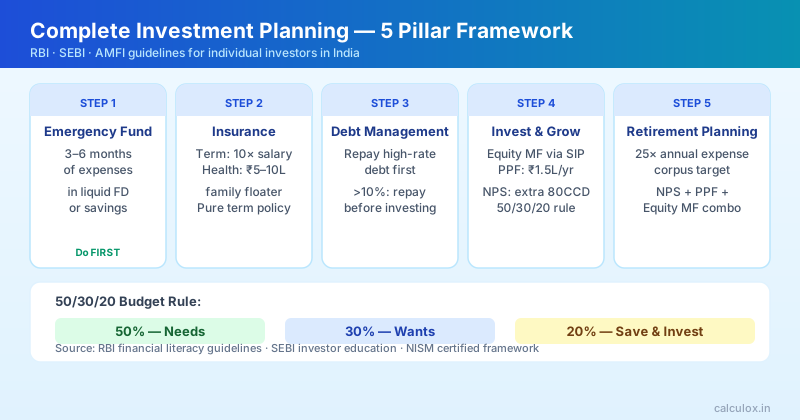
Try it yourself →
Use our free SIP Calculator for instant results
Quick Answer
A complete investment plan follows six steps: (1) define goals with timelines, (2) calculate monthly surplus, (3) understand asset classes, (4) set allocation by age (70% equity at 25–35, scaling down as you near retirement), (5) choose SIP/FD/gold vehicles, (6) monitor and rebalance annually. Indians with a written plan accumulate 3–5× more wealth over 20 years than those who invest without direction, primarily because a plan prevents panic selling and automates regular contributions.
Investment Planning: Why It Matters
Investment planning is the process of systematically allocating your money to achieve financial goals (home, education, retirement, wealth creation). Without a plan, you save without direction and miss wealth-creation opportunities. Indians with systematic plans accumulate 3-5x more wealth than those without plans.
Investment planning answers: How much to invest? Where to invest? When to invest? When to rebalance?
Step 1: Define Your Financial Goals
Before investing, list your goals and timelines: Short-term (1-3 years): Emergency fund, vacation, gadgets. Medium-term (3-10 years): Home down payment, car, education. Long-term (10+ years): Retirement, children's marriage/education, wealth creation.
Assign amounts: Emergency fund ₹3-6 lakh, Home ₹20-50 lakh, Retirement ₹1-2 crore. Time-specific goals help you choose appropriate investments (stocks for long-term, FD for short-term).
Step 2: Calculate Your Investment Capacity
Investment capacity = Income - Expenses - Tax - Lifestyle. Example: ₹1,00,000 income, ₹60,000 expenses, ₹10,000 tax = ₹30,000/month available. Further breakdown: Emergency fund first (₹3-6 lakh = cover 6 months expenses), then calculate monthly surplus for investments.
Most financial advisors recommend: 30% income → Savings, 50% → Expenses, 20% → Lifestyle/Flexibility. Start with whatever you can invest consistently.
Step 3: Understand Asset Classes
Stocks: High growth (12-16% CAGR), high risk, 5+ year tenure. Mutual Funds: Diversified, 10-15% CAGR, low risk. Fixed Deposits: Safe, 5.5-6.5% returns, zero risk.
Real Estate: 8-12% appreciation, illiquid, high capital. Gold: Hedge against inflation, 7-9% returns, low growth. Bonds/Govt Securities: 5-7% returns, safe, tax benefits.
Choose based on goal timeline: Short-term → FD/Bonds, Long-term → Stocks/Mutual Funds.
Step 4: Asset Allocation Framework
Age-based allocation: Age 25-35 (40+ year horizon): 70% equity, 20% debt, 10% gold. Age 35-50 (15-30 year horizon): 50% equity, 35% debt, 15% gold. Age 50-60 (5-15 year horizon): 30% equity, 50% debt, 20% gold.
Age 60+ (retirement): 15% equity, 60% debt, 25% safe/liquid. Example: 30-year-old with ₹30,000/month surplus: ₹21,000 → equity funds (SIP), ₹6,000 → debt/FD, ₹3,000 → gold. Rebalance annually.
Step 5: Choose Investment Vehicles
For Equity (70% allocation): SIP in Nifty 50 index fund (₹500-10,000/month). SIP in large-cap, mid-cap diversified funds (₹500+/month). Direct stocks (if knowledgeable).
For Debt (20%): Fixed Deposits (5-6% return), Government securities, debt funds. For Stability (10%): Gold ETF, physical gold, real estate. Use our SIP calculator to model ₹10K/month into equity for 20 years: ₹30L invested → ₹2.5Cr final value at 12% returns!
Step 6: Implement & Monitor
Start today, don't wait for "perfect" time (dollar cost averaging handles market timing). Set up auto-invest via mutual fund apps or bank SIPs. Review quarterly (but don't obsess), rebalance annually.
Emergency fund must be liquid (savings account or FD ladder). Track against goals (are you on pace for retirement?). Increase SIP annually with 10% salary increment (step-up SIP dramatically improves final corpus).
Avoid emotional decisions during market downturns.
Common Investment Planning Mistakes to Avoid
Mistake 1: Too much cash (savings earning 4%) instead of FD/bonds (earning 6-7%). Mistake 2: Missing tax-saving opportunities (₹1.5L 80C deduction saves ₹30-45K tax annually). Mistake 3: Not rebalancing (portfolio drifts from target allocation).
Mistake 4: Panic selling during crashes (locking in permanent losses). Mistake 5: Chasing past performance (buying last year top fund). Mistake 6: Over-concentration in single sector/stock (no diversification).
Mistake 7: Not reviewing annually (missing drift, underperforming funds). Action: Use our free investment planner to avoid these, model your specific situation with real numbers, see exact corpus at retirement. Course-correct early, don't discover problems at age 60 when it's too late to recover.
Investment planning is a lifelong process - review quarterly, adjust annually, and stay disciplined through market cycles.
Frequently Asked Questions
Should I invest in mutual funds or direct stocks?▸
For most Indians, mutual funds are better: diversification reduces risk (one fund holds 30-50 companies), professional management by experts, no single stock disaster risk (if one company fails, others cushion). Direct stocks need significant time (2+ hours research/week), knowledge (understand financial statements), emotional discipline (avoid panic selling in downturns). Recommendation: Start with SIP in Nifty 50 index fund (low cost, diversified). After 5-10 years, if interested, allocate 10-20% to direct stocks of known quality companies (Infosys, TCS, HDFC if you understand them). Most successful investors keep 80% in mutual funds, 20% in direct picks.
How much emergency fund do I need before investing?▸
Recommended: 6 months of expenses in liquid savings (not invested). Example: ₹60,000/month expenses = ₹3.6L emergency fund minimum in savings account earning 4-5% interest. Only after this buffer exists, invest surplus in SIP/stocks. Why 6 months? Job loss notice + 2-month job search + 1 month buffer = 3 months minimum, but 6 months safer for stability. Emergency fund prevents forced liquidation during job loss/medical emergency (if you sell stocks in downturn to raise cash, you lock in losses). After retirement, increase emergency fund to 2-3 years expenses (less ability to earn, market may be down).
What if I start investing late (at age 40)?▸
You can still build meaningful wealth - don't despair! Example: ₹10K/month SIP at age 40-60 (20 years at 12% returns) = ₹60L invested → ₹1.4Cr at retirement (40% less than starting at 25, but still substantial). Alternative strategy: Increase SIP amount to catch up. ₹20K/month from 40-60 = ₹2.8Cr. Or shorter timeline: ₹15K/month from 40-55 (15 years) = ₹1.8Cr. Key: Starting immediately at 40 is infinitely better than starting at 45 or 50. The next 5 years of compounding matter. Start right away with aggressive but realistic amount you can sustain.
Should I pay off debt or invest?▸
Priority depends on interest rate of debt: High-interest debt (credit card 24%, personal loan 15-20%, auto loan 10-12%): Pay off completely first. Return from investing (12% stocks) won't reliably exceed these rates. Medium-interest debt (home loan 7-8%): Can run parallel to investments. 12% stock returns > 8% home loan cost = net 4% profit from borrowing. Low-interest debt (education loan 6-7%): Invest aggressively while paying minimum. Strategy: After paying high-interest debt completely, use 70% of surplus for investments, 30% for accelerated medium-interest debt repayment. Example: ₹30K/month surplus = ₹21K to SIP, ₹9K to home loan principal.
How often should I rebalance my portfolio?▸
Rebalance annually (every December) to maintain target allocation (70% equity, 20% debt, 10% gold). Example: Started with ₹70L equity, ₹20L debt, ₹10L gold. Markets boomed - equity grew to ₹90L (75% of ₹120L total). Rebalance: Sell ₹15L equity, buy ₹15L debt to restore 70-20-10. Why rebalance? Prevents drift into overweighted assets. Automatic "sell high, buy low" - selling what grew too much, buying what is undervalued. Don't rebalance monthly (triggers 30%+ short-term capital gains tax on profits), quarterly (excessive), or never (dangerous - portfolio drifts). Annual rebalancing in December works well. Automation: Use portfolio apps (Smallcase, Kuvera) that auto-rebalance quarterly with minimal tax impact.
What is the impact of inflation on my investment returns?▸
Inflation erodes purchasing power: 12% stock returns seem great, but at 6% inflation, real return = 12% - 6% = 6% actual buying power increase. Historically: Stocks beat inflation by 6-8% real returns. Bonds provide only 1-2% real return after inflation. Gold hedges inflation (keeps pace, doesn't outpace). Retirement planning impact: If inflation stays at 6%, money needed at 60 will be 2.4x today's amount (25 years compounding at 6%). Our retirement calculator accounts for inflation automatically - always input realistic inflation (5-7% for India). Strategy: Maintain 60-70% stocks to beat inflation, use real estate and gold for inflation hedge (30-40% of portfolio), avoid holding too much cash (loses purchasing power).
How do I avoid emotional decisions in market downturns?▸
Market downturns are gut-wrenching: 2008 crash 60% loss, 2020 COVID crash 35% loss. Emotional mistakes: Selling at bottom to recover losses (locks in losses), stopping SIP (buying high, skipping low), moving to safe FDs (missing recovery). Prevention strategies: (1) Automate: Set SIP on auto, don't touch it. (2) Review only quarterly (not daily). (3) Understand: Downturns always recover - 2008 recovered in 5 years, 2020 in 6 months. (4) Reframe: Downturns = opportunity to buy more at lower prices via SIP. ₹10K SIP when market down ₹1000 = 10 units. When up ₹1500 = 6 units. Lower average cost! (5) Time horizon: If 10+ years until need, downturns irrelevant. Only matters if you need money in 2-3 years (use FD instead). Mantra: Invest for long term, ignore short-term noise, maintain SIP discipline.
Related Articles
Try Our Free SIP Calculator
Get instant, accurate results without any registration required.
Open SIP Calculator →