Simple Interest Calculator: Formula & Calculation Guide
Calculate simple interest instantly. Learn SI formula, difference from compound interest, and use cases for loans and deposits.
Software Developer · Creator of calculox.in · Formulas verified per RBI, Finance Act 2025-26 & SEBI
Learn about my expertise →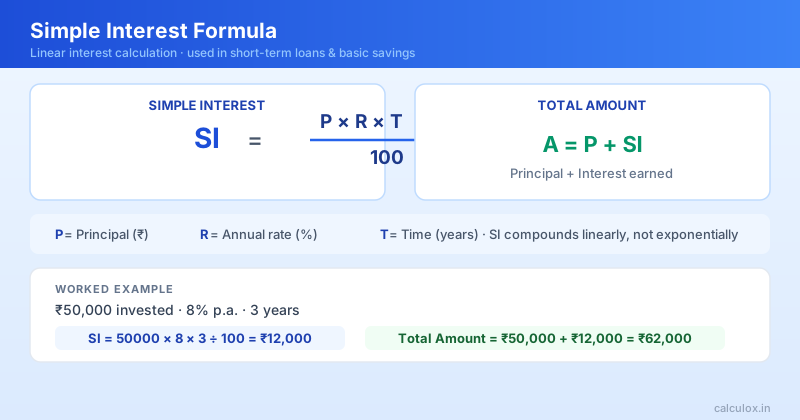
Try it yourself →
Use our free Simple Interest Calculator for instant results
What is Simple Interest?
Simple Interest (SI) is interest calculated only on the original principal amount, not on previously earned interest. This makes it straightforward and predictable - the interest amount remains the same every year. Formula: SI = (P × R × T) / 100, where P = principal (loan/savings amount), R = annual interest rate (%), T = time period in years.
Example: Rs 10,000 at 5% annual interest for 3 years gives SI = (10,000 x 5 x 3) / 100 = Rs 1,500. Total amount you receive = Rs 10,000 + Rs 1,500 = Rs 11,500. In comparison, compound interest would give you Rs 11,576 (slightly more) because interest earns interest.
Simple interest is used for short-term loans, personal loans, and certain government savings schemes. It is easier to calculate and understand compared to compound interest, making it popular for quick financial decisions.
Simple Interest Formula & Calculation
The SI formula is straightforward: SI = (P × R × T) / 100. For the final amount (Principal + Interest): Amount = P + SI = P(1 + RT/100). Step-by-step calculation example: Rs 1 lakh (principal) at 8% (annual interest rate) for 2.5 years.
SI = (100,000 x 8 x 2.5) / 100 = Rs 20,000. Total amount = Rs 100,000 + Rs 20,000 = Rs 1,20,000. For fractional years: Rs 50,000 at 6% for 1.5 years = (50,000 x 6 x 1.5) / 100 = Rs 4,500.
Simple interest is used extensively in: Personal loans from banks and NBFCs. Post office savings schemes (NSC, Kisan Vikas Patra). Government schemes like Sukanya Samriddhi.
Trade credit and business lending. Short-term fixed deposits (tenure < 6 months). Student education loans.
The simplicity of SI makes it transparent - you know exactly how much interest you will pay or earn, with no surprises from compounding.
Simple Interest vs Compound Interest
This is the critical difference that determines which calculation method applies to your situation: Simple Interest (SI): Interest is calculated and paid on principal only, every year in fixed amounts. Compound Interest (CI): Interest is calculated on principal plus previously earned interest - interest earns interest! Comparison Example: Rs 10,000 at 10% interest for 3 years. SI Calculation: Year 1: Rs 1,000 interest.
Year 2: Rs 1,000 interest. Year 3: Rs 1,000 interest. Total SI = Rs 3,000.
Total amount = Rs 13,000. CI Calculation: Year 1: Rs 1,000 interest (10% of 10,000). Year 2: Rs 1,100 interest (10% of 11,000).
Year 3: Rs 1,210 interest (10% of 12,100). Total CI = Rs 3,310. Total amount = Rs 13,310.
The difference is Rs 310 (CI gives more). Impact over longer periods: For 10 years, the difference becomes substantial. SI = Rs 20,000 (fixed every year).
CI = Rs 25,937 (compounds each year). For 20 years, SI = Rs 30,000 but CI = Rs 67,275! SI is used for: Shorter-term loans (personal loans, auto loans). Post office schemes.
Government bonds. CI is used for: Bank fixed deposits (all FDs use CI). Mutual fund investments.
Savings accounts. Long-term investments. Rule of thumb: For durations under 3 years, SI vs CI difference is small.
For durations above 5 years, CI significantly outpaces SI.
Where Simple Interest is Used in India
Understanding where SI applies helps you evaluate financial products correctly: Personal Loans: Most banks and NBFCs use SI for tenure under 3 years (typically 1-3 years). Example: ICICI, Axis, IndusInd personal loans. Amount: Rs 5,000-Rs 10 lakh.
Rate: 10-16% annually. Auto Loans: Some finance companies use SI for auto loans, especially non-EMI structured loans. Home Loans: Mostly use reducing balance (form of CI), not SI.
Trade Credit: Business-to-business lending often uses SI. Example: Rs 10 lakh borrowed for 90 days at 12% annual rate. Government Schemes: Sukanya Samriddhi (SSY): 8.0% interest annually (SI).
National Savings Certificate (NSC): 7.7% interest (SI/CI hybrid). Kisan Vikas Patra (KVP): Double your money in ~10 years (SI-based calculation). Post Office Savings Account: 4% annual interest (SI).
Short-term Fixed Deposits: Bank FDs under 6 months may use SI (quarterly interest accrual). Overdraft Facilities: Bank overdrafts sometimes use SI calculated daily. Student Education Loans: Government schemes like Vidyalakshmi or state schemes often use SI.
Knowing which method your loan uses is important - SI is generally borrower-friendly (cheaper than CI) but less favorable for savers and investors.
Simple Interest Calculation for Different Time Periods
SI formula adjusts based on whether time is expressed in years, months, or days: For Years: SI = (P × R × T) / 100. For Months: SI = (P × R × M) / 1200. (Divide by 1200 because 100 × 12 = 1200 accounts for monthly conversion). For Days: SI = (P × R × D) / 36500. (Divide by 36500 because 100 × 365 = 36500 accounts for daily conversion).
Example 1 - Months: Rs 25,000 at 8% for 9 months. SI = (25,000 x 8 x 9) / 1200 = Rs 1,500. Example 2 - Days: Rs 50,000 at 6% for 90 days.
SI = (50,000 x 6 x 90) / 36500 = Rs 739.73. Example 3 - Fractional years: Rs 1,00,000 at 7% for 2 years 6 months (2.5 years). SI = (100,000 x 7 x 2.5) / 100 = Rs 17,500.
Why multiple formulas? Banks calculate interest based on actual time period of the loan or deposit. A personal loan of 18 months uses monthly formula. A short-term FD for 45 days uses daily formula.
Daily compounding is common in savings accounts and overdrafts. Some schemes use 360 days instead of 365 (Old IS method) - always verify with your bank.
Use Our Simple Interest Calculator
Our free Simple Interest Calculator simplifies all calculations with an intuitive interface: Step 1 - Enter Principal Amount: Input the loan amount or savings amount (Rs 1000 to Rs 10 crore). Step 2 - Enter Annual Interest Rate: Enter as percentage (e.g., 8 for 8% annual rate). Step 3 - Choose Time Period: Select years, months, or days.
You can enter fractional periods (e.g., 2.5 years for 2 years 6 months). Step 4 - Click Calculate: Instantly see: Total Principal invested. Total Interest earned.
Total Amount (Principal + Interest). Exact interest per month/day (helpful for budgeting). Step 5 - Optional: Compare with Compound Interest: Our calculator shows SI vs CI side-by-side, helping you understand the difference.
You can adjust the interest rate to see sensitivity analysis - if your loan rate drops from 10% to 8%, how much do you save in total interest? This is invaluable for comparing loan offers from different banks. Example scenario: You have two personal loan offers - Bank A at 12% SI for 3 years vs Bank B at 11% SI for 3 years. Use our calculator to instantly see which one costs less in total interest (Bank B saves Rs 27,750 on a Rs 5,00,000 loan!).
Real-World Simple Interest Examples
Example 1 - Personal Loan Decision: You need Rs 3,00,000 for home renovation. Bank A offers 12% SI for 3 years. Total interest = (300,000 x 12 x 3) / 100 = Rs 1,08,000.
Total repayment = Rs 4,08,000. Monthly EMI = Rs 11,333 (fixed throughout). Bank B offers 11% SI for 3 years.
Total interest = (300,000 x 11 x 3) / 100 = Rs 99,000. Total repayment = Rs 3,99,000. Monthly EMI = Rs 11,083.
Bank B saves you Rs 9,000 over 3 years. Example 2 - Post Office Savings: You invest Rs 50,000 in Kisan Vikas Patra (KVP) at 7.2% SI for 10 years (approx). SI = (50,000 x 7.2 x 10) / 100 = Rs 36,000.
Total amount = Rs 86,000. This doubles your original investment. Example 3 - Government Bond: You buy Rs 10 lakh National Savings Certificate at 7.7% SI for 5 years.
SI = (1,000,000 x 7.7 x 5) / 100 = Rs 3,85,000. Total = Rs 13,85,000. Safe, government-guaranteed return.
Example 4 - Business Overdraft: A business borrows Rs 50,000 for 60 days at 12% annual SI. SI = (50,000 x 12 x 60) / 36500 = Rs 987. Interest paid for 2 months = Rs 987 (very reasonable for business borrowing).
These examples show SI is transparent and predictable - making it ideal for short-term borrowing.
Common SI Mistakes & How to Avoid Them
Mistake 1 - Confusing SI with CI: Many borrowers think SI and CI are the same. Result: They are surprised when actual interest charges exceed their calculations. Solution: Always confirm with your lender whether interest is SI or reducing balance (form of CI).
Mistake 2 - Not Reading the Fine Print: Some loans claim SI but include processing fees, hidden charges, or prepayment penalties. Result: Actual cost of loan is much higher than calculated SI. Solution: Ask for a complete loan statement showing total cost, break-even analysis, and all charges.
Mistake 3 - Comparing Loans with Different Tenures: Comparing a 2-year loan with 14% SI vs 3-year loan with 12% SI without calculating totals. Result: Choosing the wrong loan based on rate alone. Solution: Always compare total interest paid, not just the interest rate percentage.
Mistake 4 - Forgetting to Account for Partial Months/Days: Assuming interest is calculated for full months even if the loan is for 45 days or 1.5 months. Result: Unexpected interest calculations. Solution: Use our calculator to see exact interest for your specific timeline, accounting for days.
Mistake 5 - Not Negotiating SI Rate: Assuming the quoted rate is fixed. Result: Paying more than necessary. Solution: Negotiate! Many banks offer discounts for employees, senior citizens, or based on credit score.
You can often reduce SI rate by 0.5-1% through negotiation. Mistake 6 - Ignoring SI vs CI Comparison for Longer Periods: Taking a 5-year SI loan without checking if a CI alternative would be cheaper (some loans offer both options). Result: Paying unnecessary interest.
Solution: Always ask for SI vs CI comparison for tenures above 3 years, as CI can sometimes be cheaper long-term.
Frequently Asked Questions
What is the SI formula and how do I remember it?▸
The SI formula is: SI = (P × R × T) / 100. Where P = Principal (amount borrowed/saved), R = Annual interest rate (as %), T = Time in years. A memory trick: "PRT divided by 100 gives you SI!" This formula works for any time period - just adjust 100: (1) For years: divide by 100. (2) For months: divide by 1200 (100 x 12). (3) For days: divide by 36500 (100 x 365). Real example: Rs 5,00,000 at 10% for 2 years gives SI = (500,000 x 10 x 2) / 100 = Rs 1,00,000. This is straightforward and predictable - no surprises!
How is simple interest different from compound interest?▸
SI: Interest calculated yearly on principal only - remains the same every year. CI: Interest calculated on principal + accumulated interest - the interest itself earns interest! Comparison for Rs 10,000 at 10% for 3 years: Simple Interest: Year 1: Rs 1,000 interest. Year 2: Rs 1,000 interest. Year 3: Rs 1,000 interest. Total SI = Rs 3,000. Compound Interest: Year 1: Rs 1,000 interest (10% of 10,000). Year 2: Rs 1,100 interest (10% of 11,000). Year 3: Rs 1,210 interest (10% of 12,100). Total CI = Rs 3,310. Difference = Rs 310 (CI is better as a saver, worse as a borrower). For longer periods (10+ years), CI dramatically outpaces SI. SI is simpler and more transparent, making it easier for borrowers and savers to plan.
What is the difference between SI and CI for 1 year?▸
For exactly 1 year, SI and CI are IDENTICAL! Both give the same result: Amount = Principal × (1 + R/100). For Rs 10,000 at 10% for 1 year: SI = Rs 1,000. CI = Rs 1,000. No difference! The difference emerges only from year 2 onwards, when CI compounds. This is why short-term loans (< 2 years) often use SI - there is minimal difference and SI is easier to calculate. For durations above 3 years, CI becomes significantly more favorable.
Is Simple Interest used for mortgages/home loans?▸
No, standard home loans do NOT use SI. Most home loans use a reducing balance method (a sophisticated form of CI) or direct EMI calculations. With reducing balance, interest is calculated on the outstanding principal monthly, so as you pay down principal, interest decreases. Example: Rs 50 lakh home loan at 9% would pay roughly Rs 37,000 interest in month 1 but only Rs 36,500 in month 2 (principal decreased slightly). Some short-term personal loans (1-3 years) from banks and NBFCs may use SI, especially non-EMI personal loans. Always ask your bank: "Is this SI or reducing balance method?" before accepting a loan. The difference can be substantial - a Rs 5 lakh personal loan over 3 years at 12% would cost Rs 1,80,000 extra interest if CI instead of SI is used.
What is daily interest accrual and where is it used?▸
Daily interest accrual means interest is calculated every single day based on your account balance on that day. Formula: Daily interest = (Principal × Annual Rate) / 365. Example: Rs 1,00,000 at 6% annual rate = (100,000 x 6) / 36500 = Rs 16.44 daily interest. If your balance on a day changes, tomorrow interest is recalculated. Where daily accrual is used: (1) Savings accounts - interest is calculated daily on actual balance. (2) Overdraft facilities - daily interest on borrowed amount. (3) Short-term FD schemes (< 6 months) - often use daily compounding. (4) Recurring deposits - monthly contributions earn daily interest from the deposit date. Daily accrual is borrower-friendly (pay interest only on funds actually borrowed) and saver-friendly (earn interest from day 1 of deposit).
How do I calculate SI for fractional periods like 2 years 6 months?▸
Convert fractional periods to decimal form: 2 years 6 months = 2.5 years. Then use the standard formula: SI = (P × R × T) / 100. Example: Rs 1,00,000 at 8% for 2.5 years. SI = (100,000 x 8 x 2.5) / 100 = Rs 20,000. Or convert to months: 2 years 6 months = 30 months. Use the monthly formula: SI = (P × R × M) / 1200 = (100,000 x 8 x 30) / 1200 = Rs 20,000 (same answer, good!). For precise calculations involving partial months or days, always use our SI calculator to avoid errors.
Can I calculate SI for partial months or days?▸
Yes, absolutely! This is crucial for real loans and deposits. For partial months or days, use the daily formula: SI = (P × R × D) / 36500. Where D = number of days. Example: Rs 50,000 at 12% annual rate for 45 days. SI = (50,000 x 12 x 45) / 36500 = Rs 739.73. Banks use this calculation daily for overdrafts, short-term loans, and savings accounts. Some banks use 360 days instead of 365 (called banker s year method) - always confirm with your bank. Our calculator automatically handles this, making it easy to see exact interest for any period.
Related Articles
Try Our Free Simple Interest Calculator
Get instant, accurate results without any registration required.
Open Simple Interest Calculator →