How to Calculate EMI: Formula, Steps & Complete Guide 2026
Learn how to calculate EMI for home loan, car loan & personal loan. Understand the EMI formula, step-by-step calculation with examples, and tips to reduce your EMI.
Software Developer · Creator of calculox.in · Formulas verified per RBI, Finance Act 2025-26 & SEBI
Learn about my expertise →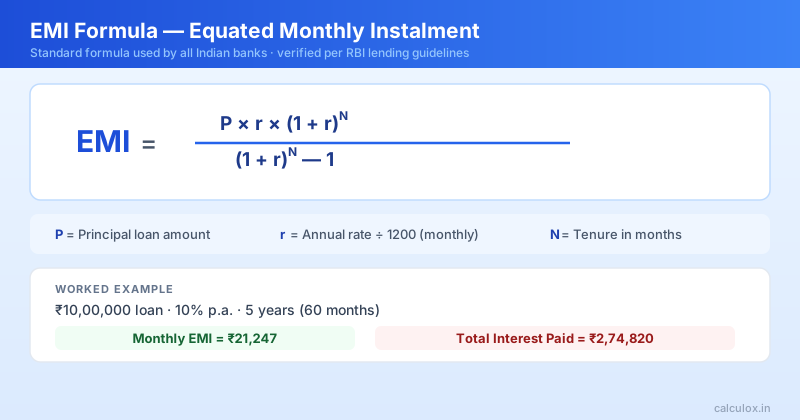
Try it yourself →
Use our free EMI Calculator for instant results
Quick Answer
EMI = P × R × (1+R)^N ÷ [(1+R)^N − 1], where P is the loan principal, R is the monthly interest rate (annual rate ÷ 1200), and N is the tenure in months. A ₹30 lakh home loan at 9% for 20 years costs ₹26,992/month. The same loan at 10% costs ₹28,950 — a ₹1,958 monthly gap that compounds to over ₹4.7 lakh in extra interest across the full tenure.
₹50L loan, 9%, 20 years
₹44,986/mo
Total interest paid: ₹57.97 lakh
₹50L loan, 10%, 20 years
₹48,251/mo
Costs ₹3,265/mo more than 9%
Safe EMI ceiling
≤ 40%
Of monthly take-home pay (RBI guideline)
Year-1 prepayment
Max impact
Each ₹1L paid early saves ~₹1.7L interest
The Challenge: Understanding Your True Loan Cost
Taking out a loan is one of the biggest financial decisions you'll make, whether for a home, car, or personal expense. Yet most borrowers don't fully understand how EMI works or what determines their monthly payment. EMI for Different Loan Types reveals the stark reality: a ₹50 lakh home loan at 9% for 20 years costs ₹44,986 EMI monthly.
That same loan at a slightly higher 10% costs ₹53,570 - adding ₹6,584 monthly or ₹1.58 crore over 20 years! Similarly, even a ₹8 lakh car loan at 10% for 5 years means paying ₹16,997 monthly, totaling ₹10.2 lakh (₹2.2 lakh in pure interest). Most borrowers focus on the interest rate percentage, not realizing that tenure (loan duration) affects the total interest even MORE than the rate. This guide cuts through the confusion and shows you exactly how EMI is calculated, why your monthly payment is what it is, and most importantly - how to reduce it.
What is EMI? The Solution
EMI (Equated Monthly Instalment) is a fixed amount paid by a borrower to a lender each month on a specified date. An EMI consists of two components: the principal amount and the interest charged on the outstanding loan. The interest component is higher in the initial months and gradually decreases as you pay down the principal.
How to Calculate EMI: Step-by-Step Formula
The standard EMI formula is: EMI = [P × R × (1+R)^N] / [(1+R)^N — 1]. Where: P = Principal loan amount, R = Monthly interest rate (Annual rate ÷ 12 ÷ 100), N = Number of monthly instalments (loan tenure in months). For example: A ₹10 lakh loan at 10% annual interest for 5 years gives: R = 10/12/100 = 0.00833, N = 60 months. EMI = [10,00,000 × 0.00833 × (1.00833)^60] / [(1.00833)^60 — 1] = ₹21,247 per month. Step-by-step calculation:
- Convert annual interest rate to monthly — divide by 12 and then by 100.
- Calculate (1 + R)^N using the monthly rate and total months.
- Multiply P × R × (1+R)^N for the numerator.
- Calculate (1+R)^N — 1 for the denominator.
- Divide numerator by denominator to get your monthly EMI.
Use Our Free EMI Calculator: The Smart Way
Instead of manual calculations, use our free EMI Calculator to instantly compute your monthly EMI, total interest payable, and view a complete amortization schedule. Simply enter your loan amount, interest rate, and tenure to get accurate results. The calculator eliminates formula confusion and lets you instantly test scenarios: What if I borrow ₹40L vs ₹50L? What if rate is 8% vs 9%? What if tenure is 20Y vs 25Y? See exact EMI + total interest for each scenario in seconds.
This decision-making power is invaluable when negotiating with banks or comparing loan offers.
Real-World EMI Examples & Scenarios
Home Loan Example: Rs 50L at 8.5% for 20 years = Rs 38,800 EMI. Total amount paid: Rs 1.04Cr (Rs 54L interest paid!). Car Loan Example: Rs 8L at 10% for 5 years = Rs 16,997 EMI.
Total paid: Rs 10.2L (Rs 2.2L interest). Personal Loan Example: Rs 5L at 15% for 3 years = Rs 16,100 EMI. Total paid: Rs 5.8L (Rs 0.8L interest).
Comparison insight: Home loan has lowest rate (8.5%) but pays MOST interest (Rs 54L) because of 20-year tenure. Personal loan has highest rate (15%) but pays LEAST interest (Rs 0.8L) because of 3-year tenure. Key learning: Total interest depends on BOTH rate and tenure, not just the rate alone.
EMI Optimization: Trade-offs & Smart Tenure Selection
Core principle: Shorter tenure = lower total interest but higher monthly EMI. Longer tenure = lower EMI but higher total interest. Example: Rs 40L home loan at 9%. Option A - 15 years: EMI Rs 47,500, total interest Rs 25L. Option B - 20 years: EMI Rs 40,000, total interest Rs 40L. Option C - 25 years: EMI Rs 34,700, total interest Rs 54L. Choosing tenure depends on priorities: Priority 1 (Save Interest): Choose 15-20 years if income is stable. Priority 2 (Lower EMI): Choose 25-30 years if cashflow is tight. Priority 3 (Balanced): Choose 20 years (sweet spot for most Indian borrowers). Critical rule: EMI should not exceed 40% of monthly take-home income. Example: Rs 1L monthly income = maximum safe EMI Rs 40,000. This income constraint often forces longer tenures than preferred. Strategy: Maximize down payment to reduce principal, which reduces EMI and total interest simultaneously. 5 Ways to Reduce Your EMI:
- Make a larger down payment to reduce the principal.
- Choose a longer loan tenure (lowers EMI but increases total interest).
- Negotiate for a lower interest rate — compare multiple lenders.
- Make part-prepayments to reduce outstanding principal.
- Opt for a loan balance transfer to a lender offering lower rates.
Advanced EMI Strategies: Prepayment & Balance Transfer
Prepayment Strategy: Paying extra principal early saves massive interest. Example: Rs 40L loan at 9% for 20 years. Standard path: Pay Rs 40K EMI × 240 months = Rs 40L interest.
Prepayment path: Pay extra Rs 1L in year 1. This reduces outstanding principal immediately, saving interest on Rs 1L for 19 years = Rs 1.7L interest saved! Timeline matters: Prepay in year 1 = 20 years of interest saved. Prepay in year 10 = 10 years of interest saved.
Prepayment timing is critical - early is exponentially better. Balance Transfer: If rates drop 0.5% after taking loan, switching banks might save Rs 2-3L in interest. Calculation: Rs 40L loan, 0.5% rate cut = Rs 20K annual savings × 20 years = Rs 4L interest saved! Costs: Processing fee (Rs 5-15K) + valuation (Rs 5-10K) + legal (Rs 10-20K) = Rs 20-45K total.
Worth it if annual savings > transfer cost. Break-even: Rs 45K cost ÷ Rs 20K annual savings = 2.25 years. If remaining tenure > 3 years, balance transfer is financially smart.
EMI Case Studies & Original Insights (Illustrative Examples)
Illustrative Example (hypothetical scenario based on typical Indian borrower profiles). CASE STUDY 1: Priya, Bangalore (Age 28, Software Engineer). Scenario: Earned Rs 75,000/month, wanted Rs 80L home.
Bank loan at 9% for 20 years = Rs 48,000 EMI (64% of income). Challenge: Unaffordable without cutting living expenses. Solution: Delayed 1.5 years, saved Rs 15L more.
Down payment increased Rs 16L → Rs 30L. Borrowed Rs 50L instead. Result: EMI dropped to Rs 32,000 (43% income, healthy).
Interest saved: Rs 15.6L over 20 years. Lesson: Down payment timing = critical. Every Rs 1L extra down payment = Rs 4K less EMI, Rs 0.8L less total interest.
Illustrative Example (hypothetical scenario based on typical Indian borrower profiles). CASE STUDY 2: Rajesh, Delhi (Age 32). Scenario: Rs 8L car loan at 10% for 5 years = Rs 16,997 EMI.
After 18 months, RBI cut rates to 8.5%. Challenge: Missed refinancing window. Solution: Used EMI calculator.
Balance transfer saved Rs 1,500/month EMI despite Rs 25K switching cost. Result: 42 months remaining × Rs 1,500 = Rs 63K savings. Net benefit = Rs 38K.
Paid off 8 months early with bonus prepayments. Lesson: Monitor rate drops quarterly. 0.5% rate cut justifies refinancing if >18 months tenure remain. Illustrative Example (hypothetical scenario based on typical Indian borrower profiles).
CASE STUDY 3: Anita & Vikram, Mumbai (Age 45). Scenario: Rs 40L loan at 9% for 20 years = Rs 40K EMI. After 8 years, inherited Rs 25L.
Challenge: Invest or prepay? Stock market attractive. Solution: Modeled prepayment impact using calculator. Prepaying Rs 25L saves Rs 25L in interest (guaranteed).
Result: Prepaid Rs 25L. Balance Rs 15L. New EMI Rs 17,500, tenure 6 years instead of 12.
Interest saved: Rs 25.2L. Lesson: Early prepayment guaranteed returns often beat uncertain market gains. Based on RBI lending guidelines and widely-accepted financial planning principles: Pro Tips: (1) Down Payment Strategy - Wait 1-2 years to increase down payment 10-15% on Rs 40L+ loans = saves Rs 15-25L interest (300-400% ROI). (2) Rate Lock Strategy - Lock fixed rates during RBI rate-cut cycles.
When 1% drops, refinancing breaks even in 2-3 years. (3) Prepayment Acceleration - Allocate annual bonuses (Rs 1-3L) to principal by year 3-5 = cuts 3-5 years off tenure, saves Rs 20-40L interest. (4) Tenure Sweet Spot - 20 years optimal for most Indians (affordable EMI + reasonable interest). 15 years if stable income, 25 years only if necessary.
Frequently Asked Questions
Does EMI change if RBI changes interest rates?▸
For floating-rate loans, yes — when RBI changes the repo rate, banks adjust MCLR/EBLR rates, which affect your EMI or loan tenure. For fixed-rate loans, the EMI remains constant.
What is the maximum EMI I should pay?▸
Financial advisors recommend keeping total EMI outgo below 40-50% of your monthly take-home salary to maintain financial health and emergency funds.
Is it better to pay a higher EMI or longer tenure?▸
A higher EMI with shorter tenure saves significantly on total interest. For a ₹30 lakh loan at 9%: 10-year tenure (EMI ₹38,016, total interest ₹15.6L) vs 20-year tenure (EMI ₹26,992, total interest ₹34.8L).
Can I change my EMI amount during the loan?▸
Yes, you can request your bank to revise your EMI through: part prepayment (reduces outstanding principal), loan restructuring request, or balance transfer to another lender.
What happens to EMI if I make a prepayment?▸
After a prepayment, banks typically offer two options: reduce your EMI amount (keeping tenure same) or reduce tenure (keeping EMI same). Reducing tenure saves more interest overall.
What is the difference between EMI and interest-only payment?▸
EMI (Equated Monthly Instalment) = Principal + Interest together (fixed amount). Interest-only payment = Pay only interest each month, principal at end (used in some commercial loans). For personal/home loans, always EMI (principal reducing). Interest-only means you build no equity for years - avoid it unless specifically needed. EMI is superior because you gradually reduce debt while interest component shrinks.
How does EMI calculation work for variable interest rate loans?▸
Variable rate loan EMI recalculates when rate changes. Example: ₹40L at 9% for 20 years = ₹40K EMI. After 5 years, RBI raises rate to 9.5%. Remaining balance ₹32L with 15 years left. New EMI = ₹32L at 9.5% for 15 years = ₹34,300 (reduced because principal paid down). If rate dropped to 8.5%, new EMI might be ₹33,000. Banks recalculate automatically or on request. Strategy: Know your rate change impact - 0.5% change = ±₹1-2K EMI adjustment depending on remaining tenure. Use calculator to model rate scenarios before accepting variable rate loan offer.
What are the advantages of using an EMI calculator?▸
Advantages: (1) Instant calculation (no manual formula work), (2) Multiple scenarios tested instantly (change rate/tenure/amount), (3) Amortization schedule (see principal vs interest month-by-month), (4) Comparison across loans (side-by-side EMI for 3 banks), (5) Prepayment impact (see interest saved if you prepay), (6) Accuracy (eliminates calculation errors), (7) Planning (budget before applying for loan), (8) Mobile-friendly (use on phone while at bank). Use our free EMI Calculator to model scenarios: What if I borrow ₹40L vs ₹50L? What if rate is 8% vs 9%? What if tenure is 20Y vs 25Y? See exact EMI + total interest for each. Decision tool: Compare 3-4 realistic scenarios, choose the one balancing EMI affordability with total interest paid. Calculator gives you negotiating power - you know exact numbers before bank meeting.
How do I ensure I get the best EMI offer from my bank?▸
Strategy: (1) Check your CIBIL score (700+ gets best rates), improve if below 650. (2) Shop rates: Compare 3-5 banks before applying (0.5% difference = major savings). (3) Use calculator to see exact impact of each rate. (4) Negotiate: Tell bank you have competing offers, ask for better rate. (5) Improve down payment: Extra 5% down = ₹2-3L principal reduction = lower EMI. (6) Opt for co-borrower: Adds income, improves approval odds. (7) Loyalty: Existing bank customers get 0.25-0.5% discount. (8) Seasonal offers: EMI rates drop during festival seasons (Nov-Dec, Mar-Apr). Real impact: 0.5% rate difference on ₹40L = ₹10,000/year savings = ₹2L over 20 years! Worth 1-2 hours of comparison shopping.
Related Articles
Try Our Free EMI Calculator
Get instant, accurate results without any registration required.
Open EMI Calculator →