RD Calculator Guide: Recurring Deposit Interest & Returns
Calculate recurring deposit interest and maturity amount. Learn how RD works, compare RD vs FD, and see your monthly returns with our free RD calculator.
Software Developer · Creator of calculox.in · Formulas verified per RBI, Finance Act 2025-26 & SEBI
Learn about my expertise →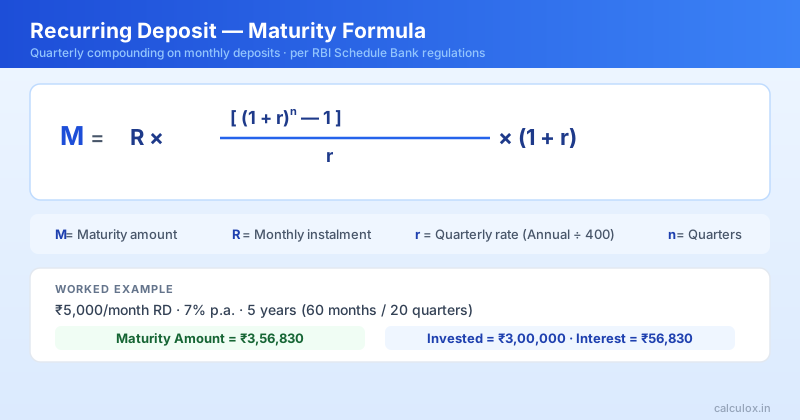
Try it yourself →
Use our free RD Calculator for instant results
What is a Recurring Deposit (RD)?
A Recurring Deposit (RD) is a savings scheme offered by banks where you commit to deposit a fixed amount every month for a predetermined period (tenure ranging from 3 months to 10 years). At the end of the tenure, you receive the total of all deposits plus compounded interest earned. RDs are specifically designed for salaried individuals and anyone with monthly income who wants to build a corpus systematically without having large lump sum upfront.
Unlike FDs requiring Rs 1-10 lakh, RDs allow small monthly investments (Rs 100-500) making them accessible to middle-income earners. RDs are significantly safer than mutual funds (no market risk) backed by DICGC insurance up to Rs 5 lakh. Monthly deposits combined with compound interest creates surprising wealth over 10-20 years, making RDs excellent for building emergency funds, buying car, children's education, or retirement corpus.
How RD Interest is Calculated
RD interest uses compound interest on monthly deposits: Maturity Value = PMT × (((1 + r)^n - 1) / r) × (1 + r), where PMT is monthly deposit, r is monthly rate (annual rate/12/100), n is total months. Worked example: Rs 5,000/month for 5 years (60 months) at 6% annual rate. Monthly rate = 6/12/100 = 0.005.
Maturity = 5,000 × (((1.005)^60 - 1) / 0.005) × 1.005 = 5,000 × 63.27 × 1.005 = Rs 3,19,335. Total invested = Rs 3,00,000. Interest earned = Rs 19,335.
Key insight: Each deposit earns interest from deposit month onwards. First deposit earns 60 months interest, second earns 59 months, etc. This staggered interest is why RDs earn more than simple interest but less than lump sum FD.
Senior citizens get 0.50%-1.0% additional (6% becomes 6.5%-7.0%). Use our RD Calculator for instant results.
RD vs FD: Detailed Comparison
Fixed Deposit (FD): Lump sum required (Rs 1-10 lakh). Higher interest rates (6.5%-7.0%). Fixed maturity amount.
Best if large savings available immediately. Example: Rs 5,00,000 invested in 5-year FD at 6.5% = Rs 6,65,000 maturity. Recurring Deposit (RD): Small monthly deposits (Rs 500-50,000/month).
Slightly lower rates (6.0%-6.5% vs FD's 6.5%-7.0%). Variable growth as deposits accumulate. Best for salaried employees.
Same Rs 5,00,000 total (Rs 5,000/month for 100 months) at 6% = Rs 5,31,500 maturity. FD earns Rs 65,000 interest vs RD Rs 31,500 interest. VERDICT: FD better if you have capital available.
RD better for salaried because: (1) Gradual investing without budget impact, (2) Forced discipline preventing spending, (3) Rupee-cost averaging, (4) Accessible (Rs 100/month vs Rs 1 lakh), (5) Achieves goals with manageable amount.
Real-World RD Examples for Indians
Example 1 - Young Professional: Amit, age 25, earns Rs 40K/month. He starts Rs 5,000/month RD at 6% for 30 years (age 55). Maturity = Rs 5,000 × (((1.005)^360 - 1) / 0.005) × 1.005 = Rs 37,40,000! Total invested = Rs 18,00,000.
Interest = Rs 19,40,000. 30 years compounding turns Rs 18L into Rs 37L! Example 2 - Mid-Career Goal: Neha, age 35, wants Rs 20L for daughter's education by age 55 (20 years). At 5% FD/RD, she needs Rs 6,400/month = Rs 15,36,000 invested growing to Rs 20,50,000. Example 3 - Retiree Income Planning: Rajesh retired with Rs 20,00,000.
He opens 8 RDs of Rs 2,50,000 each with different 1-year tenures maturing each year, creating Rs 2,50,000 annual retirement income while maintaining capital. Example 4 - Emergency Fund: Priya, age 30, wants Rs 5L emergency fund. Rs 8,000/month RD at 6% for 5 years = Rs 5,31,500.
Total invested = Rs 4,80,000. She builds emergency fund while living within budget!
RD Tenure Options & Rates
Short-term (3 months to 1 year): Simple or quarterly compound interest. Rates: 4.5%-5.5%. Short 1-3 years: Standard tenure for most RDs.
Rates: 5.5%-6.0%. Useful for building car/bike corpus. Medium-term (3-5 years): Popular tenure.
Rates: 6.0%-6.5%. Suitable for home down payment fund. Long-term (5-10 years): Highest rates (6.5%-7.0%).
Excellent for retirement or children's education. Senior citizens (60+): Get 0.50%-1.0% additional interest at every tenure. Special Escalating RD: Monthly deposit increases automatically (e.g., 10% yearly).
Rs 5,000 month 1 becomes Rs 5,500 in year 2, Rs 6,050 in year 3. Mirrors salary increases! Flexible RD: Allows varying deposits based on cash flow availability. Interest increases with tenure encouraging long-term discipline.
RD Withdrawal, Penalties & Loan Options
At Maturity: Receive full maturity amount (principal + interest) credited automatically to account. Then reopen new RD or withdraw. Premature Closure: Allowed after 3 months at most banks.
Incurs 1.0%-1.5% interest penalty below contracted rate. Example: 6% RD broken after 2 years gets only 5.0%-5.5% interest. Loss around Rs 6,700 on Rs 10,000/month for 24 months.
Partial Withdrawal: Some banks allow withdrawing accrued interest while keeping RD active - you continue earning. Loan Against RD: Instead of breaking, take loan at 1-2% above RD rate (much cheaper than personal loan at 12-18%). You continue earning RD interest and pay minimal net cost! This is smartest option for emergency funds.
RD Wealth Building & Goal Planning
The true power of RDs lies in long-term wealth creation. Start Rs 5,000/month RD at age 25: After 30 years (age 55) at 6% = Rs 37,40,000 retirement corpus. Start Rs 10,000/month RD at age 28 for kid's higher education: After 15 years = Rs 23,60,000 for college fees + housing.
These are life-changing numbers! Key advantages: (1) Small monthly commitment (Rs 5K-10K), (2) Forced savings discipline, (3) Guaranteed returns (6%-7%), (4) Inflation protection, (5) Tax-saving RD (5-year lock-in). Strategy: Open multiple RDs for different goals (Education RD, Home RD, Retirement RD). Each matures when needed.
This goal-based approach provides psychological motivation and prevents fund mixing.
Calculate Your RD Maturity
Use our free RD Calculator to project maturity amount and plan goals. Enter: Monthly deposit amount (Rs 500 to Rs 5,00,000+), Tenure in months (3 to 120+), Annual interest rate (check bank rates). Instantly see: Exact maturity amount, Total interest earned, Year-by-year growth, Impact of increasing deposits, Comparison across rates.
Try scenarios: Rs 3K vs Rs 5K/month? 5-year vs 10-year? 5% vs 6.5% rates? Our calculator helps you choose optimal RD strategy for retirement, education, or any financial goal!
Frequently Asked Questions
What is the minimum monthly deposit for RD?▸
Most banks allow RD starting from Rs 100-500/month minimum. Some banks offer RD in multiples of Rs 100 or Rs 500, while others accept any amount. Maximum typically goes up to Rs 5-10 lakh/month for regular customers with no upper limit technically. The beauty of RDs is accessibility - even a Rs 500/month RD for 20 years builds significant corpus of Rs 2-3 lakhs. Some Super RDs allow variable deposits where minimum is Rs 500 in month 1, then you can increase as income grows. Check with your specific bank for their minimum deposit rules and any special offers.
Can I skip RD payments or change amount mid-way?▸
Different banks have different policies on skipping payments. Most banks do NOT allow skipping - skipping 2-3 consecutive deposits typically closes your RD account. Some progressive banks allow 1-2 skips per year with penalty interest. For changing amount: Most banks require opening a NEW RD for increases or decreases. If your Rs 5,000 RD is running and you want Rs 6,000/month, open separate Rs 1,000/month RD for the remainder. Some new Flexible RD schemes allow changes without opening new deposits. Best approach: Choose conservative amount you can afford, then open SECOND RD when income increases. Instead of skipping, take Loan Against RD if you need funds urgently - much cheaper than personal loan!
Is RD interest taxable and can I avoid TDS?▸
Yes, RD interest is fully taxable as income for that financial year at your applicable slab rate (10%, 20%, 30%). If total interest exceeds Rs 40,000 (Rs 50,000 for seniors) in a FY, banks automatically deduct 20% TDS. Example: Rs 25,000 interest = no TDS. Rs 60,000 interest = Rs 12,000 TDS deducted. Avoiding TDS: Submit Form 15G (if total income is below tax slab) or Form 15H (for seniors below poverty line) to your bank. This prevents automatic TDS deduction. Tax-Saving RD: Special 5-year RD scheme where principal qualifies for Rs 1.5L Section 80C deduction, saving Rs 45,000+ in taxes (30% bracket). Interest earned is fully taxable but principal deduction makes it tax-efficient.
Can I increase my RD monthly contribution and which banks offer best rates?▸
Increasing RD: Most traditional banks do NOT allow increasing same RD - you must open SEPARATE RD for additional amount. Example: Started Rs 5,000/month, want Rs 7,000? Open new Rs 2,000/month RD with same tenure. Some progressive banks offer Escalating RD schemes where monthly deposit increases automatically (e.g., 10% per year, Rs 5,000 becomes Rs 5,500 in year 2). Current rates (June 2026): SBI 4.5%-6.0%, ICICI 5.5%-6.5%, HDFC 5.0%-6.0%, Axis 5.75%-6.5%, Kotak 6.0%-6.75%, IndusInd 6.0%-6.8%, Small Finance Banks 6.5%-7.5%. Always prioritize safety (DICGC coverage Rs 5L) and service quality over chasing highest rates - a 0.5% difference is only Rs 25-30 extra per month on Rs 5,000 deposit.
What happens if I break my RD before maturity and can I open multiple RDs?▸
Premature closure penalty: Breaking RD before tenure (allowed after 3 months at most banks) incurs 1.0%-1.5% interest penalty below contracted rate. Example: Your 6% RD broken after 2 years gets only 5.0%-5.5% interest. Loss around Rs 6,700 on Rs 10,000/month for 24 months. Partial withdrawal: Some banks allow withdrawing accrued interest without closing RD - you continue earning. Loan against RD: Instead of breaking, take loan at 1-2% above RD rate (much cheaper than personal loan at 12-18%). You continue earning RD interest and pay minimal net cost. Opening multiple RDs: Absolutely! This is excellent strategy - Education RD (Rs 8,000/month for 12 years), Marriage RD (Rs 10,000/month for 5 years), Retirement RD (Rs 15,000/month for 20 years). Each RD matures when you need the funds. You can open 5-10 RDs simultaneously in same bank or spread across banks leveraging Rs 5L DICGC insurance per bank.
Is RD good for retirement planning and how to use the RD Calculator?▸
RD is excellent for retirement planning when combined with other instruments. 40-year-old investing Rs 10,000/month RD for 20 years (age 60) at 6% builds Rs 38,70,000 retirement corpus. BUT do not rely solely on RD - do NOT put all retirement money in RD alone (6% growth insufficient). Better strategy: 40% RD (safe), 40% equity mutual funds (growth), 20% debt funds (stability). RD Ladder: Multiple Rs 2-3L RDs with consecutive 1-year tenures maturing each year = Rs 2-3L annual retirement income. Using our RD Calculator: Enter monthly deposit (Rs 5,000), tenure in months (120 for 10 years), annual rate (6%), instantly see: exact maturity amount, total interest, year-by-year growth, impact of increasing deposit, comparison across rates. Try scenarios: Rs 3K vs Rs 5K/month? 5-year vs 10-year? 5% vs 6.5% rates? Calculator answers instantly, helping you choose optimal RD strategy for your retirement and financial goals.
Related Articles
Try Our Free RD Calculator
Get instant, accurate results without any registration required.
Open RD Calculator →