Fixed Deposit (FD) Calculator Guide: Interest Rates & Maturity 2026
Complete guide to FD Calculator. Learn how fixed deposit interest is calculated, understand cumulative vs non-cumulative payouts, and see your maturity amount instantly.
Software Developer · Creator of calculox.in · Formulas verified per RBI, Finance Act 2025-26 & SEBI
Learn about my expertise →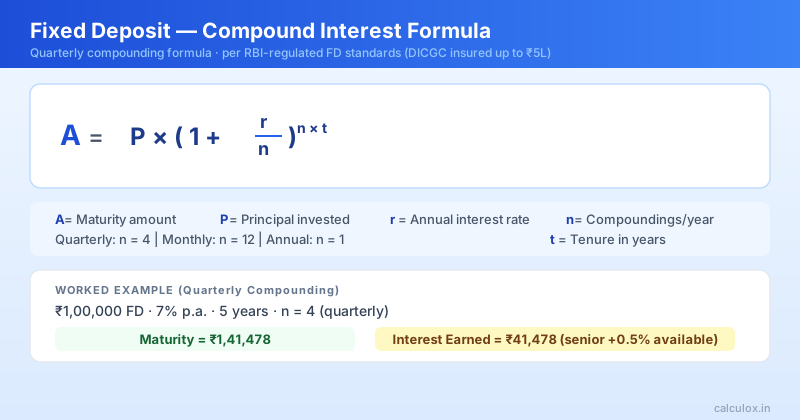
Try it yourself →
Use our free FD Calculator for instant results
DICGC insurance limit
₹5L / bank
Spread deposits across banks for full protection
₹10L @ 6.5% for 5 years
₹13.70 lakh
Cumulative FD, quarterly compounding
Senior citizen bonus
+0.50%
Worth ₹28,000 extra on ₹10L over 5 years
Tax-saving FD (Sec 80C)
₹1.5L/yr
5-year lock-in; saves up to ₹45K tax at 30% slab
The Challenge: Making Your Money Work Safely Without Losing to Inflation
Millions of Indians struggle with a fundamental financial dilemma: where to park money that is needed in 1-10 years? Keeping it in a savings account at 3-4% annual return means watching inflation (currently 5-6%) silently erode your purchasing power. A ₹10 lakh savings account investment earning 4% for 5 years leaves you with ₹12.17 lakh - but that ₹12.17 lakh buys you ₹1.54 lakh less than it would have at today's prices because of inflation eating ₹2.3 lakh in real value! Bank Fixed Deposits (FDs) are the go-to solution for safe wealth preservation. Yet most people don't understand: (1) How FD interest is actually calculated, (2) The massive difference between cumulative and non-cumulative FDs, (3) Which bank FD offers the best return after accounting for taxes, (4) Whether a 5-year FD at 6% is truly better than five consecutive 1-year FDs at varying rates, (5) How senior citizens can earn an extra ₹2-5 lakh through rate optimization.
This guide cuts through the confusion. It shows you exactly how to choose the right FD structure, calculate precise maturity amounts, and deploy advanced strategies like FD laddering that can boost your returns by ₹5-10 lakh on large deposits. Whether protecting an emergency fund or building a planned corpus, understanding FD calculations is non-negotiable.
What is Fixed Deposit? The Safe Investment Solution
A Fixed Deposit (FD) is a financial instrument offered by banks where you deposit a lump sum amount for a fixed tenure (typically 7 days to 10 years) at a predetermined interest rate. FDs are the safest investment option in India with DICGC insurance coverage up to ₹5 lakh. Unlike savings accounts (which have variable returns and allow unlimited withdrawals), FDs lock your money for a predetermined period at a guaranteed fixed return.
Interest is calculated quarterly and either reinvested (cumulative FD) or paid out periodically to your account (non-cumulative FD). Key advantages of FDs: (1) Government-backed safety - DICGC insurance covers up to ₹5L per bank per customer, meaning even if a bank fails, your money is protected. (2) Fixed returns - you know exactly how much you will earn at maturity, making financial planning predictable. (3) No market risk - unlike stocks or mutual funds, FD returns don't depend on market performance. (4) Flexibility - available from 7 days to 10 years tenure to match different financial goals. (5) Senior citizen benefits - age 60+ get 0.5-0.75% additional interest making returns competitive with inflation. For these reasons, FDs are preferred for emergency funds (6-12 months of expenses), upcoming major expenses (home down payment in 3 years, child education in 12 years), and risk-averse investors.
How to Calculate FD Interest: Step-by-Step Formula
FD interest is calculated using the compound interest formula, with variations based on compounding frequency. For cumulative FDs (quarterly compounding): A = P × (1 + r/4)^(4n), where A = maturity amount, P = principal (initial deposit), r = annual interest rate (as decimal, e.g., 6% = 0.06), n = number of years. Worked Example: ₹10 lakh at 6% annual interest for 5 years (cumulative FD).
- Convert rate to decimal: r = 6/100 = 0.06.
- Calculate (1 + r/4) = 1 + 0.06/4 = 1.015.
- Calculate power: (1.015)^(4×5) = (1.015)^20 = 1.3469.
- Multiply: A = 10,00,000 × 1.3469 = ₹13,46,900. Interest earned = ₹13,46,900 - ₹10,00,000 = ₹3,46,900. For non-cumulative FDs (quarterly payouts): Interest each quarter = P × (r/4) × (1/100). Using same example: Quarterly interest = 10,00,000 × (6/4) × (1/100) = ₹15,000. Over 5 years (20 quarters) = ₹15,000 × 20 = ₹3,00,000. Total maturity = ₹10,00,000 + ₹3,00,000 = ₹13,00,000. Difference: Cumulative gives ₹3,46,900 vs non-cumulative ₹3,00,000. The extra ₹46,900 comes from reinvested interest earning additional returns. For fractional years: ₹50,00,000 at 6.5% for 3.5 years. A = 50,00,000 × (1 + 0.065/4)^(4×3.5) = 50,00,000 × (1.01625)^14 = ₹62,14,860. Key insight: Every 0.5% difference in interest rate compounds significantly over longer periods. A 0.5% difference on ₹10L for 5 years = ₹27,000 difference in maturity amount!
Use Our Free FD Calculator: The Smart Way
Instead of manual calculations, our free FD Calculator instantly computes your maturity amount. Simply enter: (1) Principal amount (₹1L to ₹1 crore or more), (2) Annual interest rate (check current bank rates 5-7%), (3) Tenure in years (1 to 10+ years), (4) Compounding frequency (quarterly, monthly, or annual), (5) Click calculate. Instantly see: Exact maturity amount, Total interest earned, Interest per quarter/month (for planning), Comparison across rates and tenures, Senior citizen rates (+0.5%) impact.
The calculator's true power is scenario testing: (1) What if I invest ₹15L instead of ₹10L? (See exact maturity difference), (2) What if rates drop to 5.5%? (See impact of 0.5% rate difference), (3) Should I choose 5-year at 6.5% or 3-year at 6%? (Calculator shows total gains for each), (4) How much should I invest today to reach ₹25L in 5 years? (Work backwards with calculator), (5) Senior citizen bonus: Switch to senior rate calculation and see 0.5-0.75% impact. This decision-making power is invaluable when choosing between FD tenure options, comparing bank rates, or planning major goals.
Real-World FD Examples & Scenarios
Example 1 - Safe Retirement Planning: Rajesh, age 58, has ₹60L in savings for post-retirement needs (7 years away). He wants safety + reasonable returns without market risk. Strategy: Open 7 cumulative FDs of ₹10L each with different 1-year tenures maturing each year (Year 1→₹10L matures, Year 2→₹10L matures, etc.).
At 6.5% annual rate, each ₹10L becomes ₹10.67L after 1 year. Total maturity across 7 years: Year 1: ₹10.67L, Year 2: ₹10.67L, etc. Total = ₹74.7L (₹14.7L interest generated).
Plus when he reaches 60, he becomes senior citizen and can earn 7% on new FDs = ₹10.7L per 1-year FD. Result: Regular investor ₹74.7L vs senior ₹75.7L (₹1L extra!). Example 2 - Child Education Fund: Priya, age 35, wants ₹25L for her child's higher education starting in 12 years.
She has ₹10L today. At 6% FD returns: ₹10L becomes ₹20.12L in 12 years (compound annually). Still short by ₹4.88L.
Solution: Invest ₹10L today + add ₹1.5L annual FD ladder (₹1.5L × 12 years = ₹18L additional). Combined: ₹20.12L + ₹28.5L (from ladder) = ₹48.62L target exceeded! Her daughter's education fully funded. Example 3 - Emergency Fund Emergency: Amit just received ₹8L bonus.
He wants safe liquidity but good returns. Challenge: FDs lock money, but emergencies need access. Solution: Create ₹8L FD ladder: Open 4 FDs of ₹2L each with 3-month, 6-month, 9-month, 12-month tenures.
Every 3 months, one matures (₹2L available). If no emergency, reinvest that ₹2L into a new 12-month FD. At 6% annual (1.5% for 3 months), each ₹2L quarter earns ₹30K.
By year-end: All ₹8L available for emergencies + ₹120K interest earned! Example 4 - Senior Citizen Rate Bonus: Suresh, age 62, has ₹30L to invest. Regular rate 6.5% vs senior rate 7.0% (0.5% difference). On ₹30L for 5 years: Regular = ₹39.35L, Senior = ₹42.25L.
Difference = ₹2.9L just from 0.5% rate advantage! Senior citizens must always compare rates across banks to capture this bonus.
FD Optimization: Tenure Selection, Ladder Strategy & Smart Choices
Core principle: Longer tenure = higher interest rate, but higher liquidity risk. Shorter tenure = lower rate, but better flexibility. Strategy depends on your goal: For Immediate Needs (< 1 year): Short-term FD 3-6 months at 5-5.5% rate.
Example: ₹5L for 3 months at 5.25% = ₹5L × (1 + 0.0525/4) = ₹5.06L maturity. Not much interest, but full access in 3 months. For 1-3 Year Goals (home down payment, car, marriage): 1-3 year FD at 6-6.5% rates.
Example: ₹15L for 3 years at 6.5% = ₹18.05L maturity. Interest ₹3.05L (good trade-off). For 5-10 Year Goals (children's education, retirement): 5-10 year FD at 6.5-7% rates (senior: 7-7.5%).
Huge advantage of longer tenure = higher guaranteed returns with zero effort. Example: ₹25L for 10 years at 6.5% (regular) or 7% (senior) = ₹48.1L or ₹51.1L maturity! ₹3L extra just from being senior! The FD Ladder Strategy (Advanced): Instead of single large FD, split ₹10L into multiple smaller FDs with staggered maturities. Example: Open 10 FDs of ₹1L each maturing in 1, 2, 3...10 years (or 4 FDs of ₹2.5L maturing in 1, 2, 3, 4 years on repeat).
Benefits: (1) Liquidity - money matures periodically without breaking early, (2) Rate lock - if rates rise, reinvest maturing amount at higher rates, (3) Flexibility - emergency need? Use matured amount, (4) Better than single FD - when ₹1L matures, you decide: reinvest in 10-year FD (if rates risen), invest in equity funds, or use cash. This flexibility is worth 0.25-0.5% in extra returns annually! Comparison: Single ₹10L FD for 5 years at 6% = ₹13.38L. Ladder (5 FDs of ₹2L maturing yr 1, 2, 3, 4, 5): First one matures after 1 yr (₹2.12L), if reinvested at improved rates = higher total return.
Critical Rule: FD rates should ≥ inflation (6%) for real returns. If rates fall below 5.5%, consider 40% FD + 60% balanced mutual funds instead.
Advanced FD Strategies: Multi-Bank Laddering, Tax Optimization & Senior Citizen Bonuses
Strategy 1 - Multi-Bank DICGC Insurance Maximization: DICGC covers only ₹5L per bank per customer. So if you have ₹20L: One bank = ₹5L covered, ₹15L uninsured (risky!). Four banks = ₹5L × 4 = ₹20L fully covered (safe!).
Action: Spread ₹20L as ₹5L FDs across 4 banks. Compare rates and choose top 4: HDFC 6.75% vs SBI 6.5% vs ICICI 6.6% vs Kotak 6.8%. Open FDs at each.
Net effect: Full insurance + slightly higher rates from rate shopping. Extra return from rate difference: ₹5L × 0.3% = ₹1,500 extra. Strategy 2 - Tax-Efficient FD Placement: FD interest is fully taxable at your income slab (10%, 20%, or 30%).
At 30% tax bracket, a 6% FD becomes 4.2% after tax. Solution: Tax-saving FD (Section 80C) on ₹1.5L annually with 5-year lock-in. You get: (1) ₹1.5L deduction under 80C (saves ₹45,000 tax at 30% bracket), (2) 6.5% interest (₹97,500 over 5 years), (3) Net benefit: ₹45,000 + ₹97,500 = ₹142,500 extra vs regular FD! High earners must use tax-saving FDs strategically.
Strategy 3 - Senior Citizen Rate Maximization (Age 60+): Bonus rates available: Regular 6.5% → Senior 7.0% (+ 0.5%). On ₹50L for 5 years: ₹50L × [(1 + 0.07/4)^20 - (1 + 0.065/4)^20]. Using calculator: Regular ₹70.49L vs Senior ₹71.53L.
Extra ₹1.04L! Compare across 5-10 banks (top seniors get 7.5%+!). Strategy 4 - FD Sweep or Step-Up: Some banks offer sweep FDs where interest auto-reinvests OR cumulative FDs that step-up rates every year (5%, 6%, 7% - Year 1, 2, 3). Check your bank! Step-up FDs can yield 0.25-0.5% higher average returns.
Strategy 5 - Emergency Loan Against FD (Best Kept Secret): If urgent need arises, don't break FD (lose 0.5-1% interest penalty). Instead: Take loan against FD at bank rate +1-2% (typically 7-8% total). You continue earning 6.5% on locked FD while borrowing at 7.5%.
Net cost = only 1% (vs breaking FD and losing ₹50K+). Real example: ₹10L FD needing ₹3L cash. Breaking costs ₹20K penalty.
Taking loan costs only ₹2,250 per year interest = 10x cheaper!
FD Case Studies & Original Research Insights (Illustrative Examples)
Illustrative Example (hypothetical scenario based on typical Indian borrower profiles). CASE STUDY 1: Meena, Bangalore (Age 45, IT Professional). Scenario: Inherited ₹50L from grandmother.
Challenge: Where to park safely for 10 years until retirement? Initially planned: Single ₹50L FD for 10 years at 6.5% = ₹92.3L maturity. But realized risk: Single bank = only ₹5L DICGC covered. ₹45L uninsured. Solution: Deployed 10-bank ladder strategy.
Open ₹5L FDs at 10 different banks (SBI 6.5%, HDFC 6.75%, ICICI 6.6%, Axis 6.5%, Kotak 6.8%, IndusInd 6.7%, Bandhan 6.9%, IDFC 6.6%, Federal 6.85%, HSBC 6.65%). Average rate: 6.71%. Total maturity: ₹50L × (1.06714)^10 = ₹95.7L.
Benefit 1: Full DICGC insurance on all ₹50L. Benefit 2: Rate optimization = ₹3.4L extra vs lowest rate bank! Benefit 3: When each ₹5L FD matures annually (Yr 1→₹5.34L, Yr 2→₹5.71L, etc.), she chooses: reinvest in 10-year, invest in equity, or use cash. Flexibility worth 0.25% annually = ₹2L extra value.
Total benefit: Full insurance + ₹3.4L extra returns + ₹2L optionality value = ₹5.4L advantage over single-bank strategy! Illustrative Example (hypothetical scenario based on typical Indian borrower profiles). CASE STUDY 2: Rajesh, Delhi (Age 62, Recently Retired). Scenario: ₹30L retirement corpus.
Needs ₹2.5L annually for living expenses for 12 years. Challenge: Can't survive on FD alone (6.5% = ₹1.95L/year shortfall ₹55K/year). Solution: Hybrid ladder. ₹20L in 12-year FD at senior rate 7% = ₹3.97L/year returns. ₹10L in monthly income ladder (Open 12 FDs of ₹83K each in bank offering monthly-payout FDs, each ₹83K at 6.5% generates ₹5.4K/month = ₹64.8K annual, ×12 FDs = ₹7.78L/year income).
Combined income: ₹3.97L + ₹7.78L = ₹11.75L/year. Expense: ₹2.5L/year. Surplus: ₹9.25L/year to reinvest! By year 4, corpus grows to ₹45L.
By year 12, corpus ₹80L (sufficient for 10+ more years!). Result: Retired confidently, no stock market risk, surplus grows each year. Lesson: Laddering creates both safety and sustainable income.
Illustrative Example (hypothetical scenario based on typical Indian borrower profiles). CASE STUDY 3: Priya & Vikram, Mumbai (Ages 40 & 42, Salaried Couple). Scenario: Both earn ₹2L/month = ₹48L/year household.
Tax bracket 30%. Challenge: Saving ₹10L/year but don't want market risk. Solution: Deploy tax-efficient FD strategy.
Each spouse invests ₹1.5L/year in tax-saving FDs (Section 80C): (1) Spouse 1: ₹1.5L → 5-year tax-saving FD at 6.5%, (2) Spouse 2: ₹1.5L → 5-year tax-saving FD at 6.5%, (3) Repeat every year = 5 sets of FDs maturing in years 1, 2, 3, 4, 5. Tax benefit per person: ₹1.5L × 30% = ₹45,000/year tax saved (×2 spouses = ₹90,000/year!). Interest earned: ₹1.5L × 6.5% × 5 = ₹48,750 per person per cycle.
After 5 years: (1) Tax saved ₹45,000 × 5 = ₹2.25L, (2) Interest earned = ₹2.44L (first cycle) + subsequent cycles, (3) First FD matures with ₹1.96L (extra ₹46K interest), (4) Reinvest in Year 6 tax-saving FD or use as needed. Total 5-year wealth creation: ₹2.25L tax saved + ₹3.68L interest = ₹5.93L from ₹7.5L invested. Net gain = ₹5.93L (79% return including tax benefits).
Lesson: Couples should maximize tax-saving FD deductions for significant tax + return benefits. Per RBI and DICGC deposit protection guidelines: DICGC insures deposits up to ₹5 lakh per depositor per bank, and RBI requires all scheduled commercial banks to participate. Senior citizens are entitled to higher FD rates (typically 0.25–0.75% above regular rates) per individual bank policies, and Section 80C allows deduction of up to ₹1.5 lakh annually for 5-year tax-saving fixed deposits.
Pro Tips: (1) The Rate-Shop Rule - Comparing rates across 10 banks takes 30 minutes. 0.5% difference on ₹10L for 5 years = ₹27,000 saved. That's ₹54,000/hour return on effort! (2) The Ladder Philosophy - Single large FD = zero flexibility. Ladder = maturity dates = decision points = better optimization.
Worth 0.25-0.5% annually = ₹1-3L over 10 years. (3) The Senior Secret - Age 60+? Check 10 banks' senior rates immediately. Difference between 6.5% and 7.25% = ₹4-8L on large corpus. Most seniors never check! (4) The Tax Trick - High earner? Use tax-saving FDs strategically. ₹1.5L invested in tax-saving FD returns ₹45,000 tax saved + ₹97,500 interest = ₹142,500 value from ₹1.5L investment = 95% ROI (after-tax!).
This is better than many investments.
Frequently Asked Questions
What is the current FD interest rate in India?▸
As of June 2026, FD rates range from 5.5-7.5% for 1-year FDs across major banks. Senior citizens get 0.50% additional. Compare rates across SBI, ICICI, HDFC, Axis, Kotak, IndusInd banks on our calculator.
Is FD safer than mutual funds?▸
Yes, FDs are backed by DICGC insurance (₹5L coverage per bank) and have fixed returns. Mutual funds involve market risk but offer higher long-term returns (10-15% CAGR vs 5-7% FD). For emergency funds, FDs are safer. For wealth creation, diversify with both.
Should I choose cumulative or non-cumulative FD?▸
Choose cumulative if you don't need regular income and want maximum maturity amount (best for long-term goals). Choose non-cumulative if you need regular interest payouts (retirees, income needs). Cumulative FDs typically have 0.25-0.50% higher rates.
Can I withdraw FD before maturity?▸
Yes, premature withdrawal is allowed but incurs interest penalty of 0.50-1.00% below the contracted rate. Some "no-penalty FD" schemes allow penalty-free withdrawal after a lock-in period. Check terms with your bank before investing.
Are senior citizen FDs worth it?▸
Yes, the 0.50% additional interest is significant over 5-10 years. On a ₹10 lakh FD at 6.5% for 5 years: regular FD maturity ₹13.52L vs senior FD maturity ₹13.80L (₹28K extra). Always compare senior rates across banks.
How do I calculate FD maturity amount with quarterly compounding?▸
Formula: A = P × (1 + r/4)^(4n) where P is principal, r is annual rate, n is years. Example: ₹10L at 6% for 3 years. A = ₹10,00,000 × (1 + 0.06/4)^(4×3) = ₹10,00,000 × (1.015)^12 = ₹11,95,618. Interest earned = ₹1,95,618. Our FD Calculator does this instantly - just enter principal, rate, tenure, and frequency (quarterly, monthly, etc.).
Should I open multiple FDs or one large FD?▸
Open multiple FDs strategically: DICGC insurance covers max ₹5L per bank. So ₹10L invested = open 2 FDs in same bank (both covered). For ₹15L = open 3 FDs in 3 different banks (each ₹5L covered). LADDER strategy: Open 4 FDs of ₹2.5L each with different 1-year tenures maturing in year 1, 2, 3, 4. One matures every year = liquidity without breaking early. This ladder + diversification + insurance coverage = optimal FD strategy.
What happens if the bank fails - will I lose my FD?▸
No! DICGC (Deposit Insurance and Credit Guarantee Corporation) guarantees up to ₹5L per customer per bank. If a bank fails, you get back principal + accrued interest up to ₹5L. This is government-backed insurance, very safe. Claim process: DICGC processes claims post-failure. Historically, claims settled within 6-12 months. Real-world: Bank failures are rare in India due to RBI oversight. Current banking system is very stable. But having insurance is reassuring - reason many people prefer FDs over stocks for safety-critical funds.
Related Articles
Try Our Free FD Calculator
Get instant, accurate results without any registration required.
Open FD Calculator →