Retirement Planning: How to Calculate Your Retirement Corpus - NISM Approach
Complete retirement planning guide using NISM framework. Calculate exact corpus needed, plan inflation-adjusted income, and secure your retirement.
Software Developer · Creator of calculox.in · Formulas verified per RBI, Finance Act 2025-26 & SEBI
Learn about my expertise →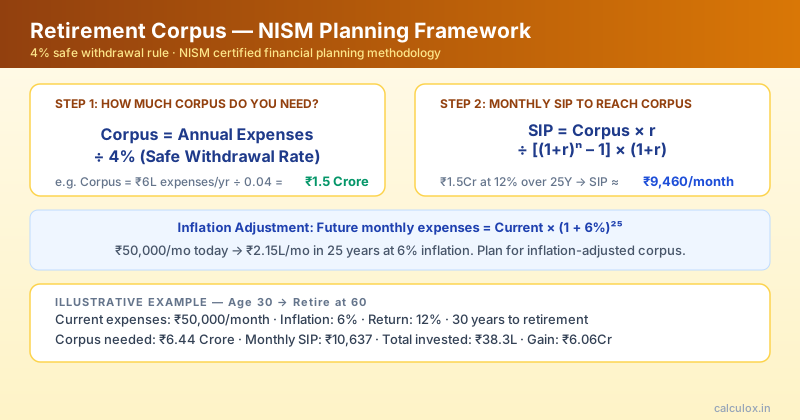
Try it yourself →
Use our free Retirement Calculator for instant results
Monthly SIP needed to build ₹1.5 crore corpus by age 60 — at 12% annual return
| Current Age | Years to Retire | Monthly SIP Needed | Total Invested | Cost of Waiting |
|---|---|---|---|---|
| 25 | 35 years | ₹1,400/mo | ₹5.88 lakh | — |
| 30 | 30 years | ₹2,510/mo | ₹9.04 lakh | +₹3.2 lakh vs age 25 |
| 35 | 25 years | ₹4,600/mo | ₹13.8 lakh | +₹7.9 lakh vs age 25 |
| 40 | 20 years | ₹8,700/mo | ₹20.9 lakh | +₹15 lakh vs age 25 |
| 45 | 15 years | ₹17,500/mo | ₹31.5 lakh | +₹25.6 lakh vs age 25 |
Why Retirement Planning is Critical
Retirement can last 25-35 years (age 60-95). Average Indian spends ₹2-3 lakh annually post-retirement. Without planning, most retirees face financial stress by age 70-75. With proper planning, you earn passive income that exceeds spending needs (goal: 80% of pre-retirement income post-retirement). Retirement corpus needed: ₹2-5 crore for middle-class Indians, ₹5-20 crore for affluent.
Step 1: Calculate Current Monthly Expenses
Track actual spending for 3-6 months (use calculator apps). Average monthly expense = baseline. Example: Average ₹75,000/month (housing, food, transport, healthcare, entertainment). This is critical input for retirement planning. Note: Post-retirement expenses typically 80% of working life (no office transport, less entertainment), but healthcare increases by 20-30%.
Step 2: Project Post-Retirement Monthly Expenses
Inflation-adjusted expenses at retirement: Future spending = Current spending × (1 + inflation rate)^years to retirement. Assume 6% inflation. Example: ₹75,000/month today, retire at 60 (25 years away) = ₹75,000 × (1.06)^25 = ₹3.22 lakh/month. Plan for 30 years post-retirement = ₹3.22L × 360 months = ₹1.16 crore, PLUS healthcare 20% = ₹1.4 crore minimum corpus.
Step 3: Estimate Investment Returns
Conservative estimate: 7-8% annual return post-retirement (less risk, more debt, FD-heavy). This income offsets 40-50% of spending. Example: ₹1.4Cr corpus at 7.5% = ₹10.5 lakh annual income = ₹87.5K/month. Required spending ₹3.22L/month, so corpus covers 27% of retirement. Add government pension (if any), family income, insurance proceeds.
Step 4: Apply the NISM 4-Step Retirement Framework
Phase 1 (60-65): High activity, spend 100% of planned amount, withdrawal = 25% corpus. Phase 2 (65-75): Moderate activity, spend 90% of planned, withdrawal = 20% corpus. Phase 3 (75-85): Lower activity, spend 70%, withdrawal = 15% corpus. Phase 4 (85+): Minimal activity, annuity covers 100%, withdrawal = passive income. This spreads risk across multiple phases and reduces early corpus drain.
Step 5: Plan Multiple Income Streams
Reduce single-corpus reliance: Government pension (if applicable) - ₹20-30K/month. Home rental income (if applicable) - ₹50-100K/month. Fixed deposit interest - ₹50K/month (from ₹1Cr at 6%). Part-time work/consulting - ₹30-50K/month (age 60-70). Insurance annuity - ₹20-40K/month. Family support (if any). Diversified income reduces corpus pressure by 30-40%.
Real Retirement Planning Example
Person: 35 years old, ₹12L annual salary, ₹75K/month spending. Goal: Retire at 60 (25 years).
- Post-retirement spending at 60 = ₹75K × (1.06)^25 = ₹3.2L/month.
- 30-year retirement cost = ₹3.2L × 360 = ₹1.15Cr.
- Investment returns cover 40% = ₹0.46Cr.
- Required corpus = ₹1.15Cr (target ₹1.2Cr minimum).
- SIP to build ₹1.2Cr in 25 years at 12% return = ₹2.2K/month. Total savings = ₹66L invested → ₹1.2Cr built!
Frequently Asked Questions
How much retirement corpus do I need?▸
Rule of thumb: 25× your annual retirement spending. Example: Spending ₹3.2L/month × 12 = ₹38.4L/year × 25 = ₹96 lakh minimum (₹1Cr target). More accurate: Use NISM framework to calculate phase-wise withdrawals and income sources.
Is ₹1 crore enough for retirement?▸
Depends on lifestyle. Conservative: ₹1Cr supports ₹60-80K/month spending (25 years at 7% returns). Upper-middle: Need ₹2-3Cr for ₹2L/month lifestyle. Our calculator helps you model your specific situation.
What if I retire before 60 (FIRE movement)?▸
Early retirement needs much larger corpus (35-40× annual spending instead of 25×). Example: Retire at 45, corpus needed = ₹38.4L × 40 = ₹1.5Cr. Requires aggressive saving (30-50% income) in 20 years. Use SIP calculator for modeling.
Should I take pension or lump sum at retirement?▸
Pension: Safe, guaranteed income but low returns (3-4%). Lump sum: Need discipline to invest wisely (7-8% returns) but better if healthy family history (live 30+ years). Most prefer hybrid: Take partial lump sum + pension.
How does inflation affect retirement?▸
Inflation is retirement's biggest enemy. At 6% inflation, money loses value 50% in 12 years. ₹1L today = ₹30K buying power in 20 years. Retirement corpus must account for inflation throughout 30+ year period. Always invest in inflation-hedging assets (stocks 20-30%, real estate, gold 10%). Our calculator uses 6% inflation assumption - adjust if expecting different.
Can I retire with less than ₹1 crore?▸
Yes if spending is low. Frugal lifestyle ₹30-40K/month = ₹3.6-4.8L annually = ₹90-120L corpus needed (25× rule). ₹50L corpus at 7% returns = ₹3.5L annual income = ₹29K monthly. Possible scenarios: Retire in low-cost city (Bhopal, Indore vs Delhi). Move to home country after overseas career. Combine pension + corpus (government pension ₹20K + ₹30K corpus = ₹50K/month). Disadvantage: Zero margin for medical, lifestyle inflation, family help. Conservative approach: Target ₹1Cr minimum for middle-class lifestyle.
Is the NISM 4-step framework rigid or flexible?▸
Flexible! NISM provides structure, not laws. Adapt to your situation: If healthy genes, spend conservatively ages 60-70, aggressively later. If dependent children, adjust withdrawals. If pension income stops at 70, increase corpus drawdown. If real estate income starts at 65, reduce withdrawal needs. Framework guides thinking, not rigid application. Our calculator lets you customize all phases and spending patterns for YOUR retirement, not generic template.
What role does Social Security/government pension play in retirement corpus calculation?▸
Government pension (if eligible) = major corpus reduction. Example: Eligible for ₹20K/month pension = ₹2.4L annually. Over 25-year retirement = ₹60L of spending covered by pension (reducing corpus needs by ₹60L!). Strategy: (1) Calculate pension entitlement (use CRA - Calculation of Retirement Allowance formula for govt employees), (2) Assume conservative 3% annual increase (inflation), (3) Subtract from corpus needs. Corporate employees: No govt pension, so higher corpus needed (₹1.5Cr vs ₹1Cr for govt employees). Important: Don't over-rely on pension - corpus should cover 70% of retirement spending, pension = bonus safety net.
Should I take lump sum or monthly pension when I retire from government job?▸
Hybrid is best: Take 50% lump sum + 50% monthly pension. Why? Lump sum gives you flexibility to invest (earn returns), monthly pension gives guaranteed income security. Example: ₹1Cr lump sum at retirement. Take ₹50L lump sum (invest at 7% = ₹3.5L annual income), take ₹50L as monthly pension (₹2.5L annually through monthly payments). Total ₹5.5L annual income (60% from pension, 40% from corpus investment). This balance = risk-free income + flexibility. Pure monthly pension = safe but no growth. Pure lump sum = growth but risky (if outlive corpus).
What is a reasonable withdrawal rate from retirement corpus?▸
Safe withdrawal rate = 4% annually from corpus (historically sustainable over 30+ years without depleting capital). Example: ₹1Cr corpus, 4% withdrawal = ₹4L/year (₹33K/month). If you need ₹5L/year, you deplete capital faster = risky (might run out at 85-90). More aggressive: 5% withdrawal = ₹5L/year from ₹1Cr, but riskier (may deplete by age 80). Formula: Determine annual retirement need, work backward to corpus size. Need ₹5L/year, 4% rule = need ₹1.25Cr corpus. Adjust for inflation: 4% withdrawal erodes with inflation, so review annually and adjust withdrawals.
How do I estimate inflation impact on retirement corpus?▸
Inflation compounds annually. At 6% inflation, purchasing power halves in 12 years. Example: ₹5L annual need today, in 12 years need ₹10L to maintain same lifestyle. Retirement planning solution: (1) Assume 6-7% inflation in projections, (2) Increase withdrawal annually with inflation (if ₹33K monthly this year, ₹35K next year after 6% increase), (3) Allocate investments: 40% equity (beats inflation), 40% bonds (stable income), 20% gold/real estate (inflation hedge). Our retirement calculator automatically accounts for inflation - input your current expenses and inflation rate, see projected corpus needed.
Should I retire at 60 or work until 65?▸
Decision depends on: (1) Health - can you work until 65 comfortably? (2) Corpus - is ₹1Cr+ ready by 60 or need more time? (3) Pension - government job (pension available) vs private (no pension). Working 5 extra years gives: (1) ₹30-40L additional corpus from continued savings, (2) 5 fewer years of withdrawal (corpus stretches further), (3) Pension eligibility changes (1-2% higher pension per extra year). Math: If corpus ₹80L at 60, can retire. If corpus ₹40L at 60, work until 65. Our retirement calculator shows exact corpus needed by retirement age - use it to decide optimal retirement timing.
How do I manage retirement during market crashes?▸
Market crashes during retirement are scary but manageable with proper planning: (1) Emergency liquidity: Keep 3-5 years expenses in bonds/FDs (don't need to sell equities). (2) Continue modest equity exposure: Even retirees benefit from 20-30% equity for growth during long retirements (30+ years). (3) Withdrawal strategy: If market down 30%, reduce withdrawals 10-15% that year instead of selling at loss. (4) Pension income: Government pension/fixed annuity provides floor income (survive without touching investments). (5) Part-time income: Many retirees work part-time (hobby income ₹50-100K/year helps enormously). Real example: 2008 crash during retirement - those with liquid bonds survived easily, those who panicked and sold equities at bottom locked in losses permanently. Patience = crucial retirement skill.
Related Articles
Try Our Free Retirement Calculator
Get instant, accurate results without any registration required.
Open Retirement Calculator →