Percentage Calculator: 6 Essential Percentage Calculation Methods
Complete guide to percentage calculations. Learn percent hike/discount, what percent is X of Y, percentage change, reverse percentage, and sequential percentages.
Software Developer · Creator of calculox.in · Formulas verified per RBI, Finance Act 2025-26 & SEBI
Learn about my expertise →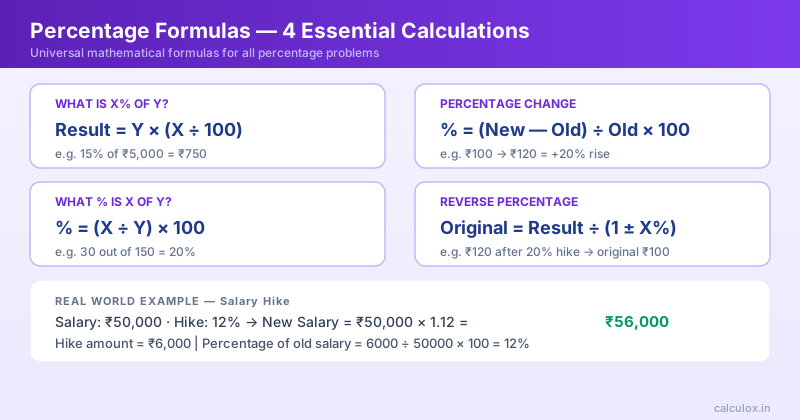
Try it yourself →
Use our free Percentage Calculator for instant results
What is Percentage?
Percentage means “per hundred” - a way to express a number as a fraction of 100. The symbol % represents this concept. Example: 25% = 25/100 = 0.25 as a decimal.
Percentages are used everywhere in daily life: discounts on shopping items, salary increases and appraisals, interest rates on loans and savings, test scores and grades in schools, inflation rates affecting purchasing power, and profit margins in business. Understanding percentages is essential for making informed financial decisions. For instance, if a bank offers 7% annual interest on savings, knowing how to calculate that 7% helps you understand how much money you will earn on your deposit.
Similarly, when shopping, calculating the actual discount percentage helps determine if a sale is truly worth buying. Percentages make it easy to compare different quantities and ratios, regardless of the actual numbers involved. This is why percentages are considered one of the most important mathematical tools for personal finance management.
Method 1: Percentage Hike/Discount
Formula: New Amount = Original Amount × (1 ± P/100). For percentage hike (increase): New Amount = Original × (1 + P/100). For percentage discount (decrease): New Amount = Original × (1 - P/100).
Real-world example - Salary increment: You earn ₹50,000 per month and get a 15% raise. New salary = 50,000 × (1 + 15/100) = 50,000 × 1.15 = ₹57,500. The ₹7,500 increase represents your 15% hike.
Another example - Shopping discount: You want to buy a shirt priced at ₹1000, and it is on 30% discount. Final price = 1000 × (1 - 30/100) = 1000 × 0.70 = ₹700. You save ₹300 on this purchase.
This method is particularly useful when you know the original amount and the percentage change, and you want to quickly find the new amount. Banks use this calculation for interest additions. Retailers use it for discounts.
HR departments use it for salary adjustments.
Method 2: What Percent of X is Y?
Formula: Percentage = (Y / X) × 100. This method answers the question: “What percentage is Y out of X?” Real-world example - Test score calculation: You scored 75 marks out of 100 in an exam. What percentage is this? Percentage = (75 / 100) × 100 = 75%.
Your percentage score is 75%. Business example - Profit margin: A shopkeeper bought goods for ₹100,000 (cost price) and wants to know what percentage profit ₹20,000 represents. Percentage = (20,000 / 100,000) × 100 = 20% profit.
Banking example - Interest earned: If you earned ₹5,000 interest on a ₹100,000 savings account, the percentage return is (5,000 / 100,000) × 100 = 5%. This method is crucial for understanding relative performance, evaluating returns on investments, calculating profit margins in business, and assessing test performance. Whenever you need to express one number as a percentage of another, this is your formula.
It helps compare apples to apples even when the base amounts are different.
Method 3: Percentage Change (Growth or Decline)
Formula: % Change = ((New Value - Old Value) / Old Value) × 100. This method calculates how much something has increased or decreased as a percentage. Stock market example: You bought a stock at ₹100 per share.
It is now trading at ₹130 per share. What is the percentage gain? % Change = ((130 - 100) / 100) × 100 = (30 / 100) × 100 = 30% gain. Loss example: A product that cost ₹150 is now selling for ₹120 due to inventory clearance. % Change = ((120 - 150) / 150) × 100 = (-30 / 150) × 100 = -20% (20% decrease).
Inflation example: If the price of a liter of milk increased from ₹45 to ₹50, the percentage increase is ((50 - 45) / 45) × 100 = 11.1% increase per liter. This calculation is invaluable for analyzing business growth rates, investment returns, inflation tracking, salary growth evaluation, and market trend analysis. The key insight is that percentage change is always relative to the original value (the denominator).
A ₹10 increase on ₹100 is 10%, but the same ₹10 increase on ₹50 is 20% - the base matters significantly.
Method 4: Reverse Percentage (Finding the Base)
Formula: Base = (Known Amount × 100) / Percentage. This method works backwards - when you know the percentage and the resulting amount, but need to find the original amount. Shopping example: A store advertises “Save ₹750 with 25% discount.” What was the original price? Base = (750 × 100) / 25 = 75,000 / 25 = ₹3,000 original price.
Loan example: You know that ₹15,000 represents 20% of your annual bonus. What is your total annual bonus? Total = (15,000 × 100) / 20 = 1,500,000 / 20 = ₹75,000 total bonus. Tax calculation: If you paid ₹22,500 as 18% GST on a purchase, what was the price before GST? Original price = (22,500 × 100) / 18 = ₹125,000.
This method is frequently used in retail (finding original prices), taxation (finding gross amounts), commissions (finding total sales), and finance (finding total amounts when you only know a percentage portion). It is particularly helpful for consumers who want to verify if advertised discounts are genuine or for businesses analyzing financial records.
Method 5 & 6: Sequential Percentages
When multiple percentage changes occur one after another, you cannot simply add the percentages. Instead, multiply the factors. Formula: Final Amount = Base × (1 + P1/100) × (1 + P2/100) × ... × (1 + Pn/100).
Example - Two consecutive salary increases: Starting salary ₹1,00,000. First year: 10% increase. New salary = 100,000 × 1.10 = ₹110,000.
Second year: 20% increase on the new salary. Final salary = 110,000 × 1.20 = ₹132,000. If you had simply added 10% + 20% = 30%, you would have calculated ₹130,000, which is ₹2,000 less! The difference compounds because the second percentage is applied to the increased amount, not the original.
Discount stacking example: A clothing store offers 25% discount on an already 30% discounted item. Final price = Original × (1 - 0.30) × (1 - 0.25) = Original × 0.70 × 0.75 = Original × 0.525 = 52.5% of original price. So the total discount is 47.5%, not 55%.
Compound interest follows the same principle: each year, interest is calculated on the new total (principal plus previous interest), creating the powerful effect of “interest earning interest.” This method appears frequently in multi-year investments, successive salary reviews, compound discounts, and inflation calculations spanning multiple years.
Real-World Percentage Examples for Indians
Example 1 - Salary negotiation: You are offered a job at ₹40,000/month. You negotiate a 12% salary increase from the initial offer. New salary = 40,000 × 1.12 = ₹44,800/month.
You gain ₹4,800 extra monthly or ₹57,600 annually - significant money for negotiation! Example 2 - Home loan interest: Your home loan is ₹50,00,000 (50 lakhs) at 8.5% annual interest. Year 1 interest = 50,00,000 × 8.5% = ₹4,25,000 in first year interest alone. Example 3 - Stock market returns: You invested ₹1,00,000 in mutual funds.
After 5 years, it is worth ₹1,60,000. Your percentage return = ((160,000 - 100,000) / 100,000) × 100 = 60% total gain, or roughly 12% annually. Example 4 - GST on purchases: A restaurant bill shows ₹1,000 + 18% GST = ₹1,180 total.
The 18% GST amount = 1,000 × 0.18 = ₹180. Understanding this helps you budget correctly - the actual cost is ₹1,180, not just ₹1,000.
Common Percentage Mistakes & How to Avoid Them
Mistake 1 - Adding percentages instead of multiplying: Students often add 10% + 20% = 30% for successive increases. Reality: 10% increase followed by 20% increase = 1.10 × 1.20 = 1.32 or 32% total, not 30%. Always multiply factors for sequential changes.
Mistake 2 - Using wrong base for percentage change: Many people calculate percentage decrease incorrectly. For a ₹100 item reduced to ₹75, the decrease is (25/100) = 25%, not 33%. The base should be the original amount, not the final amount.
Mistake 3 - Confusing percentage increase and percentage points: If inflation rises from 5% to 8%, that is 3 percentage points, not 3% increase. The actual percentage increase in inflation rate is (8-5)/5 = 60% increase. News often confuses these terms.
Mistake 4 - Forgetting to convert percentages to decimals: When calculating 15% of ₹5,000, you must use 0.15, not 15. Correct: 5,000 × 0.15 = ₹750. Wrong: 5,000 × 15 = ₹75,000.
Mistake 5 - Not verifying discount claims: A store claims “70% off.” Check: Original ₹1000, discount ₹700, final price ₹300. Many stores misrepresent discounts - always calculate. Mistake 6 - Percentage vs absolute numbers: A ₹10 increase on ₹100 is 10% significant, but a ₹10 increase on ₹1,000 is only 1% significant.
Always consider the percentage relative to the base, not just the absolute number.
Frequently Asked Questions
What is the difference between percent and percentage?▸
In everyday usage, “percent” and “percentage” are used interchangeably, but technically: “Percent” refers to the unit or symbol (%) itself. “Percentage” refers to the amount or value expressed as a fraction of 100. Example: “A discount of 20 percent” or “A percentage of 20%” both mean the same thing. However, in formal contexts: “What percent of the total is this?” (asking for the rate). “The percentage increase was 15%” (stating the result). For most practical financial and mathematical purposes, you can use these terms interchangeably without concern.
How to calculate discount percentage?▸
Discount % = (Discount Amount / Original Price) × 100. Step-by-step: Find the discount amount in rupees (Original Price - Discounted Price). Divide discount amount by original price. Multiply by 100 to get percentage. Example: Original price ₹1,000, discounted price ₹700. Discount amount = ₹1,000 - ₹700 = ₹300. Discount % = (300 / 1,000) × 100 = 30% discount. You save ₹300, which is 30% of the original price. Practical tip: Always verify advertised discounts. A ₹5,000 product with “₹1,000 off” is 20% discount, not 25%. Retailers sometimes use absolute rupee amounts to make discounts sound bigger than the actual percentage.
How to calculate percentage increase?▸
% Increase = ((New Value - Old Value) / Old Value) × 100. Step-by-step: Find the difference between new and old values. Divide by the old value (base). Multiply by 100. Example: Your salary increased from ₹40,000 to ₹50,000. Increase = ₹50,000 - ₹40,000 = ₹10,000. % Increase = (10,000 / 40,000) × 100 = 25% increase. Financial tip: When comparing salary offers or investment returns, always calculate percentage increase, not just absolute amounts. A ₹10,000 increase on ₹50,000 (20%) is better than a ₹10,000 increase on ₹100,000 (10%), even though the rupee amount is the same.
Can a percentage be more than 100%?▸
Yes, absolutely! A percentage can be any value from 0% to infinity. If value doubles, that is 100% increase (you have 200% of original value). If value triples, that is 200% increase (you have 300% of original value). Example: An investment of ₹1,00,000 that grows to ₹3,00,000 has a 200% gain (or 300% of original). Stock market: A stock that goes from ₹100 to ₹500 has a 400% increase. Real estate: Property value appreciation from ₹25 lakh to ₹1 crore is 300% appreciation. Percentages above 100% indicate more than doubling or tripling - they are common in high-growth investments and are perfectly valid mathematical expressions.
How to apply multiple percentage changes?▸
For sequential percentage changes, multiply the factors rather than adding percentages. Formula: Final Value = Initial × (1 + P1/100) × (1 + P2/100) × ... Example: ₹1,000 with +10% increase followed by -20% discount. Step 1: Apply 10% increase: 1,000 × 1.10 = ₹1,100. Step 2: Apply 20% discount: 1,100 × 0.80 = ₹880. Or directly: 1,000 × 1.10 × 0.80 = ₹880. This is different from simply calculating (10 - 20 = -10%) and getting 1,000 × 0.90 = ₹900 (incorrect!). The order matters in some cases: Increasing by 10% then decreasing by 20% = ₹880. Decreasing by 20% then increasing by 10% = 1,000 × 0.80 × 1.10 = ₹880 (same result when only multiplying). This principle is crucial for compound interest, multi-year investment returns, and successive salary or price adjustments.
What is the fastest way to estimate percentages mentally?▸
Quick estimation tips: 10% of any number: Move decimal point one place left. 10% of ₹500 = ₹50. 5% of any number: Half of 10%. 5% of ₹500 = ₹25. 1% of any number: Move decimal point two places left. 1% of ₹500 = ₹5. 20% of any number: 2 × 10%. 20% of ₹500 = ₹100. 25% (quarter): Divide by 4. 25% of ₹400 = ₹100. 50% (half): Divide by 2. 50% of ₹800 = ₹400. 15% of number: 10% + half of 10%. 15% of ₹200 = ₹20 + ₹10 = ₹30. Mental math becomes quick with practice. For exact calculations, use a calculator, but for quick estimation while shopping or comparing deals, these shortcuts are invaluable.
How do percentage calculations apply to investments and returns?▸
In investing, percentage calculations are essential: Annual Return: If you invested ₹1,00,000 and earned ₹12,000 in one year, your return is (12,000 / 100,000) × 100 = 12% annual return. CAGR (Compound Annual Growth Rate): For multi-year investments, you calculate the average annual percentage growth considering compounding. Dividend yield: If a stock costs ₹500 and pays ₹10 annual dividend, yield = (10 / 500) × 100 = 2% yield. Portfolio allocation: If you have ₹1,00,000 to invest and want 60% stocks, 30% bonds, 10% cash, you allocate ₹60,000, ₹30,000, ₹10,000 respectively. Inflation adjustment: Real returns = Nominal returns - Inflation rate. If you earned 10% and inflation was 5%, your real return is approximately 5% in purchasing power. Understanding these percentages helps you make informed investment decisions and evaluate whether your portfolio is performing well against benchmarks.
Related Articles
Try Our Free Percentage Calculator
Get instant, accurate results without any registration required.
Open Percentage Calculator →