New vs Old Tax Regime 2025-26: Which is Better?
Complete comparison of New vs Old tax regime for FY 2025-26. Learn which regime saves more tax with real examples and recommendations.
Software Developer · Creator of calculox.in · Formulas verified per RBI, Finance Act 2025-26 & SEBI
Try it yourself →
Use our free Tax Calculator for instant results
Overview of Two Tax Regimes
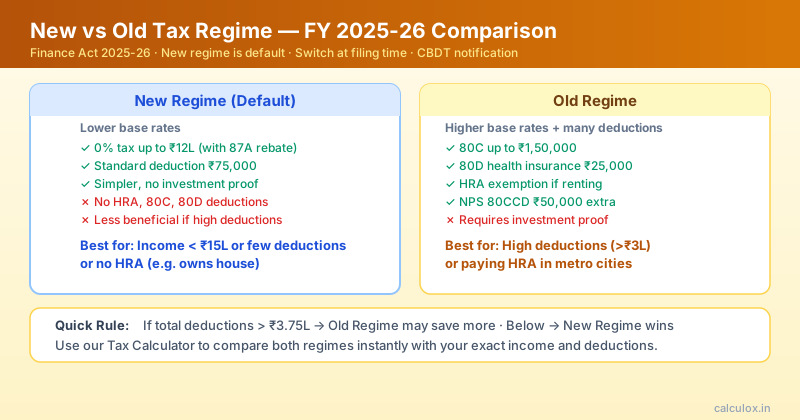
India offers two parallel income tax systems: New Regime (default since FY 2023-24) and Old Regime. New Regime: Simpler tax with lower tax rates but NO deductions allowed (except standard ₹75K). Ideal for employees with minimal investments and no home loans.
Old Regime: Traditional tax with higher base slabs BUT allows numerous deductions (80C, 80D, HRA, home loan interest, NPS). Ideal for high earners with mortgages and investments. From FY 2023-24, New Regime is default - you automatically opt in unless you specifically choose Old Regime.
You can switch between regimes every year based on your situation that year. Understanding both helps you save ₹15-50K annually depending on your income and investments.
New Tax Regime Slabs 2025-26
Up to ₹3L: 0% tax (Nil). ₹3-6L: 5% tax (₹15,000 on full ₹6L bracket). ₹6-9L: 10% tax. ₹9-12L: 15% tax. ₹12-15L: 20% tax. Above ₹15L: 30% tax. Rebate 87A: If income ≤ ₹7L, you get full tax relief up to ₹25,000, making your tax zero even if calculated.
Standard deduction: ₹75,000 allowed. Key limitation: NO Section 80C, 80D, HRA, home loan interest, or other deductions allowed in New Regime. Even if you invest ₹1.5L in PPF or pay ₹2L home loan interest, you cannot claim these in New Regime.
This makes New Regime mathematically simpler but often more expensive for high earners.
Old Tax Regime Slabs 2025-26
Up to ₹2.5L: 0% tax (Nil). ₹2.5-5L: 5% tax (₹1.25L for full bracket = much higher than New!). ₹5-10L: 20% tax (significantly steeper). ₹10-20L: 30% tax. Above ₹20L: 30% tax. Deductions allowed: Section 80C (₹1.5L limit for PPF, ELSS, insurance, FD), Section 80D (₹75K for health insurance, ₹1L with senior parents), HRA exemption (40% basic in metros), Section 24(b) home loan interest (₹2L), Section 80CCD NPS (₹2L additional beyond 80C), Section 80TTA savings interest (₹10K), education loan interest (₹1.5L).
Standard deduction: ₹75,000 same as New. Total deductions can reach ₹5-6L annually making Old Regime far more attractive for higher earners despite steeper rates.
Real Comparison Examples
Example 1 - ₹8L income, no deductions: New Regime = 8L minus 75K standard = 7.25L taxable = 5L at 5% (₹2.5L) + 2.25L at 10% (₹22.5K) = ₹52.5K tax. Old Regime = same = ₹52.5K. Difference = ZERO.
Prefer New Regime for simplicity. Example 2 - ₹12L income with ₹4.75L deductions (HRA ₹2L + 80C ₹1.5L + health insurance ₹75K + home loan ₹50K): New Regime = 12L minus 75K = 11.25L taxable = ₹1,78,500 tax. Old Regime = 12L minus 4.75L = 7.25L taxable = ₹55,500 tax (after considering slabs).
Savings = ₹1,23,000 in Old Regime! Example 3 - ₹20L income with max deductions ₹10L: New Regime = ₹3,43,500 tax. Old Regime = ₹2,50,000 tax. Savings = ₹93,500 annually by choosing Old Regime.
Rule: If total deductions exceed ₹1L, Old Regime almost always saves more. Below ₹1L deductions, New Regime simpler and competitive.
Year-by-Year Switching Strategy
You can switch regimes every financial year based on your situation that specific year - no permanent commitment required. Strategic approach: Years 1-2 (young, no dependents, minimal investments): Choose New Regime, simple filing, lower stress. Years 3-7 (bought home, took mortgage): Switch to Old Regime, claim ₹1.5-2L home loan interest annually = ₹45-60K tax savings.
Years 8-10 (kids education, health insurance): Maximize Old Regime with 80C (education planning) + 80D (insurance) = ₹45K savings. Years 11-25 (high income, max investments): Stick with Old Regime, combine HRA + home loan interest + 80C + 80CCD = ₹1-1.5L annual tax savings. Pre-retirement (age 55+): Consider NPS contributions (₹2L additional deduction under 80CCD(1B)) for last 5 years = ₹50K+ annual savings + tax-free retirement income.
Flexibility lets you optimize every single year.
Decision Framework: When to Choose Which Regime
Choose New Regime if: Income ₹5-8L with minimal deductions, you value tax simplicity, no home loan, minimal insurance/investment habit, prefer set-and-forget approach. Choose Old Regime if: Income > ₹10L AND total deductions expected > ₹1L, active home loan (interest ₹1.5-2L/year), consistent PPF/ELSS investing (₹1.5L/year), family health insurance (₹50-75K/year), NPS investing (₹2L/year). Mixed decision (₹8-10L income): Calculate both regimes with your estimated deductions, pick lower tax, reassess next year.
Key insight: 75% of Indian salaried employees in ₹12-20L bracket overpay tax by ₹15-30K annually simply by not switching to Old Regime. Use our Tax Calculator to model both with your actual numbers every July.
Special Considerations: Life Stage Impact on Regime Choice
Age 25-30 (Entry-level): New Regime likely better (income ₹5-8L, minimal deductions, simplicity). Age 30-40 (Mid-career, marriage, home purchase): Switch to Old Regime when home loan taken (interest ₹2L+ deduction saves ₹60K+ annually). Age 40-50 (Peak earnings, children education): Maximize Old Regime (80C education investments, home loan interest, children insurance).
Age 50-55 (Pre-retirement): Add NPS ₹2L deduction (80CCD(1B), saves additional ₹60K at 30% bracket). Age 55+ (Retirement): Old Regime continues to win with pension income exemptions (standard deduction benefit). Example: Same person - New at 25, Old from 30-60, back to New at 60+ (based on situation).
Life stage matters as much as income level in regime selection.
Frequently Asked Questions
Can I choose new regime then switch to old regime next year?▸
Yes absolutely! You have complete flexibility to switch every financial year. Example: FY 2024-25 choose New Regime (no deductions yet), FY 2025-26 switch to Old Regime (bought home, took loan), FY 2026-27 switch back to New (sold home), FY 2027-28 Old again (took education loan). No permanent commitment, no penalties for switching. This flexibility is huge advantage - many Indians don't know about it. At ITR filing time, always calculate both regimes and file with whichever gives lower tax.
At what income should I switch to old regime?▸
Threshold: Switch to Old Regime if income > ₹10L AND have deductions > ₹1L. Examples: Income ₹10L with HRA ₹2L + 80C ₹1.5L = Old saves ₹50K. Income ₹8L with only 80C ₹1.5L = both regimes give similar tax, choose New for simplicity. Income ₹20L with HRA ₹2L + home loan ₹2L + 80C ₹1.5L + NPS ₹2L = Old saves ₹1L+. For income ₹8-10L range, calculate both with your actual deductions using our calculator - difference is ₹3-8K, you can choose either. Golden rule: Higher income + higher deductions = Old Regime wins dramatically.
Does HRA exemption differ between regimes?▸
HRA rules are identical in both regimes - no difference! In both New and Old, HRA exemption = Minimum of (actual HRA, 40% basic in metro, rent minus 10% basic). Claiming is same: Form 12BB with employer + rent receipts. Tax saving is same: ₹30,000 HRA exemption at 20% bracket = ₹6,000 saving. So HRA is not a deciding factor between regimes. Decision should be based on other deductions (80C, home loan, NPS, health insurance).
Can I claim rebate 87A in both regimes?▸
Rebate 87A exists in both regimes but is MUCH more powerful in New Regime. In New Regime: If income ≤ ₹7L, Rebate 87A gives FULL tax relief (zero tax) up to ₹25,000. Example: Income ₹6.5L, tax calculated ₹15,000, Rebate 87A wipes it to zero = you pay ZERO tax. In Old Regime: Rebate 87A applies if income ≤ ₹5L (lower threshold) and doesn't give full relief for higher incomes. Example: Income ₹6L in Old Regime, you still might pay some tax. So for income ₹5-7L range, New Regime with Rebate 87A is unbeatable - you pay zero tax anyway even without deductions. For income > ₹7L, rebate doesn't help so other deductions matter more.
What if my income increases during the year?▸
You still file ITR for full-year income. Progressive tax rates apply across both regimes: Every rupee from ₹0-3L taxed at 0%, next ₹0-3L taxed at 5%, next ₹0-3L at 10%, and so on. Higher income just moves additional rupees to higher brackets, not retroactive on all income. Example: If you earned ₹8L but expected ₹6L, don't worry - you only pay incremental tax on that additional ₹2L. No surprise, progressive rates are fair. File ITR with actual income, take no tension.
Is there any downside to choosing Old Regime?▸
Old Regime has one technical downside: You can never go back to Old Regime if you choose New Regime in some years. Once you choose New Regime (default from FY 2023-24), you must claim Old Regime via explicit election on ITR, but later switching back to New becomes permanent from that year onward under latest rules. BUT this is complex and most people don't hit this limit. Simpler approach: If planning to stay in Old Regime long-term (age 30-60 with mortgage), just stick with it. If unsure, ask CA. For most salaried employees earning ₹10-30L, Old Regime with deductions is clear winner, and this permanently rule shouldn't bother you.
Related Articles
Try Our Free Tax Calculator
Get instant, accurate results without any registration required.
Open Tax Calculator →