How to Calculate Home Loan EMI - Formula & Step-by-Step Guide
Learn how to calculate home loan EMI with formulas, examples, and step-by-step guide. Includes EMI calculation tricks and strategies to reduce EMI.
Software Developer · Creator of calculox.in · Formulas verified per RBI, Finance Act 2025-26 & SEBI
Learn about my expertise →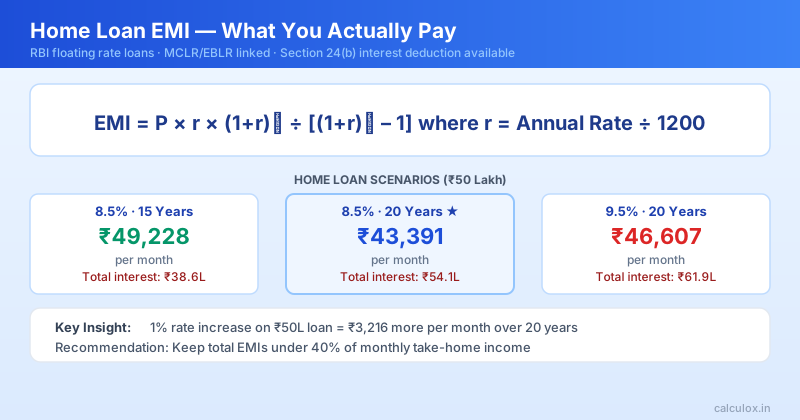
Try it yourself →
Use our free EMI Calculator for instant results
The Challenge: Finding an EMI You Can Afford Without Overextending
Millions of Indians dream of owning a home but struggle with a critical question: Can I afford this EMI? Home loans are the largest financial commitments most Indians make - often ₹20 lakh to ₹1 crore with 15-30 year repayment periods. Yet most home buyers don't deeply understand how EMI is calculated, why the same loan amount at different rates results in vastly different EMIs, or how prepayments can cut decades off their loan tenure. A ₹50 lakh home loan at 8.5% costs ₹48.75 lakh in interest over 20 years - meaning you pay nearly 100% extra just in interest! But at 8%, the same loan costs ₹47.5 lakh in interest.
That 0.5% difference = ₹1.25 lakh saved with no extra effort. Worse, most borrowers don't calculate the total cost upfront. They focus only on "Can I afford this monthly EMI?" without asking "Will I be paying more in interest than principal?" or "Could a 25-year tenure save my monthly budget while costing ₹20 lakh extra in total interest?" This guide provides complete EMI calculation understanding, practical strategies to reduce EMI, and advanced techniques like strategic prepayment that can save you ₹15-30 lakh over your loan lifetime.
Whether you're a first-time buyer or refinancing, understanding EMI mechanics is non-negotiable.
What is Home Loan EMI?
Home Loan EMI (Equated Monthly Installment) is the fixed monthly payment you make to repay your home loan. This amount remains constant throughout the loan tenure (typically 15-30 years) and includes both principal (the original borrowed amount) and interest (the cost of borrowing) components. EMI stands for Equated Monthly Installment - the word "equated" means the amount stays the same every month, making budgeting predictable and easy to plan.
For example, a ₹50 lakh home loan at 8.5% annual interest for 20 years requires an EMI of approximately ₹48,800 per month. This means every month for 240 months (20 years × 12), you pay exactly ₹48,800. In early months, most of this ₹48,800 goes toward interest, with only a small portion reducing your principal debt.
By later months, the proportion reverses - most goes toward principal, very little toward interest. This is called amortization. The EMI is predictable, allowing you to budget accurately and plan your finances confidently.
Unlike floating-rate loans where the EMI can change with market conditions, a fixed-rate EMI remains constant, providing peace of mind.
Home Loan EMI Formula - Step-by-Step Calculation
The EMI formula is: EMI = P × [R × (1+R)^N] / [(1+R)^N - 1]. Where: P = Principal (Loan Amount in rupees), R = Monthly Interest Rate (Annual Rate ÷ 12 ÷ 100), N = Number of Months (Tenure in Years × 12). Step-by-Step Example: ₹50 lakh loan at 8.5% annual interest for 20 years.
- Convert annual rate to monthly: 8.5% ÷ 12 = 0.708% monthly. As decimal: R = 0.708/100 = 0.00708.
- Calculate (1+R)^N = (1.00708)^240 = 5.728.
- Calculate R × (1+R)^N = 0.00708 × 5.728 = 0.0405.
- Calculate (1+R)^N - 1 = 5.728 - 1 = 4.728.
- Divide: 0.0405 ÷ 4.728 = 0.008566.
- Multiply by principal: ₹50,00,000 × 0.008566 = ₹42,830 (approximately). More commonly, banks use online EMI calculators. Our Home Loan EMI Calculator does this instantly - just enter the principal, rate, and tenure. Key insight: Even 0.5% difference in interest rate changes EMI significantly. At 8%, the same ₹50L loan = ₹41,590 EMI (₹1,240 less per month!). Over 240 months, that's ₹2.97 lakh saved.
EMI Examples at Different Loan Amounts & Rates
Understanding EMI scaling across different loan sizes helps you plan your property budget. All examples at 8.5% interest for 20-year tenure: ₹25L Loan: Monthly EMI ₹21,415. Total paid: ₹51.4L (₹26.4L interest). ₹50L Loan: Monthly EMI ₹42,830.
Total paid: ₹102.8L (₹52.8L interest). ₹75L Loan: Monthly EMI ₹64,245. Total paid: ₹154.2L (₹79.2L interest). ₹100L Loan: Monthly EMI ₹85,660. Total paid: ₹205.6L (₹105.6L interest).
Notice the pattern: Every ₹25L additional loan = ₹21,415 additional monthly EMI. Impact of tenure: Same ₹50L loan at 8.5%, comparing tenures: 15-year tenure: ₹48,800/month EMI. Total paid ₹87.6L (₹37.6L interest). 20-year tenure: ₹42,830/month EMI.
Total paid ₹102.8L (₹52.8L interest). 25-year tenure: ₹38,930/month EMI. Total paid ₹116.8L (₹66.8L interest). 30-year tenure: ₹36,180/month EMI. Total paid ₹130.2L (₹80.2L interest).
Critical insight: Extending tenure from 15 to 30 years reduces monthly EMI by ₹12,620 (26% lower) but increases total interest paid by ₹42.6L (113% more!). Long tenures hurt wealth building significantly.
How EMI Breaks Down Into Principal & Interest Over Time
This is the critical insight most borrowers miss: in early months, almost all your EMI goes toward interest, not building equity! Amortization breakdown for ₹50L loan at 8.5% over 20 years (₹42,830 EMI): Month 1: ₹35,417 interest, ₹7,413 principal (83% interest!). Month 2: ₹35,304 interest, ₹7,526 principal (slight improvement). Month 12: ₹34,650 interest, ₹8,180 principal.
Month 120 (Year 10): ₹24,580 interest, ₹18,250 principal (turning point!). Month 240 (Year 20, final): ₹302 interest, ₹42,528 principal (99% principal!). The mathematical reason: Interest is calculated daily on your outstanding balance.
Month 1, your balance is ₹50L. Month 240, your balance is near zero. As you pay down principal, the interest portion naturally shrinks because there's less balance to charge interest on.
This structure has huge implications: (1) Early prepayment saves massive interest because you're reducing a large outstanding balance. (2) Waiting until year 10 to prepay ₹5L saves only 1/3 the interest compared to prepaying in year 1. (3) Most of your early payments are taxes/interest, not actually building equity. This is why accelerating principal payment through strategic prepayments is crucial for wealth building.
Strategies to Reduce Your Monthly EMI
Strategy 1: Increase Your Down Payment. Every ₹10L additional down payment reduces EMI by approximately ₹9,700. Example: Property ₹75L.
With 20% down (₹15L loan = ₹32,365 EMI) vs 30% down (₹52.5L loan = ₹44,887 EMI). Increasing down from 20% to 30% = ₹15L more down but ₹12,522 less EMI monthly. Over 20 years, you pay ₹30.05 lakh less interest.
Best strategy if you have savings: Pay maximum down payment possible (25-30%) rather than minimum (10-15%). Strategy 2: Choose Longer Tenure. Extending tenure from 20 to 25 years reduces EMI by ~8-10% monthly. ₹50L at 8.5% reduces from ₹42,830/month (20Y) to ₹38,930/month (25Y).
Savings: ₹3,900/month. BUT total interest increases from ₹52.8L to ₹66.8L (₹14L extra!). Use only if monthly budget is tight, then prepay later.
Strategy 3: Negotiate Interest Rate With Banks. Interest rates vary across banks by 0.25-0.75%. Shopping 5 banks can save you 0.5% = ₹1.25 lakh in interest over 20 years.
Strategy 4: Make Prepayments. Any extra amount you pay reduces principal immediately, shrinking the interest-bearing balance. Strategy 5: Opt for Balance Transfer.
If you're 5+ years into a loan and rates have dropped, transferring to a lower-rate bank saves interest despite transfer costs (processing ₹10-20K). Rule: Only transfer if 1% rate cut saves ₹12-15K/year (costs recovered in 2 years).
The EMI-to-Income Ratio Rule & Financial Health
Financial advisors universally recommend: EMI should not exceed 40% of your gross monthly income. This is the EMI-to-Income Ratio rule. Example calculations: If you earn ₹1,00,000/month gross → Safe EMI ≤ ₹40,000.
If you earn ₹2,00,000/month gross → Safe EMI ≤ ₹80,000. This 40% threshold ensures you have sufficient income for other expenses (food, utilities, insurance, children's education, taxes) and emergency savings. Breaking this rule causes stress: Going above 40% (say 50% of income on EMI) leaves only 50% for all other expenses.
With taxes (20-30%), you have only 20-30% of income for living expenses. This is financially unsustainable. Many borrowers stretch beyond 40% because banks approve loans up to 60% EMI-to-income ratio, taking advantage of greedy borrowers.
Never do this. Conservative borrowers use 30% ratio or less, leaving maximum flexibility. The 40% rule includes ALL loans (home + car + personal), not just home EMI.
Example: ₹1L salary, car EMI ₹20K, home EMI ₹35K = ₹55K total EMI. This exceeds 40% and causes financial stress. Always keep 6 months emergency fund (₹3-6L) BEFORE taking a home loan.
This cushion prevents forced property sale if income drops.
Home Loan Prepayment Strategy - The Ultimate Interest Saver
This is the most powerful wealth-building strategy most Indians ignore: Strategic prepayment can save you ₹15-30 lakh in interest and reduce your loan tenure by 5-10 years! Real example: ₹50L loan at 8.5% for 20 years = ₹42,830 EMI. Total interest paid = ₹52.8L (if no prepayments). Now, prepay ₹5L in Year 1.
This immediately reduces outstanding principal to ₹45L. Your monthly interest drops from ₹35,417 (₹50L × 8.5% ÷ 12) to ₹31,875 (₹45L × 8.5% ÷ 12). Extra ₹3,542 per month now applies to principal instead of interest.
Over remaining 19 years, you pay ₹43.7L instead of ₹52.8L. Interest saved = ₹9.1L! Mathematical insight: Month-1 prepayment saves interest on ₹5L for 240 months (20 years). Month-120 prepayment saves interest on ₹5L for only 120 months.
Month-240 prepayment saves interest for 0 months. Conclusion: Early prepayments are exponentially more valuable than late prepayments. Strategy: Make prepayments as early and as large as possible.
When you get bonus/increment/gift/inheritance, prepay immediately. Even ₹50K yearly prepayment accumulates to ₹10L over 20 years, saving ₹3-5L in interest. Pro-tips: (1) Confirm your bank allows prepayment without penalty (most modern banks do). (2) Prepay during financial windfalls (year-end bonus, increments, gifts). (3) Make lump-sum prepayments (not monthly extra) to avoid confusion. (4) Track how much you've prepaid - many borrowers forget and overpay.
Comparing Home Loans Across Banks to Find The Best EMI
Interest rates vary significantly across banks - shopping around saves you ₹1-3 lakh in interest. Comparison Example for ₹50L loan over 20 years: Bank A (SBI): 8.5% = ₹42,830 EMI. Bank B (HDFC): 8.25% = ₹41,635 EMI (₹1,195 less monthly!).
Bank C (ICICI): 8.75% = ₹44,025 EMI (₹1,195 more monthly!). Bank D (Axis): 8.5% = ₹42,830 EMI. Over 20 years: Bank B saves ₹2.87L interest vs Bank C.
Comprehensive comparison framework: (1) Compare minimum 5 banks for rates (standard rate varies 0.25-0.75%). Most banks: SBI, HDFC, ICICI, Axis, Kotak, IndusInd. (2) Consider hidden costs beyond interest rate: Processing fee (₹10-25K), documentation fee (₹5-10K), appraisal fee (₹3-10K). Total hidden costs = ₹20-45K (offset by interest savings in 2-3 years). (3) Check prepayment flexibility: Can you prepay without penalty? After how many years? Modern banks allow free prepayment anytime. (4) Tenure flexibility: Can you extend/reduce tenure without re-applying? (5) Disbursal speed: Some banks disburse in 3 days, others take 2-3 weeks. (6) Customer service reputation: Read reviews on actual customer experiences.
Decision formula: Don't just look at base rate. Use our EMI Calculator to model all banks side-by-side with hidden costs included. Even 0.25% rate difference = ₹1.25L saved over 20 years.
Worth 2 hours of rate shopping! Pro tip: Visit banks with salary increase proof or job change offers - banks offer 0.25-0.5% rate discounts for new customers.
Frequently Asked Questions
What is home loan EMI?▸
Home Loan EMI (Equated Monthly Installment) is the fixed monthly payment combining principal and interest. At 8.5% for 20 years, a ₹40L loan requires ₹31,040/month EMI.
How much down payment should I keep?▸
Typically 20% down payment is standard (₹10L on ₹50L property). Some banks allow 10-15% for salaried employees. Higher down payment = lower EMI and less total interest.
What is the EMI-to-income ratio rule?▸
Financial advisors recommend keeping EMI ≤ 40% of monthly income. Example: ₹1,00,000 income → EMI should be ≤ ₹40,000. Higher ratio causes financial stress.
Can I reduce my home loan EMI?▸
Yes! Increase down payment, choose longer tenure (but pays more interest), make prepayments, refinance at lower rate, or increase income with a co-borrower.
Is 20 years or 25 years tenure better?▸
Depends on your income: 20Y = higher EMI but Rs 2-3L less total interest. 25Y = lower EMI but more interest. Choose based on affordability and long-term goals.
What is principal vs interest breakdown and when should I prepay?▸
EMI Breakdown: Initially, most EMI goes to interest. Gradually, principal increases. Example: Rs 40L loan at 8.5%, month 1 has Rs 22,668 interest (73%) vs Rs 8,372 principal. By month 240, mostly principal. CRITICAL: Early prepayments save massive interest because they reduce outstanding principal immediately. Prepaying Rs 1L in month 1 saves more interest than in month 200. Strategy: Make prepayments EARLY if you have extra funds (bonus, gifts). This drastically reduces overall interest paid and can shorten tenure significantly.
Can I switch banks (balance transfer) if rates drop?▸
YES! Balance Transfer to another bank at lower rates can save Rs 1-3L in interest. Example: Rs 30L remaining at 9% for 10 years. Switching to 8% saves Rs 1-2L! Costs involved: Processing Rs 5-15K, Valuation Rs 3-10K, Legal Rs 10-20K (total Rs 20-45K). Worth it if annual savings > transfer cost. On Rs 30L, 1% cut saves Rs 12-15K/year - costs recovered in 3 years! Best time: During RBI rate-cut cycles. Always calculate exact savings before switching. Never switch just to jump to lower EMI if tenure extends significantly - total interest paid might increase!
How can I use our EMI calculator for different scenarios?▸
Our free Home Loan EMI Calculator helps you instantly calculate EMI for any combination: Enter loan amount (Rs 10L to Rs 1Cr), annual interest rate (5% to 12%), loan tenure (5 to 30 years), immediately see: Your monthly EMI amount, Total amount payable, Total interest paid, Year-by-year amortization, Impact of prepayments, Comparison across different tenure and rate scenarios. Try scenarios: What if I take Rs 40L vs Rs 50L? 20-year vs 25-year tenure? 8% vs 9% interest? The calculator shows all variations instantly, helping you choose the optimal loan structure matching your budget and financial goals!
What is a floating rate home loan and how does it affect EMI?▸
Floating rate = interest rate changes with RBI policy rate. Advantage: Initial rate lower (0.5-1% cheaper than fixed). Disadvantage: EMI increases if rates rise. Example: ₹40L loan at floating 7.5% (initial) = EMI ₹39,500. If RBI raises rate 1%, your rate becomes 8.5% = EMI jumps to ₹42,500 (+₹3,000/month!). Risk: If you budget ₹40K EMI but rate jumps to 8%, actual EMI becomes ₹45K (5% of salary lost). Strategy: (1) Fixed rate better if you expect rate increases, (2) Floating better if rates stable/declining, (3) Hybrid: Fixed for first 5 years, then floating. Check RBI policy history - rates have moved 0.5-2% annually over decades. Choose based on your risk tolerance.
Should I get a co-borrower or guarantor for my home loan?▸
Co-borrower = equal liability (helps approval, increases borrowing capacity). Guarantor = no liability, just vouches for you (doesn't improve capacity). Benefits of co-borrower: (1) Approval easier (bank sees 2 incomes), (2) Borrow more (Rs 40L as individual → Rs 60-70L as couple), (3) Lower EMI burden (spread across 2 people), (4) Both build credit history. Example: Individual ₹8L salary = max Rs 32L loan (40% EMI rule). Couple with ₹16L combined = max Rs 64L loan. Same EMI (Rs 128K/person vs Rs 256K individual) = more affordable. Risk: If co-borrower defaults, you're fully liable. Best practice: Spouse as co-borrower (shared property benefit), avoid random co-borrowers (legal complications).
What is loan-to-value (LTV) ratio and why does it matter?▸
LTV = Loan amount as percentage of property value. Example: Property worth ₹50L, loan ₹40L = 80% LTV. Banks prefer <80% LTV (lower risk). Higher LTV = you put less down, borrow more. Implications: 70% LTV (30% down) = easiest approval, best rates. 80% LTV (20% down) = standard, good rates. 90% LTV (10% down) = higher rates, stricter approval. Impact: On ₹50L property, 70% LTV = Rs 35L loan, 90% LTV = Rs 45L loan. Interest difference = Rs 10L on corpus, which compounds to Rs 20L+ over 20 years. Strategy: Put maximum down payment you can afford (improves LTV, reduces total interest, gets better rates). Even 5% extra down payment saves Rs 5-10L in interest over loan life.
Related Articles
Try Our Free EMI Calculator
Get instant, accurate results without any registration required.
Open EMI Calculator →