Home Loan vs Rent: Complete Financial Analysis - Which is Better?
Detailed comparison of buying vs renting in India. Analyze total cost of ownership, break-even analysis, tax benefits, and make data-driven decision.
Software Developer · Creator of calculox.in · Formulas verified per RBI, Finance Act 2025-26 & SEBI
Learn about my expertise →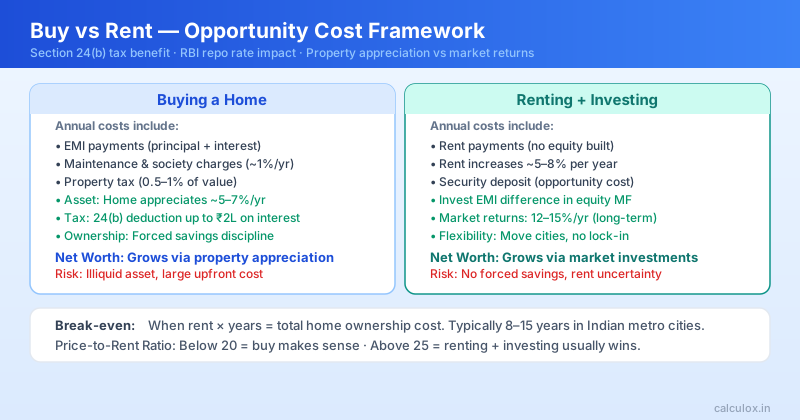
Try it yourself →
Use our free Home Loan vs Rent Calculator for instant results
The Buy vs Rent Decision Framework
This is deeply personal financial decision. Buy if: planning to stay 10+ years, have 20% down payment ready, stable income (job security), want to build equity and have control. Rent if: value flexibility highly, uncertain about location or job stability, don't have large down payment, living in expensive metro, want to invest surplus in stocks instead of property.
Financial analysis framework: Calculate complete total cost of ownership (loan EMI + interest, property tax, annual maintenance, home insurance, registration/stamp duty upfront) versus total rent cost (rent × 12 months × years, with rent escalation assumed at 6% annually). Break-even analysis answers: When does accumulated home appreciation offset the rental savings and investment returns? Timeline insight: Most homes in Indian metros break-even after 10-12 years, but this varies dramatically by city, property price, and appreciation rate.
Calculate Total Cost of Ownership
Home price: ₹50 lakh. Down payment (20%): ₹10 lakh. Loan amount: ₹40 lakh at 8.5% for 20 years. Annual loan interest year 1: ₹3.2 lakh (fully deductible section 24b). Maintenance: 0.5% of value = ₹25K annually. Property tax: 5-10K/year. Insurance: 5-10K/year. Registration, stamp duty: ₹3-5 lakh upfront (not recurring). Total year 1 cost: ₹38.5L EMI + ₹55K maintenance/tax = ~₹39L annually.
Calculate Total Rent Cost (20-year equivalent)
Rent for equivalent home: ₹30,000/month = ₹3.6L/year. Rent increases 6% annually (inflation). Year 1: ₹3.6L.
Year 5: ₹4.8L. Year 10: ₹6.4L. Year 20: ₹10.3L.
Total rent over 20 years (compound): ₹1.45 crore. Invest down payment ₹10L that you'd use for home: at 10% returns for 20 years = ₹67L (grows during rental years). Net rent cost: ₹1.45Cr - ₹67L = ₹78L net (rent wins financially!).
BUT: Home equity built = ₹40L principal + appreciation.
Break-Even Analysis: When Does Home Win?
Property appreciation: Assume 7% annual appreciation. ₹50L property after 20 years = ₹1.93Cr. Down payment ₹10L + investments ₹67L = ₹77L sunk during renting. Home path: Paid ₹78L total (loan EMI + maintenance) = left with ₹1.93Cr asset.
Rent path: Paid ₹78L total rent, left with ₹77L invested (in other assets). Home path wealth = ₹1.93Cr. Rent path wealth = ₹77L (assets) + rental flexibility.
Home wins by ₹1.15Cr if you live 20 years! But break-even is 10-12 years in most metros.
Tax Benefits of Home Loan
Section 24(b) interest deduction: ₹2L/year tax deduction (year 1 interest ₹3.2L, deductible ₹2L). At 30% bracket = ₹60K tax saving/year. Over 20 years = ₹12L total tax saving! Section 24(b) principal: No deduction (unlike interest). This tax benefit makes home ownership more attractive vs renting for high-income earners (30% bracket).
Non-Financial Factors
Buying advantages: Security and stability, no landlord interference, kids grow in one place, forced savings through EMI discipline, social status and family pride, freedom to renovate and personalize, hedge against rent inflation, asset to borrow against. Renting advantages: Flexibility to move jobs and cities, zero maintenance headaches, lower initial capital needed, less long-term commitment, better for income-focused years, ability to upgrade or downsize based on life stage. Emotional factors matter: Some people love ownership for security and control, others value flexibility and mobility.
Life stage strategy: Young professional (25-30) in metro = RENT and invest (maximize wealth-building, stay job-flexible). Married with kids (35-45) with stable job = BUY for stability (fixed school location, family security). Retired (60+) with paid-off home = HOME is security (zero EMI frees ₹30-50K/month for living expenses and medical needs).
Decision = financial math + lifestyle preferences + job stability + family goals combined.
Frequently Asked Questions
At what income level should I buy a home?▸
Rule of thumb: Home price = 3-4× annual income. ₹1.5Cr income = target ₹4.5-6Cr home. Loan eligibility: Most banks lend 4-5× annual income. ₹1.5Cr income = eligible for ₹60-75L loan. Your down payment must make up the difference.
How much down payment should I keep?▸
Minimum: 20% down (avoids NMC insurance premium). Standard: 25-30% down (shows financial strength). Smart: 30% down + emergency fund ₹10L separate (don't use all savings for down payment).
Is renting and investing better than buying?▸
Mathematically: Depends on rent inflation vs property appreciation + your investment returns. ₹30K rent (inflation 6%) vs ₹50L property (appreciation 7%) - home wins 8-10 years later. But if you're great investor (12-15% returns), rental path competes.
What if property doesn't appreciate as expected?▸
Even without appreciation: You've built equity (paid ₹40L principal over 20 years). Home becomes paid-off asset. Worst case: Home stays same price but you stop paying rent (no money leaves post-payment). Renting = perpetual outflow.
Should I buy in expensive metro or affordable smaller city?▸
Expensive metro (Delhi/Mumbai): High rent (₹30-50K), high appreciation (7-9%), good rental income if you leave. Tier-2 city: Low rent (₹10-15K), moderate appreciation (4-5%), growing job market. Buy in metro if stable income + long-term commitment. Tier-2 if: Budget constraint, want affordability, don't need premium location. Economics change by city - calculate buy vs rent for YOUR city.
How does home appreciation affect the decision?▸
Home appreciation turns the equation dramatically. Low appreciation (2-3% in stagnant areas): Rent wins financially - invest down payment instead. Moderate appreciation (5-6% in tier-2 cities): Break-even 12-15 years. High appreciation (7-9% in metros): Home wins decisively after 10-12 years. Rule: If property appreciates faster than your investment returns, buy wins. If investments outpace appreciation, rent wins. Our calculator lets you input YOUR city's appreciation rate for personalized decision.
What about property maintenance and hidden costs?▸
Maintenance costs homeowners ignore: Annual maintenance (0.5-1% of property value = ₹500-1,000/month for ₹50L property). Society fees (₹5-10K/month in metros). Property tax (₹5-15K/year). Insurance (₹5-10K/year). Repairs (₹50K every 3-5 years). Total = ₹1-2L annually hidden costs. Renters avoid all these. However, landlord paying these = reflected in higher rent. So rent already accounts for maintenance - it's baked in. Trade-off: Own home = capital preserved but trapped. Rented = flexibility + someone else pays maintenance.
What if I need to relocate for job before 10 years?▸
Worst scenario for homebuyers. Before 10 years, you might be underwater (sold price < remaining loan). Options: (1) Rent out home (if ₹50K+ rental income possible) - pay rent in new city, get positive cash flow. (2) Sell at loss (rare if market appreciating, but possible). (3) Keep & pay both home EMI + rent in new city (financial burden). Smart strategy: If job unstable or relocating likely, RENT instead. After 10+ years when break-even passed, more protected.
How do I calculate break-even for my specific city?▸
Use our Home Loan vs Rent Calculator: Input (1) Home price in your city, (2) Down payment % (20-30%), (3) Loan rate (current 8.5%), (4) Tenure (20 years), (5) Rent for equivalent home (check on 99acres, Sulekha), (6) Rent inflation (assume 6%), (7) Property appreciation (city-dependent: metros 7-9%, tier-2 4-5%). Calculator shows month-by-month comparison: Total rent paid vs Total ownership cost (EMI + maintenance + tax + insurance - tax benefits). Where lines cross = break-even point. Most Indian metros = 10-12 years. Tier-2 cities = 12-15 years. Use this personalized break-even, not generic rules.
Should I consider NRI or investment property apart from primary home?▸
Investment property (rental income) has different break-even than primary home. Rental yield (annual rent / property price) in metros = 3-4% (property ₹50L, rent ₹1.5L/year = 3% yield). Add property appreciation 7% = total 10% return. At 10% return, break-even faster than primary home (which has zero rental income). BUT: Maintenance + tax + vacancy + tenant issues eat into returns. Net after all costs = 5-6% effective return. For wealth-building: Property investment makes sense only if (1) you have capital ₹50L+ beyond primary home, (2) can handle tenant management, (3) plan long-term (15+ years). Most salaried employees better off with SIP (12% returns, zero maintenance).
What is the biggest mistake people make when comparing buy vs rent?▸
Mistake: Comparing EMI vs rent ignoring appreciation and tax benefits. They see ₹50K EMI vs ₹30K rent, choose rent. But after 10 years: Owner has ₹50L property worth ₹80L (₹30L appreciation) + tax saved ₹12L (24(b) home loan interest deduction). Total = ₹42L net gain after selling. Renter: Paid ₹36L total rent, owns zero. Difference: ₹42L! Better approach: Use our Buy vs Rent Calculator to model complete scenario (appreciation, taxes, maintenance, rent increase) not just EMI vs rent snapshot.
How does inflation impact the buy vs rent decision?▸
Inflation is actually favorable to homebuyers, unfavorable to renters. Why? Your EMI stays fixed but inflation makes future payments cheaper. ₹50K EMI today = ₹40K real value in 10 years at 6% inflation. But rent increases with inflation - ₹30K rent becomes ₹53K in 10 years! Homeowner advantage: Fixed EMI for 20 years means inflation erodes the burden. Renter disadvantage: Rent escalation compounds annually. After 20 years at 6% inflation, rent is ₹96K/month on same home! This is why homeowners eventually break-even - fixed costs + inflation + appreciation work in their favor. Use our calculator to model real inflation rates for your city.
Related Articles
Try Our Free Home Loan vs Rent Calculator
Get instant, accurate results without any registration required.
Open Home Loan vs Rent Calculator →