Healthy Profit Margin by Industry - Benchmarks for Indian Businesses
Industry-wise profit margin benchmarks for Indian businesses. Learn healthy margin % by sector and optimize pricing strategy.
Software Developer · Creator of calculox.in · Formulas verified per RBI, Finance Act 2025-26 & SEBI
Learn about my expertise →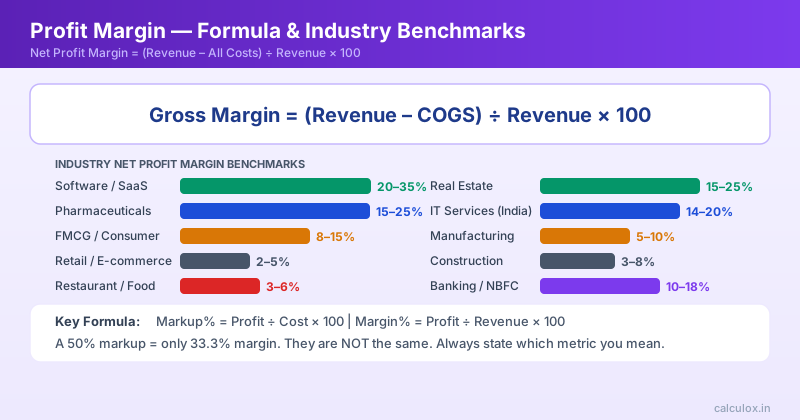
Try it yourself →
Use our free Profit Margin Calculator for instant results
What is Profit Margin?
Profit Margin = The percentage of profit on every ₹100 of sales. Formula: Profit Margin % = (Profit / Revenue) × 100. Example: Cost ₹100, Selling ₹150, Profit ₹50 = 33.3% margin.
Healthy margin varies by industry: Retail 10-20%, SaaS 60-80%. Your margin determines business sustainability and how long you can survive during downturns. A business with 40% margin survives cost increases and market competition far better than one with 5% margin.
Margin is your safety net - the larger your margin, the more flexibility you have to negotiate with suppliers, invest in growth, handle taxes and overhead, and still remain profitable.
Retail & Wholesale Margins
Regular Retail: 10-20% margin typical (low-cost retailers work with 5-10%, premium retailers 20-30%). Electronics Retail: 12-18% margin on modern products (was 25-30% 10 years ago, competition compressed margins). Clothing Retail: 20-40% margin depending on price point (budget brands 20%, premium 40-50%).
Premium/Luxury Goods: 40-60%+ margin (brand value and limited competition allow higher margins). Grocery & FMCG: 5-10% margin (highest volume, slimmest margins, survival depends on turning stock rapidly). Online Retail: 15-40% margin varies with fulfillment model (Amazon, Flipkart take 15-20% commission).
Marketplace sellers: Must achieve base margin of 40-50% to account for 15-20% commission, payment gateway charges, and operational costs. Strategic lesson: Low margin retail = high volume dependency. One bad month hurts cash flow.
Food & Restaurant Margins
QSR (Quick Service - Fast Food): 5-15% margin typical (high labor, rent, food wastage costs). Dine-in Restaurants: 15-25% margin (better margins than QSR due to higher pricing power, but face higher labor and ambiance costs). Cloud Kitchens: 10-18% margin (lower rent than dine-in, no front-of-house staff, but delivery commissions cut margins).
Packaged Foods (FMCG): 15-35% margin at retail (wholesale distributor 20-25%, retailer adds 20-30%). FMCG Brands: 40-70% margin at manufacturer level (brand value, distribution scale, bulk manufacturing). Food manufacturing benefits from scale (larger volume = lower per-unit costs) and brand premium (branded flour ₹30/kg vs generic ₹22/kg = both 40% margin but different absolute profit).
Restaurants struggle most - labor is 25-35% of revenue, rent 8-15%, food cost 25-35%, leaving only 15-25% for margin. Automation (chain operations, technology, reduced staff) improves margins significantly.
Manufacturing & Industrial Margins
Heavy Manufacturing (machinery, auto parts): 8-15% margin typical (capital intensive, long sales cycles, thin margins). Consumer Products (soaps, detergents, cosmetics): 20-40% margin (mid-scale production, brand value). FMCG Brands: 40-70% margin at manufacturer (Colgate, ITC, HUL operate at these margins due to scale and distribution control).
SaaS (Software as a Service): 70-85% margin typical (Google, Microsoft, Freshworks achieve 80%+ margins - once software is built, selling copies costs almost nothing). Digital Services (web design, consulting): 40-70% margin (your time = inventory, once delivered costs near zero). Consulting: 40-70% margin (expert billing high hourly rates, minimal material cost).
Real Estate Developers: 60-100%+ margin (buy land at ₹50L/acre, develop, sell at ₹1.5Cr/acre = 200% markup = 66% margin). Higher margins in intellectual property and digital products due to scalability - you build once, sell infinitely without additional cost.
Pricing Psychology & Margin Optimization
Price perception is not always tied to cost. Pricing frameworks: Cost-Plus (cost + 40% margin) works for commodities but leaves money on table for premium products. Value-Based Pricing (charge what customer perceives as value) allows 60-80% margins for premium brands.
Dynamic Pricing (Uber, hotels: high demand = higher prices) improves margins seasonally. Bundling (sell low-margin + high-margin items together) improves overall margin. Example: Electronics store: Phones 12% margin, but bundle phone + case + screen protector + insurance = 28% blended margin.
Loss Leaders (sell one item at 0-5% margin to attract customers who buy high-margin items) common in retail.
Margin Erosion: What Happens When Your Margin Declines
Warning signs: Margin declining 2-3% year-on-year needs immediate investigation. Causes: (1) Costs rising faster than prices: supplier increased raw material 15%, you raised selling price only 5% = 10% margin loss. (2) Competition forcing price cuts: Market flooded with new competitors, you cut prices to retain customers, margin shrinks. (3) Operational inefficiency: Waste increasing (10% of inventory expires), inventory turnover slowing, labor costs creeping up. (4) Channel mix change: Shifted from direct sales (50% margin) to distributors (30% margin) = 20% margin loss. (5) Product mix shift: Selling more low-margin volume products instead of high-margin specialty items. Recovery strategies: Negotiate aggressively with suppliers (10% cost reduction = equivalent of 50% price increase when margin 20%), improve operational efficiency (reduce waste, increase turnover), exit low-margin products, invest in automation to cut labor, reposition to higher-price-point segment.
Frequently Asked Questions
What is the difference between markup and margin?▸
Markup = Profit / Cost (expressed as % of cost). Margin = Profit / Selling Price (expressed as % of selling price). Example: Cost ₹100, Selling ₹150, Profit ₹50 = 50% markup (50/100) but 33% margin (50/150). Same profit, different percentages! Many business owners confuse these. A 50% markup does NOT equal 50% margin - it equals only 33% margin. A 50% margin requires 100% markup (cost ₹100, sell ₹200). Use our calculator to convert instantly between markup and margin for your products.
What is a healthy profit margin for a retail store?▸
Depends on retail type: Grocery stores 5-10% margin (high volume business). Electronics retail 12-18% margin (inventory cost, competition). Clothing 20-40% margin (depends on price point - budget 20%, premium 40%). Jewelry/watches 35-60% margin (low volume, high price, premium positioning). Pharmacies 15-25% margin (regulated pricing limits upside). General rule: If margin < 20%, you are high-volume/low-margin business vulnerable to cost increases. If margin > 40%, you have pricing power and room for negotiations. Most healthy retail margins 20-30% - enough to cover overhead and market volatility.
Why is my margin declining over time?▸
Typical causes and frequency: Costs rising faster than prices (40% of margin erosion). Inflation raises supplier costs 10%, you raise selling price only 3% because of competition = 7% gap creates margin squeeze. Competition forcing price cuts to retain customers (30%). New entrants undercut your price, you reduce price to stay competitive, margin shrinks. Waste/theft increasing (15%). Inventory shrinkage, damaged goods, unsold perishables eating into margins. Operational inefficiency (10%). Slower inventory turnover, excess labor hours, high logistics costs. Product mix (5%) - shift to lower-margin items. Action plan: Audit last 3 years of margin data month-by-month. Identify which products/channels losing margin fastest. Investigate causes (call suppliers, track waste, analyze labor). Execute: Negotiate cost reductions, raise prices strategically on low-elasticity products, cut unprofitable SKUs, improve operations.
How do I increase profit margin without raising prices?▸
Price is one lever. Cost management levers: (1) Negotiate supplier costs - bulk discounts (30% volume = 5-10% cost reduction), long-term contracts for stability, explore alternate suppliers, vertical integration (make instead of buy). (2) Reduce waste - implement inventory controls (3% industry waste, aim for 1%), better demand forecasting to avoid excess inventory, quality control to reduce defects. (3) Improve efficiency - batch similar orders together (reduce changeover cost), optimize logistics routes (15% fuel saving), automation (labor 25% of cost, tech replaces 30-40%). (4) Improve turnover - faster inventory rotation means less money tied up, less spoilage. For ₹100 cost item: Every ₹5 cost reduction = 5% margin improvement at same price = equivalent of 11% price increase benefit without losing customers. Cost reduction is often easier than price increases in competitive markets.
Is it better to have high margin or high volume?▸
Ideal outcome: High margin AND high volume. But if choosing between two extremes: SaaS/Consulting prefer high margin low volume (one ₹100L project at 80% margin = ₹80L profit). Retail prefers high volume low margin (1000 items ₹1,000 each at 20% margin = ₹2L profit = same as 1 item ₹100L at 80% margin but faster cash flow). Why different? SaaS has high fixed costs (developers, infrastructure) upfront - margin covers those. Retail has ongoing variable costs - volume drives absolute profit. Rule: If margin < 15%, you MUST have high volume to be profitable. If margin > 40%, volume flexibility exists (you can profit on smaller volume). Most sustainable businesses target 25-35% margin with increasing volume for growth.
How do I know if my margin is competitive for my industry?▸
Benchmark against industry standards: Check industry reports (CIBIL, ICRA publish industry margin studies), talk to peer businesses (informal networks), analyze public company financials (if trading), look at competitor pricing if visible. Problem: Different accounting methods make comparisons tricky. Solution: Focus on Gross Margin % = (Revenue - COGS) / Revenue. This removes operating expenses variation. Your Gross Margin 35% vs industry average 32% = you are above average = good position. Gross Margin 20% vs industry 28% = urgent action needed - either your costs are high or prices are low. Annual benchmarking (compare your margin to industry trends) helps catch drift early before it becomes crisis.
Related Articles
Try Our Free Profit Margin Calculator
Get instant, accurate results without any registration required.
Open Profit Margin Calculator →