Complete Guide to Investment Options in India - Compare All Asset Classes
Comprehensive guide to all investment options available to Indians. Compare stocks, mutual funds, bonds, gold, real estate, insurance - make informed decisions.
Software Developer · Creator of calculox.in · Formulas verified per RBI, Finance Act 2025-26 & SEBI
Learn about my expertise →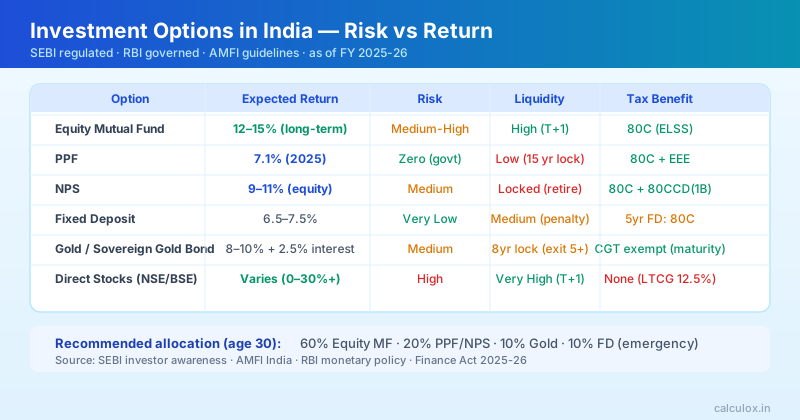
Try it yourself →
Use our free SIP Calculator for instant results
Overview of Investment Options in India
India offers diverse investment options from safe to high-risk. Each suits different goals and timelines. Safe options (0-3% risk): Fixed Deposits (5.5-6.5% return), Government Securities (5-7%), Savings Accounts (4-5%).
Medium-risk (5-8% risk): Bonds (5-7%), Gold (7-9% appreciation), Real Estate (8-12%), Conservative Mutual Funds (8-10%). High-risk (10-15% risk): Stocks (12-18% CAGR), Growth Mutual Funds (12-15%), Startups (0-100%). Return expectation: Higher risk = higher returns historically over 10+ years.
Beginner investors should start safe, gradually move to growth assets as knowledge builds. Asset allocation by age balances risk appropriately.
Fixed Deposits (FD) - The Safe Route
Return: 5.5-6.5% annually. Risk: Zero (government insured up to ₹5L). Tenure: 7 days to 10 years.
Best for: Emergency fund, short-term goals, risk-averse investors, retirees. Advantages: Guaranteed returns, insurance coverage, loan against FD available. Disadvantages: Low growth, inflation erodes value, liquidity lower (early withdrawal penalties). ₹10L FD at 6% for 10 years = ₹17.91L (beat inflation but slow growth).
Mutual Funds - The Balanced Choice
Return: 10-15% CAGR (equity), 5-7% CAGR (debt). Risk: Medium (equity funds volatile short-term, safe long-term). Tenure: 1-40 years (no fixed tenure).
Best for: Most Indian investors, SIP preferred. Types: Equity funds (growth), Debt funds (income), Balanced funds (mix), Index funds (low cost). Advantages: Diversification, professional management, flexible investments from ₹500/month, tax-efficient ELSS (capital gains exempt <1L).
Start with SIP in index funds (Nifty 50 or Sensex), then move to actively managed funds.
Stocks - The Growth Powerhouse
Return: 12-18% CAGR historically (index returns). Risk: High short-term volatility, medium long-term. Tenure: 5+ years recommended.
Best for: Knowledgeable investors, long-term growth, wealth creation. Advantages: Ownership stake, dividend income, capital appreciation, highest long-term returns. Disadvantages: Requires research/knowledge, emotional discipline, time commitment.
Start with: Blue-chip stocks (TCS, HDFC, INFY) or Nifty 50 index, avoid penny stocks/penny. For most, mutual funds (professional management) better than direct stocks.
Gold & Silver - The Inflation Hedge
Return: 7-9% annually (long-term average). Risk: Low (tangible asset), but price volatile. Tenure: 5-10+ years.
Best for: Portfolio diversification, inflation protection, cultural preferences. Forms: Physical gold (expensive storage), Gold ETF (low cost), Gold funds (professional managed). Advantages: Inflation hedge, cultural value, low correlation with stocks (diversifies portfolio).
Disadvantages: No income (no dividends), storage costs, lower returns than equity. Allocation: 10-20% portfolio (not more, doesn't grow like stocks).
Real Estate - The Asset Appreciation Play
Return: 8-12% CAGR (property appreciation + rental income). Risk: Medium (location-dependent, illiquid). Tenure: 10-25+ years.
Best for: Wealthy investors, long-term growth, housing needs. Forms: Residential (home/rental), commercial (office), agricultural (farm). Advantages: Leverage (borrow 80%, own ₹1Cr property with ₹20L capital), rental income (6-8% yield), asset appreciation.
Disadvantages: High initial capital (₹20-50L minimum), illiquid (1-2 years to sell), maintenance, tax complexities.
Recommended Portfolio Allocation by Age
Age 25-35: 70% equity (mutual funds/SIP), 15% real estate down payment savings, 10% gold, 5% FD. Age 35-50: 50% equity, 20% real estate, 15% gold, 15% debt/FD. Age 50-60: 30% equity, 20% real estate, 15% gold, 35% debt/bonds. Age 60+: 10% equity, 10% real estate, 20% gold, 60% FD/bonds/annuity. This age-based allocation reduces risk as retirement approaches.
Frequently Asked Questions
Which investment gives highest returns?▸
Historically: Stocks (12-18% CAGR) > Real Estate (8-12%) > Gold (7-9%) > Bonds (5-7%) > FD (5-6%). But highest returns = highest risk. Stocks volatile short-term, reliable long-term (10+ years).
Should I invest in stocks or mutual funds?▸
For most: Mutual funds (diversification, no research needed). For knowledgeable investors: 80% mutual funds + 20% direct stocks. Direct stocks require: Research skills, market knowledge, emotional discipline, time.
Is gold good investment?▸
Gold is inflation hedge, not growth asset. 10-15% portfolio allocation is ideal (not >20%). Gold ETF better than physical (low cost, no storage). Gold + equity combo = best (equity growth + gold stability).
How much real estate investment needed?▸
For middle-class: 1 primary home (housing need) + rental property optional (if ₹50L+ capital). For wealthy: 2-3 properties (portfolio diversification). Real estate = illiquid, so keep 30-40% liquid assets (FD, mutual funds) for emergencies.
What is best beginner investment?▸
Start here: ₹500/month SIP in Nifty 50 index fund (lowest cost, highest diversification). Add FD for emergency fund (₹2-3L). Add health insurance (protecting against medical bankruptcy). Then expand to other asset classes as knowledge grows.
Should I invest in crypto or Bitcoin?▸
Crypto is speculative (extreme volatility, regulatory uncertainty). For wealth-building: Avoid crypto as primary investment. If interested: Only 5% portfolio maximum (money you can afford to lose). Traditional investments (stocks, mutual funds, real estate) are proven wealth-builders. Crypto = gambling, not investing for most Indians.
How should I invest if I receive a bonus?▸
Bonus windfall strategy: (1) 50% emergency fund if below ₹3L target, (2) 30% lump-sum mutual fund (one-time investment), (3) 20% home/goal savings. Don't spend bonus on lifestyle. One-time ₹2L lump-sum at 12% for 20 years = ₹1.9Cr growth (compounding!).
What is asset allocation and why does it matter?▸
Asset allocation = percentage split between stocks/bonds/gold/cash (not individual fund picks!). Example: 60% equity (growth), 30% debt (safety), 10% gold (hedge). Asset allocation determines 90% of returns (more important than fund selection!). Why? Stocks make 12% but crash sometimes - bonds make 6% but stable - gold hedges. Combined portfolio grows steadily, survives crashes. Most common mistake: Wrong allocation for age. Young person in 100% debt funds earns only 6% (inflation-adjusted: nearly zero growth). Old person in 100% stocks crashes near retirement. Correct allocation = sleep well at night AND grow wealth.
Should I stay invested during market crashes or withdraw for safety?▸
CRITICAL: Never withdraw during crashes! Crash 2008: Sensex dropped 60%. Anyone who sold locked in losses permanently. Anyone who stayed invested: Recovered 100% by 2012, then tripled by 2020. History repeats: 2020 COVID crash, same pattern. Withdraw only if: (1) Emergency need (true emergency, not panic), (2) Goal achieved (retirement, planned withdrawal). Otherwise: Market crashes = buying opportunity! Your SIP ₹10K buys more units at lower prices. Historically: Buying during crashes = 2-3x better returns than buying during booms. Psychology: Stay invested through crashes by: (1) Not watching daily prices, (2) Remembering all past crashes recovered, (3) Understanding 10+ year timeline reduces crash impact.
What is a balanced portfolio and how do I build one?▸
Balanced portfolio = diversified mix of stocks, bonds, gold, and cash. Purpose: Maximize returns while minimizing risk through uncorrelated assets. Stocks = growth (volatile 10-20% swings). Bonds = stability (steady 5-6%). Gold = hedge (opposite of stocks). Cash = liquidity (emergency backup). Example balanced portfolio by age: Age 25-35: 70% equity funds, 15% gold, 10% debt, 5% cash. Age 35-50: 50% equity, 20% debt, 20% gold, 10% cash. Age 50+: 30% equity, 40% debt, 20% gold, 10% cash. Why this works: During stock crash, bonds/gold stabilize portfolio. During bull market, stocks drive growth. Result: Less volatile, consistent 8-10% returns without stomach-churning 30% swings. Rebalance annually: If stocks grew to 80% of portfolio, sell some stocks, buy bonds to restore 70-30 split. This forces "sell high, buy low".
How much should I invest monthly as a percentage of my salary?▸
Financial experts recommend: Minimum 10% of salary (mandatory), Ideal 20-30% (accelerates wealth), Maximum 50% (if aggressive). Example: ₹1L/month salary. Minimum invest: ₹10K. Ideal: ₹20-30K. Maximum: ₹50K (keep ₹50K for living). Breakdown of ₹20K/month ideal allocation: ₹10K SIP (growth), ₹5K emergency fund/FD (safety), ₹3K insurance premium (protection), ₹2K tax-saving (80C). Impact over 20 years: 10% investment (₹10K/month) = ₹48L final corpus. 20% investment (₹20K/month) = ₹96L final corpus. 30% investment (₹30K/month) = ₹1.44Cr final corpus. The difference between 10% and 30% = ₹96L additional wealth. Early career (25-30): Aim 25-30% (income likely to grow). Mid-career (30-45): Maintain 20-25%. Late career (45-55): Maximize 30-40% to catch up. Retirement years (55+): Shift to withdrawals.
What is the best time to invest - market peak or crash?▸
Best time = RIGHT NOW, regardless of market level. Why? Time in market > timing the market. Historical data proves: Investors who stayed invested through ALL crashes (1987, 2000, 2008, 2020) outperformed those who tried to time entry points by 2-3x. Market timing is impossible: Experts predict wrong 70% of time. Missing just 10 best days over 20 years cuts returns 50%. Solution: Start SIP immediately, invest regularly through crashes and booms, ignore market predictions. Crashes are BUYING OPPORTUNITIES - your ₹10K SIP buys 50% more units when market down 50%. When market recovers, those extra units become massive gains. Real example: Investor 1 waited for "crash" (never started). Investor 2 started ₹5K SIP in 2015, continued through 2020 crash, 2022 crash - now worth ₹50L. Investor 1 has ₹0. Time beats timing. Start now.
Related Articles
Try Our Free SIP Calculator
Get instant, accurate results without any registration required.
Open SIP Calculator →