Financial Literacy for Young Professionals: Build Wealth in Your 20s & 30s
Complete financial guide for young professionals aged 22-35. Learn investing basics, budgeting, tax planning, and build ₹1 crore by age 45.
Software Developer · Creator of calculox.in · Formulas verified per RBI, Finance Act 2025-26 & SEBI
Learn about my expertise →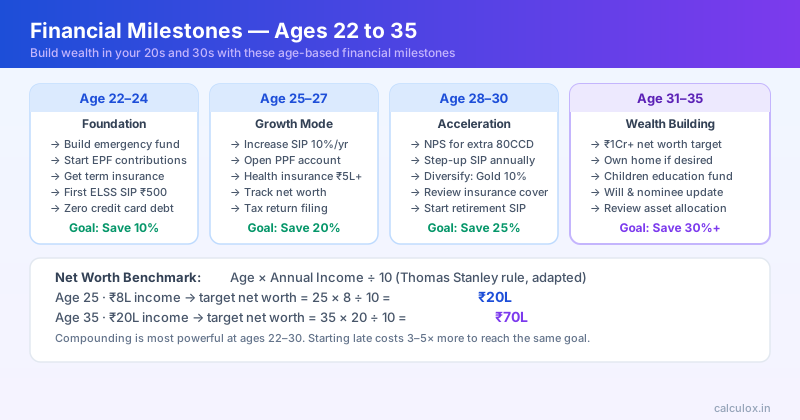
Try it yourself →
Use our free SIP Calculator for instant results
Why Your 20s & 30s Are Critical Years
Time advantage: 25 years to retirement (age 60). Compounding magic: ₹500/month SIP at 12% for 25 years = ₹1.2Cr wealth! Same SIP starting at 35 = only ₹45L final value (3x less!). Income advantage: Salaries typically increase 15-20% annually in first 10 years (use this to increase SIP).
Responsibility: Young professionals must balance lifestyle with wealth-building (critical decade determines entire financial future). The math is brutal: 10 years of delay costs you ₹50-80L in final retirement corpus. These years are literally worth millions in compounding power.
Financial Pyramid for Young Professionals
Level 1 (Foundation, ₹1-3L): Emergency fund (3-4 months expenses) + life insurance (10x annual income) + health insurance (₹10-15L cover). Level 2 (Wealth Creation, ₹10K-30K/month): SIP in mutual funds (₹10-20K), Section 80C investments (₹1,250/month). Level 3 (Growth, ₹20K+/month): Real estate down payment building, equity portfolio.
Build from bottom (foundation → emergency fund complete before investing).
The 50-30-20 Budget Rule
Salary ₹70,000/month breakdown: 50% (₹35K) → Essential expenses (rent ₹20K, groceries ₹10K, utilities ₹5K). 30% (₹21K) → Discretionary (dining ₹10K, entertainment ₹8K, shopping ₹3K). 20% (₹14K) → Savings/Investing (₹8K SIP, ₹3K emergency fund, ₹3K goals). This simple rule prevents overspending and forces 20% savings rate (₹1.68L/year). Most young professionals fail by reversing: Saving 10%, spending 90%.
Investment Strategy: Age 22-35
Years 22-28 (High risk tolerance): 80% equity (SIP ₹8-10K/month), 20% debt (FD/bonds). Build ₹30-40L corpus. Years 28-35 (Transition): 60% equity, 40% debt. Build ₹1-1.5Cr corpus. Monthly action: ₹1,000 emergency fund + ₹5,000 SIP (equity) + ₹1,000 PPF (tax-saving) = ₹7,000/month = ₹84,000/year. Over 15 years = ₹12.6L invested → ₹45-50L final value at 12% return!
Critical Habits to Build Now
- Track spending (use Wallet/Money Manager apps).
- Automate investments (SIP debit on salary day).
- Avoid high-interest debt (personal loan, credit card).
- Maintain credit score (750+).
- File ITR annually (build credit record).
- Negotiate salary increase (important for wealth building).
- Learn continuously (financial literacy compounds like money).
Salary Negotiation Strategy: Your Biggest Wealth Tool
Young professionals dramatically underestimate salary negotiation power. Starting salary at 25 compounds until 60 = 35 years. Difference between ₹50L and ₹60L starting salary: ₹10L annual difference × 35 years = ₹3.5Cr lifetime earnings difference! After taxes = ₹2.5Cr net.
Even 10% difference = ₹2.5Cr career earnings differential. Negotiation tactics: (1) Research market rate before interview (Levels.fyi, LinkedIn salary insights), (2) Negotiate starting offer aggressively (hardest negotiation in career), (3) Change jobs every 3-4 years (30-40% salary jump possible), (4) Annual appraisal expectations (5-10% raise is standard). Real example: Start ₹8L, negotiate to ₹10L (25% increase), compound at 8% annual raises, by age 60 lifetime earnings ₹2Cr higher.
That's more powerful than any investment strategy - secure your income first!
Five-Year and Ten-Year Wealth Milestones
By age 30 (5 years investing): Target ₹20-30L saved (emergency ₹5L + investments ₹15-25L). Monthly ₹5K SIP = ₹5L invested, grows to ₹8L at 12% returns. Milestone: Prove consistent investing habit.
By age 35 (10 years in): Target ₹60-80L corpus (emergency ₹6L + investments ₹54-74L). ₹10K/month SIP = ₹60L invested, grows to ₹1.1Cr! You are on track for ₹5Cr retirement. By age 40: ₹1.5-2Cr (quadrupled from age 30). Each decade multiplies wealth 2-3x with consistency.
Meeting these milestones = proof of financial discipline.
Frequently Asked Questions
How much should a 25-year-old invest monthly?▸
Rule of thumb: 20% of salary. ₹50K salary = ₹10K/month investment (₹5K SIP equity, ₹2.5K emergency fund, ₹2.5K tax-saving). This builds ₹1Cr by age 50 through compounding.
Should I pay EMI or invest in SIP?▸
Avoid debt during investment years! For ₹10L car loan at 10% vs ₹10K/month SIP at 12%: Loan costs ₹4L interest total. SIP gives ₹4L gains. Net difference: ₹8L! Choose: Use car 7+ years? Buy (depreciation <50%). Use 3 years? Rent (avoid EMI entirely, invest instead).
Is health insurance important at age 25?▸
YES! Health insurance is 100x cheaper at 25 (₹1,500/year for ₹10L cover) vs age 40 (₹5,000+/year). Without insurance at young age, medical emergency = high-interest borrowing. Prioritize health insurance immediately.
How much life insurance do young professionals need?▸
Term insurance: 10× annual salary. ₹10L salary = ₹1Cr term insurance. Cost: ₹300-500/year for 30-year term (extremely affordable). Provides: If accident/illness, family gets ₹1Cr (income replacement). Avoid expensive endowment insurance (14× premium for same cover, poor returns).
Can I build ₹1 crore by age 45?▸
Absolutely! Starting age 25, ₹10K/month SIP at 12% return = ₹1.15Cr by age 45. Key: Start immediately, don't delay, stay disciplined. One-year delay = ₹18L less wealth (compounding is powerful).
What are the most common financial mistakes young professionals make?▸
Mistake 1: Lifestyle inflation (salary increases, but spending increases equally - save 0% extra). Solution: When salary increases 10%, increase SIP only 5%, keep other expenses same. Mistake 2: No emergency fund (use credit card as backup = 24% interest debt trap). Solution: Build 6-month emergency fund before investing. Mistake 3: High-interest debt (credit cards 24%, personal loans 15% - kills wealth). Solution: Pay off high-interest debt completely before investing. Mistake 4: No insurance (term life at 25 = ₹300/year, at 40 = ₹2000/year - 6x expensive). Solution: Buy ₹1Cr term insurance at 25. Mistake 5: Chasing returns (buy hot funds, lose money). Solution: SIP in index funds, don't trade frequently. Avoiding these mistakes = automatic 2-3x better wealth outcome by 45.
How do I calculate my net worth and track progress?▸
Net Worth = Total Assets - Total Liabilities. Assets: Savings, Investments (SIP value), Home (property value), Vehicles, Gold. Liabilities: Home loan outstanding, car loan, personal loan, credit card debt. Example: Assets (₹50L savings + ₹25L SIP + ₹30L home) = ₹105L. Liabilities (₹40L home loan remaining) = Net worth ₹65L. Track quarterly: Calculate same time each quarter (Jan, Apr, Jul, Oct). Plot on spreadsheet: You'll see compound growth. From age 25-35: Net worth typically grows ₹2-5L/year if investing ₹10K/month. From 35-45: Accelerates to ₹10-20L/year due to compounding. Celebrate milestones: ₹25L, ₹50L, ₹1Cr. This tracking motivates discipline and proves your wealth-building strategy works.
What should I do if my company doesn't offer ESOP or stock options?▸
Not critical. ESOP = free equity upside, but most companies don't offer. Compensate by: Investing 10% of salary in mutual funds (captures same equity growth), building own portfolio (you control 100%), diversification reduces single-company risk. If ESOP offered: Accept (free money), but don't overweight company stock (diversify).
How do I balance paying off student loan vs investing?▸
Student loan interest 5-6% < investment returns 12-15%. Strategy: Pay minimum student loan monthly, invest remaining surplus (12-15% returns beat 5-6% cost). Continue until loan repaid naturally through regular payments. Education loan is good debt (enables earning), unlike high-interest personal loan.
Is starting to invest at 30 too late?▸
Not too late! At 30, you have 30 years to retirement. ₹10K/month at 12% for 30 years = ₹2.2Cr (more than ₹1Cr!). Advantage: Likely higher income at 30 (earn more, invest more). Disadvantage: Less compound time. Strategy: Start at 30 with ₹15-20K/month (higher salary supports more), catch up faster. Better to invest at 30 than never.
What should I do if I don't have discipline for monthly SIP?▸
Lack of discipline is common - solve it with automation! (1) Auto-debit SIP: Bank automatically deducts on salary date (no willpower needed). (2) Salary split: Employer directly transfers SIP amount before salary hits checking account (out of sight, out of mind). (3) App reminders: Set monthly notifications to boost compliance. (4) Partner/spouse accountability: Tell someone about your goal - social commitment increases follow-through. (5) Auto-increase: Set SIP to increase 5-10% annually on salary hikes. Most successful SIP investors use automation - they don't rely on discipline, they engineer systems.
How do I recover from past financial mistakes (overspending, bad investments)?▸
Everyone makes mistakes - key is to recover quickly. Steps: (1) Acknowledge mistake without shame (sunk cost cannot be recovered, focus on future). (2) Analyze root cause (impulsiveness, lack of knowledge, peer pressure?) and address it. (3) Create new plan immediately (restart SIP, rebuild emergency fund). (4) Tell someone (accountability increases success). (5) Learn from error (read, take courses, talk to advisors). Example: Invested ₹5L in penny stock, lost ₹3L. Rather than give up, restart with ₹5K/month SIP in index funds. By age 50, will have ₹2.5Cr. The ₹2L loss is painful but sunk - focus on future instead of past.
Related Articles
Try Our Free SIP Calculator
Get instant, accurate results without any registration required.
Open SIP Calculator →