Emergency Fund: How Much Should You Save? - Complete Guide
Calculate your emergency fund requirement. Learn why emergency fund matters, how many months of expenses to save, and best places to keep it.
Software Developer · Creator of calculox.in · Formulas verified per RBI, Finance Act 2025-26 & SEBI
Learn about my expertise →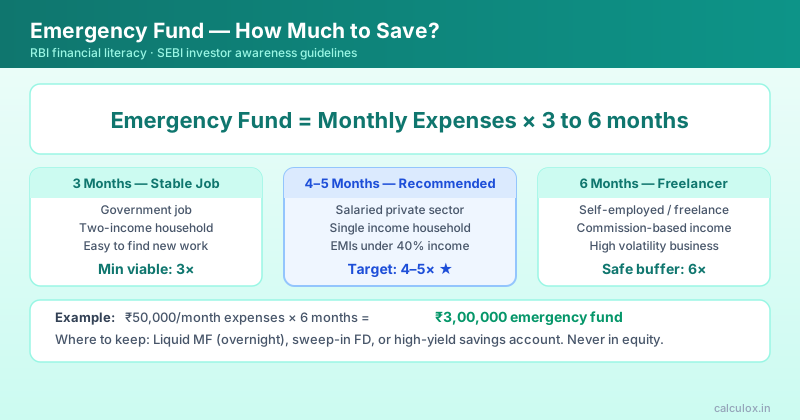
Try it yourself →
Use our free FD Calculator for instant results
Why Emergency Fund is Your Financial Foundation
Emergency fund is liquid money (3-6 months expenses) kept separate for unexpected situations: Job loss (₹2-5L depending on tenure), medical emergency (₹50K-2L), home/car repair (₹30K-200K), family emergency (variable). Without emergency fund, you resort to high-interest debt (credit card 24%, personal loan 15%). Emergency fund prevents: Forced investments liquidation (pays taxes + penalties), high-interest borrowing, financial stress, bankruptcy risk.
Financial advisors universally recommend emergency fund BEFORE retirement, investments, or home purchases. It's insurance against life's uncertainties - you hope never to use it, but catastrophic when you need it without one.
Calculate Your Emergency Fund Requirement
Formula: Emergency Fund = Monthly Expenses × Number of Months.
- Calculate monthly expenses (avg of last 3-6 months). Include: Rent/EMI, utilities, groceries, transport, insurance, subscriptions. Example: ₹60,000/month.
- Determine months needed (3-6 months typical, 6-12 for unstable income). Result: ₹60,000 × 6 = ₹3.6 lakh minimum emergency fund.
How Many Months of Expenses?
Salaried employees (stable income): 3-4 months minimum. Self-employed/business owners (variable income): 6-12 months. Dual-income families: 3-4 months (two incomes = lower risk). Single-income large family: 6-9 months (higher dependency). Post-retirement: 12+ months (no active income). Conservative approach: Build 6-month emergency fund for all, then invest remainder.
Where to Keep Emergency Fund?
Requirement: Accessible, safe, liquid (no penalties). Best options: Savings account (6.5-7% interest, instant access, ₹1-5L balance). Money market FD ladder (3-month FD rolled over, 6.5% return, still accessible in emergency).
Liquid mutual funds (6-7% return, 1-2 day redemption). Avoid: Stocks (too volatile), illiquid FD (penalties), crypto (too risky). Optimal: 60% savings account + 40% liquid FD/mutual funds for 7-7.25% blended return.
Emergency Fund vs Investments Hierarchy
Priority sequence: Step 1 (Month 1-2): Build ₹1L emergency fund (survival basics for 1.5 months). Step 2 (Month 3-6): Build ₹3L emergency fund (cover 5 months baseline). Step 3 (Month 7+): Only now start SIP/investments.
Once emergency fund built, you can invest 70% of surplus monthly into stocks/mutual funds (equity not suitable for emergency needs). Wrong priority: Investing in SIP while having zero emergency fund = forced liquidation during crisis.
Emergency Fund Growth & Maintenance
Initial building: Target ₹3L-6L in 6-12 months via monthly savings. Annual increase: Raise ₹50K when salary increases (keep pace with expense inflation). Replenishment: If emergency forces liquidation (e.g., ₹1L for medical), prioritize rebuilding over resuming investments until back to ₹3L.
Once established, emergency fund itself grows at 6-7% annual interest (no additional contribution needed), compounds over 30+ years.
Emergency Fund Structure: FD Ladder Strategy
Best approach: Split emergency fund into tiers for optimal returns + liquidity. Tier 1 (Immediate access - 20%): Keep in savings account (₹50-60K). Earns 6.5-7%, instantly accessible.
Tier 2 (Quick access - 50%): 3-month FD ladder. Invest ₹50K in FD every month on 1st (1-month, 2-month, 3-month, then rolling). Always have ₹50-100K maturing within 30 days.
Earns 6.5%, accessible in 1-30 days. Tier 3 (Medium-term - 30%): 6-month FD. Lower need for super-quick access.
Earns 6.5%, accessible in 6 months max. Example: ₹6L emergency fund = ₹1.2L savings (instant) + ₹3L in 3-month ladder (quick) + ₹1.8L in 6-month FD. Blended return: 6.7% (better than pure savings 6.5%).
Strategic advantage: Pays higher interest while keeping bulk liquid.
Frequently Asked Questions
Is 3 months or 6 months emergency fund better?▸
Salaried employees: 3-4 months sufficient (stable income, regular hiring, rehiring timeline 2-3 months). Self-employed/business owners: 6-12 months necessary (variable income month-to-month, clients may leave, business seasons volatile). Dual-income families: 3-4 months (two incomes provide buffer). Post-retirement: 12+ months (no active income, draws from corpus). Strategy: Start with 3 months target. Achieve 3L emergency fund in first 6 months. Then increase to 6 months (₹6L) over next 6-12 months. Once 6 months achieved, maintain only (grows via interest).
Can high-interest savings account replace emergency fund?▸
Yes, partially. Modern banks offer 6.5-7% interest on savings >₹1L balance (ICICI, HDFC, Axis, Kotak). Recommended split: ₹1-2L in high-interest savings account (super liquid, 4-5 hours to access), remaining ₹1.5-4L in FD ladder (3-6 month fixed deposits) earning 6.5% (accessible in emergency with 1-2 day delay). Blended return: 6.5-7.5% annually while staying liquid. Avoid: stocks (too volatile), crypto (risky), bonds (long maturity).
What if I need emergency fund before retirement?▸
This is normal and expected! Common scenarios: Job loss (1-3 month job search), medical emergency (₹50K-2L), home repair (₹50K-5L), family emergency (variable). Use emergency fund guilt-free - that is its exact purpose. Post-emergency action: Rebuild emergency fund to original level BEFORE resuming other investments. Timeline: If used ₹2L from ₹6L, rebuild in 4-6 months via monthly savings. Lesson: Emergency fund is insurance, not investment. You don't regret car insurance when it saves you in accident.
Should I count salary for next month as part of emergency fund?▸
Absolutely NO. Emergency fund must be separate, untouched corpus because emergencies occur when income stops (job loss). If you include next month's salary in emergency calculation: Job loss = no salary = no emergency fund! This is psychological mistake costing many people. True emergency fund = accessible without any reliance on future income, salary deposit, bonus, or contingent events. Ensure emergency fund is physically separate (different bank account, different bank even) from regular salary account.
Is ₹3 lakh enough for family of 4?▸
Depends heavily on lifestyle and location. Urban metro family ₹80-100K/month = need ₹4.8-6L for 6 months minimum (₹3L covers only 3 months, risky). Tier-2 city family ₹50K/month = ₹3L covers 6 months (adequate). Conservative approach: Calculate your actual expenses, multiply by 6 = target. Example: ₹75K/month = target ₹4.5L (not ₹3L). Better safe than sorry - being conservative on emergency fund is excellent financial discipline, not paranoia.
Can I use credit card as emergency backup instead of building fund?▸
Risky. Credit card (24% interest) should NEVER be your primary emergency plan. What if credit card is maxed in previous purchase? What if emergency happens when card is suspended? What if emergency needs exceed card limit? Interest cost trap: ₹2L credit card emergency at 24% = ₹1,600/month interest = takes 2 years to repay at ₹10K/month = costs ₹38,400 total (₹3L by end). Better: Emergency fund (0% cost) + credit card as backup (secondary) = best safety net. Build fund NOW, don't procrastinate.
How do I automate emergency fund building?▸
Automation = best tool for forcing savings. Method 1 (Salary split): Employer splits salary automatically. ₹60K/month salary = ₹10K auto-transfer to savings account on payday, keep ₹50K for spending. Method 2 (Bank auto-transfer): Set up scheduled transfer 1st of every month. ₹10K auto → savings, ₹10K auto → FD ladder (on 1st of months 1, 4, 7, 10 for rolling FD). Method 3 (Micro-savings apps): Cred, Cashfree do round-up savings (round up each purchase to nearest ₹100, save ₹20-30/day). Timeline: ₹10K/month = ₹3L in 6 months, ₹6L in 12 months. Automate and forget!
What if I lose my job - how long will my emergency fund last?▸
This is exactly what emergency fund protects. With ₹6L fund and ₹1L/month expenses: Covers 6 months of job loss. Strategy: Month 1-3 actively job search (most people find jobs within 3 months). Month 4-6 you have buffer while still searching or considering lower salary roles. If married (dual income): One person job loss = emergency fund covers 6-12 months easily. If single earner: ₹6L covers 6 months - sufficient for most job searches. Pro tip: Don't touch emergency fund until 2-3 months unemployment (use credit card, salary deferral, side gigs first). Only depletes when truly necessary. This is why it's truly "emergency" not "rainy day".
Can I invest emergency fund in stocks/mutual funds instead of FD/savings?▸
NO - avoid this mistake! Emergency funds MUST be in liquid, stable investments (savings account, FD, money market fund). Why? In emergency, you need instant access. Mutual fund redemption takes 2-3 days + market may be down 30% (crisis), locking losses. Example: ₹6L invested in equity fund, market crashes 40% during job loss = your emergency fund is now ₹3.6L only (when you need it most!). Better strategy: Emergency fund 100% in liquid (0% loss risk, instant access). Wealth-building fund (SIP) in mutual funds. Keep separate. This separation of concerns is crucial: Emergency = Safety net (liquid, stable). Wealth = Growth (volatile, locked). Start building your emergency fund today using our calculator to determine exact target.
Related Articles
Try Our Free FD Calculator
Get instant, accurate results without any registration required.
Open FD Calculator →