Business Loan vs Personal Loan: Complete Comparison Guide
Compare business loans vs personal loans for entrepreneurs. Analyze interest rates, eligibility, documentation, best use cases, and choose right loan type.
Software Developer · Creator of calculox.in · Formulas verified per RBI, Finance Act 2025-26 & SEBI
Learn about my expertise →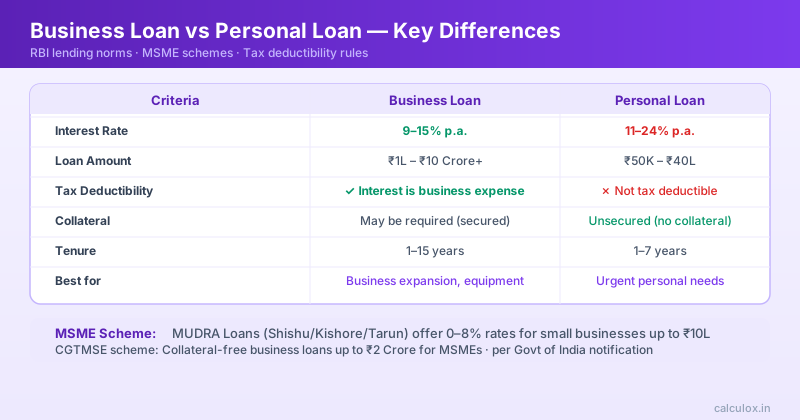
Try it yourself →
Use our free EMI Calculator for instant results
Understanding Business vs Personal Loans
Personal Loan: Unsecured, fast approval, flexible use (can use for business too), higher interest, smaller amount. Business Loan: Secured (collateral required), slow approval, purpose-specific, lower interest, larger amount. Choice depends on: Loan amount needed, purpose clarity, collateral availability, timeline, business registration status.
Personal Loan Overview
Interest rate: 10-18% p.a. (depends on credit score). Loan amount: ₹1-50 lakh typically. Tenure: 12-84 months.
Eligibility: Age 21-65, ₹3L+ annual income, good credit score 700+, 2 years salary history. Approval: 3-7 days (instant for existing bank customers). Documentation: Minimal (salary slips, bank statements, KYC).
Use case: Quick funding (renovation, wedding, emergency, vehicle). Advantages: No collateral needed, fast, flexible use. Disadvantages: High interest, smaller amount, personal credit impact.
Business Loan Overview
Interest rate: 9-16% p.a. (lower than personal for registered businesses). Loan amount: ₹5-1Cr+ (tailored to business needs). Tenure: 24-84 months typically.
Eligibility: Registered business (1-2 years old), annual revenue ₹5L+, business credit score, personal guarantee. Approval: 15-30 days (involves business verification). Documentation: Business registration, audited financials, ITR, business plan, collateral valuation.
Use case: Expansion, equipment, inventory, working capital, franchise setup. Advantages: Lower interest, larger amounts, business-specific terms. Disadvantages: Collateral required, slow approval, complex documentation.
Interest Rate & EMI Comparison
Loan ₹10L scenario: Personal loan at 15% for 5 years = EMI ₹23.8K, total interest ₹4.3L. Business loan at 12% for 5 years = EMI ₹22.2K, total interest ₹3.3L. Difference: ₹1.6K/month = ₹96K interest saving over 5 years.
For ₹50L: Personal loan 18% = ₹1.1Cr interest. Business loan 10% = ₹55L interest. Difference: ₹55L saving! Amount matters: ₹5-20L prefer personal (simpler), ₹20L+ prefer business (interest savings are significant).
Documentation & Collateral Requirements
Personal Loan: Minimal documents (salary slips 2-3 months, last 6 months bank statements, KYC). No collateral. Approval based on income + credit score.
Business Loan: Extensive documents (business registration, income tax returns 2-3 years, audited financials, business address proof, owner KYC). Collateral required (property deed, equipment, or personal guarantee). Valuation process adds 2-3 weeks to approval.
Trade-off: Extra documentation gets 2-3% lower interest rate.
Which Loan to Choose?
Choose Personal Loan if: Amount needed < ₹20L, quick approval critical (need within 1 week), no collateral available, business not registered/new. Choose Business Loan if: Amount > ₹20L, interest rate savings matter (long-term loan), business established (2+ years), collateral available. Hybrid approach: Take personal loan for immediate needs (₹10L), upgrade to business loan when registered for expansion (₹30L).
Frequently Asked Questions
Can I use personal loan for business?▸
Yes, technically allowed by most banks. But: Personal loan to business is risky (if business fails, debt becomes personal liability). Better: Register business, get business loan for credibility + lower interest + larger amount. Personal loan acceptable for very short-term business needs (3-6 months).
What credit score do I need for business loan?▸
CIBIL score 700+ for personal loan. Business loan requires 75+ credit score (out of 100, CIBIL business scoring). If below 75: Collateral valued higher (more security required), or higher interest rate charged.
Which business loan is best for MSME?▸
Best MSME loans: MUDRA (up to ₹10L, 8-10% interest, minimal documentation), government CGST-backed schemes (6-8% interest), bank commercial loans (10-14% interest). MUDRA best for <₹10L, bank loans for larger amounts.
How long does business loan approval take?▸
Typically 15-30 days: Days 1-5 (document verification), Days 5-15 (business verification + collateral valuation), Days 15-25 (credit appraisal), Days 25-30 (approval + disbursal). For registered business with 3-year financials, can be 10-15 days.
Can I repay business loan early?▸
Yes, most banks allow prepayment without penalty (some older loans have 2-3% penalty). Early repayment saves significant interest. Example: 5-year ₹10L loan at 12%, prepay after 2 years saves 3 years interest (~₹1.5L). Check loan terms for prepayment clause before signing.
What is the difference between secured and unsecured loans?▸
Secured loan (business loan): Backed by collateral (property, equipment). Bank can seize if default. Lower interest (7-10%), larger amount, lower risk for bank. Unsecured loan (personal loan): No collateral. Bank relies on credit score + income. Higher interest (12-18%), smaller amount, higher risk for bank. Risk flows differently: Secured = bank risk reduces, Unsecured = borrower risk increases (damaged credit, wage garnishment).
Can startups get business loans?▸
Startups (<1 year old) struggle with traditional business loans. Options: (1) MUDRA startup loans (up to ₹10L, 8-10%), (2) Startup India scheme loans (government backed), (3) Personal loan (easier approval), (4) Angel/VC funding (no loan, equity). Better strategy: Operate 1-2 years as sole proprietor, show revenue history, then apply for business loan with lower interest.
How does business loan affect my personal credit score?▸
If business is sole proprietorship/partnership: Personal guarantee required = default impacts personal credit score. If business is limited company: Less impact on personal score (company score separate). Default consequences: (1) CIBIL score drops 100+ points (stays 5-7 years), (2) Future loans denied/expensive, (3) Loan recovery action (wage garnishment, property seizure). Impact severity: Default damages you far more than slightly higher interest rate.
What are the government-backed loan schemes for business (MUDRA, CGTLSE)?▸
MUDRA (Micro Units Development and Refinance Agency): Loans up to ₹10L with 8-10% interest, minimal documentation, high approval rate (90%+). Best for: Startups, sole proprietors, small businesses <5 years old. CGTLSE (Credit Guarantee Trust for Micro & Small Enterprises): Government backs 80% of loan default risk, so banks lend easier at lower rates (7-9%). Eligibility: Business turnover <₹5Cr. PMMY (Pradhan Mantri Mudra Yojana): Under MUDRA, includes 3 categories (Shishu <₹50L, Kishore ₹50L-₹5Cr, Tarun >₹5Cr). Advantage: Government-backed, no collateral required, faster approval (5-7 days). Disadvantage: Lower amounts than traditional bank loans, interest rates still 8-10% (not zero). Strategy: Start with MUDRA for initial ₹10L, graduate to bank loans for larger amounts as business proves track record.
Can I convert business loan to personal loan or vice versa mid-tenure?▸
Technically possible but complex: (1) Personal loan cannot become business loan (lenders don't allow), (2) Business loan to personal loan requires loan transfer or new loan with personal guarantee. Process: Apply for new personal loan with guarantor + CIBIL score 700+, use proceeds to repay business loan. Cost: ₹5-10K processing fee + interest differential (may be higher). Timing: Only convert if interest rate drops significantly (1.5%+ difference = worthwhile). Most people stay in original loan category - switching is paperwork-heavy. Recommendation: Choose correct loan type at start (business vs personal) rather than converting mid-tenure.
What documents do I need to apply for a business loan?▸
Typically required: (1) Business registration proof (GST, Aadhar, PAN), (2) 2 years ITR (Income Tax Returns), (3) Bank statements (6-12 months), (4) Business plan or project report, (5) Collateral documents (property papers if using), (6) Personal guarantor documents (if required), (7) Proof of business premises (electricity bill, lease). Processing time: 5-10 days for MUDRA, 15-30 days for bank loans. Faster approval with better documentation. Some lenders require business to be 2+ years old (limits startups). Work with chartered accountant to prepare clean financial statements.
What happens if my business loan application is rejected?▸
Common rejection reasons: (1) Low CIBIL score (<600), (2) Inconsistent ITR (income fluctuates wildly), (3) No collateral/guarantee, (4) Business too new (<6 months), (5) Industry considered high-risk, (6) Inadequate cash flow to service loan. Remedies: Improve CIBIL score (pay dues, wait 6 months), strengthen ITR (show stable income), get guarantor, use collateral, wait 6+ months if startup, apply to different lender (SIDBI sometimes approves what banks reject). Appeals: Many banks allow reapplication after 3-6 months with improved profile.
Can I take multiple business loans from different lenders?▸
Yes, legally possible but lenders check combined outstanding debt. Example: ₹10L loan from Bank A, apply ₹10L from Bank B - Bank B will see ₹10L existing liability. They approve based on combined debt-to-income ratio. Typically: Max debt = 60-70% of annual income (conservative). Taking ₹10L + ₹10L = ₹20L debt might exceed safe limits, leading to rejection. Strategy: If needing ₹20L total, better to take single ₹20L loan (easier approval, lower rates). Multiple loans make repayment complex, more default risk.
How do I manage cash flow with a business loan EMI?▸
Business loan EMI should not exceed 30-40% of monthly profit. Example: Monthly profit ₹5L, max EMI = ₹1.5-2L. This keeps ₹3-3.5L for operations, inventory, growth. Strategy: (1) Calculate monthly profit conservatively (assume worst case). (2) Limit EMI to 30% max. (3) Track cash flow monthly - if profit drops below break-even EMI, refinance or extend tenure. (4) Build 3-month EMI reserve during good months. This discipline prevents business failure due to loan burden.
Related Articles
Try Our Free EMI Calculator
Get instant, accurate results without any registration required.
Open EMI Calculator →