BMI for Indians: What is Healthy BMI Range & How to Improve It
Understand BMI norms for Indians. Learn what is a healthy BMI range for Indian adults, why Asian BMI cutoffs differ, and practical tips to achieve healthy weight.
Software Developer · Creator of calculox.in · Formulas verified per RBI, Finance Act 2025-26 & SEBI
Learn about my expertise →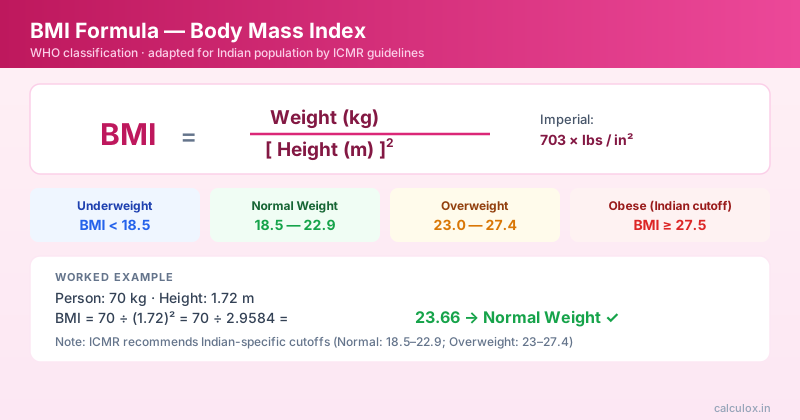
Try it yourself →
Use our free BMI Calculator for instant results
Quick Answer
BMI = Weight (kg) ÷ Height² (m²). For Indians, the ICMR recommends a healthy range of 18.5–22.9 — stricter than the WHO global standard of 18.5–24.9. South Asians carry higher visceral fat and develop type 2 diabetes and cardiovascular disease at lower BMI values than Western populations, which is why an Indian with BMI 23.5 may need intervention even though a global chart labels them "normal".
ICMR: Normal
18.5 – 22.9
Optimal healthy range for Indians
ICMR: Overweight
23.0 – 27.4
Elevated metabolic risk for South Asians
ICMR: Obese
27.5+
High risk — medical review recommended
WHO Normal (global)
18.5 – 24.9
Not calibrated for South Asian populations
What is BMI? (Core Concept)
Body Mass Index (BMI) is a simple numerical index calculated from your height and weight, providing a quick screening tool for weight-related health risks. The formula is: BMI = Weight (kg) / (Height in meters)². For example, if you weigh 70 kg and are 1.75 m tall, your BMI = 70 / (1.75 × 1.75) = 70 / 3.0625 = 22.86.
While BMI is not a perfect measure of overall health because it cannot distinguish between muscle and fat, it is widely used by doctors and health organizations globally as a screening tool to identify potential weight-related health conditions like diabetes, heart disease, and hypertension. BMI is particularly useful at a population level because it provides a consistent, easy-to-calculate metric for comparing weight status across individuals and groups. However, it has limitations - athletes with high muscle mass may appear overweight by BMI standards, even though they are healthy.
Additionally, BMI does not account for factors like age, gender, ethnicity, or body composition (fat vs muscle ratio). Despite these limitations, BMI remains the primary screening tool recommended by the WHO and health ministries worldwide, including India, because of its simplicity and reliability at population level.
Why BMI Matters: Health Implications & Indian Context
BMI matters because it directly correlates with serious health risks. The World Health Organization has established that certain BMI ranges indicate increased risk of chronic diseases: Underweight (BMI <18.5) indicates insufficient body weight and risk of malnutrition. Normal weight (BMI 18.5-24.9) is considered healthy with lowest health risks.
Overweight (BMI 25.0-29.9) increases risk of chronic diseases. Obese (BMI 30+) indicates significant health risks including diabetes, heart disease, hypertension. However, research has shown that these global cutoffs do not apply equally to all populations.
South Asians, including Indians, have a different metabolic profile compared to the European populations on which these standards were based. Indians have higher body fat percentages at lower BMI values compared to Western populations. This means an Indian with BMI 24 may have the same health risk as a Caucasian with BMI 26-27.
Indians develop higher risks for: Type 2 diabetes at lower BMI values compared to Caucasians. Cardiovascular disease and metabolic syndrome at lower BMI. Abdominal/visceral fat (more dangerous) at lower BMI values.
This is why the Indian Council of Medical Research (ICMR) developed modified BMI cutoffs specifically for Indian populations: Underweight (BMI <18.5), Normal/Healthy (BMI 18.5-22.9 - narrower than WHO), Overweight (BMI 23.0-27.4 - lower threshold than WHO), Obese (BMI 27.5+). Your Indian doctor may recommend weight loss at BMI 23-24 because research shows increased diabetes risk at this level in South Asian populations.
Step-by-Step Guide: How to Calculate Your BMI
Calculating your BMI is simple and requires only two measurements:
- Measure your weight accurately (in kilograms).
- Measure your height accurately (in meters).
- Apply the formula: BMI = Weight (kg) / (Height in meters)². Example calculation: Person weighs 70 kg, height 1.75 m. BMI = 70 / (1.75 × 1.75) = 70 / 3.0625 = 22.86. Interpreting your BMI by ICMR standards for Indians: Below 18.5 = Underweight (nutritional deficiency). 18.5-22.9 = Normal/Healthy (optimal range for Indians). 23.0-27.4 = Overweight (increased health risk). 27.5+ = Obese (significant health risk). Note: ICMR cutoffs are stricter than WHO standards (WHO considers 18.5-24.9 as normal). Our free BMI calculator does this automatically - enter your height and weight to see: Your current BMI category (WHO vs ICMR standards). Your ideal weight range based on ICMR guidelines. How many kilograms to lose or gain to reach healthy range.
Real-World BMI Examples: Different Scenarios
Example 1 - Indian woman, 5'4" (163 cm), 65 kg: BMI = 65 / (1.63 × 1.63) = 65 / 2.66 = 24.4. By WHO standards: "normal" (18.5-24.9). By ICMR standards: "slightly overweight" (above 22.9).
Recommendation: She is on the borderline and should monitor her waist circumference and fitness level. Example 2 - Indian man, 5'8" (173 cm), 80 kg: BMI = 80 / (1.73 × 1.73) = 80 / 2.99 = 26.8. By WHO standards: "overweight" (25-29.9).
By ICMR standards: "overweight" (23.0-27.4). Recommendation: He should aim to lose 5-6 kg to reach BMI 24 (optimal for Indians). Example 3 - Young professional, 170 cm, 72 kg: BMI = 72 / (1.70 × 1.70) = 72 / 2.89 = 24.9.
By WHO: "normal." By ICMR: "borderline overweight." Daily caloric intake to maintain: 25 × 72 = 1800 calories. To lose 0.5 kg/week: 1800 - 500 = 1300 calories/day. Example 4 - Indian senior (60+ years), 165 cm, 70 kg: BMI = 70 / (1.65 × 1.65) = 70 / 2.72 = 25.7.
By WHO: "overweight." By ICMR: "overweight." However, at 60+, BMI 25-26 is acceptable due to natural muscle loss with age. A younger person at this BMI would need to lose weight, but a senior's goal should be preventing further weight gain and maintaining mobility. Calculate your ideal weight range: For healthy BMI range (ICMR: 18.5-22.9 for Indians): Low end = 18.5 × (height in meters)².
High end = 22.9 × (height in meters)². Example: For someone 170 cm tall (1.70 m): Low = 18.5 × 2.89 = 53.5 kg. High = 22.9 × 2.89 = 66.2 kg.
Ideal range = 53.5-66.2 kg. If current weight is 75 kg, need to lose 9-22 kg to reach ideal range.
Misconceptions: What BMI is NOT & Limitations
While BMI is useful as a screening tool, it has several important limitations that healthcare professionals consider: BMI does not measure body fat percentage: BMI cannot tell you how much of your weight is muscle vs fat. A 100 kg person could be an athlete with high muscle mass (healthy) or have high fat percentage (less healthy), but BMI would show the same value. Body composition matters more than BMI for actual health.
BMI cannot distinguish muscle from fat: Athletes, weightlifters, and muscular individuals may have high BMI (25+) but low body fat percentage and excellent health. For these people, BMI alone is misleading. BMI does not account for age: BMI standards do not account for age-related muscle loss.
As we age, we naturally lose muscle mass, so the same BMI at age 25 vs age 65 means different things. BMI does not account for gender differences: Men and women have naturally different body compositions. Women typically have higher body fat percentages, so applying identical BMI cutoffs may not be fair.
BMI ignores fat distribution (location matters): Where fat is located matters significantly. Abdominal/belly fat (visceral fat) is more dangerous than fat in other areas. You can be overweight by BMI but have mostly peripheral fat (lower risk), or normal BMI but with excess belly fat (higher risk).
Better complementary measures to use with BMI: Waist circumference (>90 cm for men, >80 cm for women in India indicates health risk). Body fat percentage (normal: 10-20% men, 18-25% women). Waist-to-hip ratio (should be <0.9 for men, <0.85 for women).
Health professionals recommend using BMI as a starting screening tool, but combining it with other measures like waist circumference and overall fitness level for a complete health assessment. The Real Impact: "Skinny Fat" Syndrome: A person with BMI 22 (normal by BMI standards) but 35% body fat with excess belly fat has worse health outcomes than someone with BMI 25 but 18% body fat and good muscle tone. Both have very different health risks despite both being labeled "overweight" or "normal" by BMI alone.
This is why fitness level, waist measurement, and body composition matter alongside BMI.
Standard BMI Categories (WHO Guidelines)
The World Health Organization has established global BMI categories that are used by most health organizations and calculators worldwide: Underweight: BMI below 18.5 - Indicates insufficient body weight, risk of malnutrition and vitamin deficiencies. Normal weight: BMI 18.5-24.9 - Considered healthy weight range with lowest health risks. Overweight: BMI 25.0-29.9 - Increased risk of chronic diseases, though not yet obese.
Obese Class I: BMI 30.0-34.9 - Significant health risks including diabetes, heart disease, hypertension. Obese Class II: BMI 35.0-39.9 - High risk of multiple health conditions and complications. Severely obese/Class III: BMI 40 and above - Very high risk, medical intervention often recommended.
The WHO BMI categories are global standards used by most online calculators and health organizations. However, research has shown that these cutoffs do not apply equally to all populations. South Asians, including Indians, have a different metabolic profile compared to the European populations on which these standards were based.
This led the Indian Council of Medical Research (ICMR) to develop more appropriate BMI cutoffs specifically for Indian populations, reflecting the higher disease risk at lower BMI values in Indians.
Special BMI Guidelines for Indians & Asians (ICMR Standards)
The Indian Council of Medical Research (ICMR), after extensive research, established that South Asians have higher body fat percentages at lower BMI values compared to Western populations. This means an Indian with BMI 24 may have the same health risk as a Caucasian with BMI 26-27. Based on this research, ICMR recommends these modified BMI categories specifically for Indian adults: Underweight: BMI below 18.5 - Same as global standards, indicates nutritional deficiency.
Normal (healthy): BMI 18.5-22.9 - ICMR considers this the healthy range for Indians (narrower than WHO's 18.5-24.9). Overweight: BMI 23.0-27.4 - Lower threshold than WHO because Indians develop metabolic syndrome at lower BMI values. Obese: BMI 27.5 and above - ICMR considers this obesity threshold, vs WHO's 30.0.
Why the difference? Research shows that Indians have a higher percentage of abdominal fat at lower BMI values, increasing their risk for: Type 2 diabetes - Indians develop diabetes at lower BMI compared to Caucasians. Cardiovascular disease - Heart disease risk increases at lower BMI in Indian populations. Metabolic syndrome - Cluster of conditions affecting blood pressure, cholesterol, blood sugar.
These stricter cutoffs mean an Indian woman with BMI 24 (considered “normal” by WHO standards) should actually aim to reduce to BMI 22.9 or below to be in the healthy range by ICMR standards. This is why your Indian doctor may recommend weight loss at BMI 23-24, whereas global standards would say you are still “normal.”
Limitations of BMI & Alternative Measures
While BMI is useful, it has several important limitations that healthcare professionals consider: Does not measure body fat percentage: BMI cannot tell you how much of your weight is muscle vs fat. A 100 kg person could be an athlete with high muscle mass (healthy) or have high fat percentage (less healthy), but BMI would show the same value. Body composition matters more than BMI for actual health.
Cannot distinguish muscle from fat: Athletes, weightlifters, and muscular individuals may have high BMI (25+) but low body fat percentage and excellent health. For these people, BMI alone is misleading. No age consideration: BMI standards do not account for age-related muscle loss.
As we age, we naturally lose muscle mass, so the same BMI at age 25 vs age 65 means different things. Does not account for gender: Men and women have naturally different body compositions. Women typically have higher body fat percentages, so applying identical BMI cutoffs may not be fair.
Ignores fat distribution: Where fat is located matters. Abdominal/belly fat (visceral fat) is more dangerous than fat in other areas. You can be overweight by BMI but have mostly peripheral fat (lower risk), or normal BMI but with excess belly fat (higher risk).
Better complementary measures: Waist circumference (>90 cm for men, >80 cm for women in India indicates health risk). Body fat percentage (normal: 10-20% men, 18-25% women). Waist-to-hip ratio (should be <0.9 for men, <0.85 for women).
For this reason, health professionals recommend using BMI as a starting screening tool, but combining it with other measures like waist circumference and overall fitness level for a complete health assessment.
5 Evidence-Based Ways to Improve Your BMI & Health
- Reduce caloric intake smartly: Aim for a deficit of 500-750 calories per day for safe weight loss of 0.5-1 kg per week. Calculate your daily needs using: Daily calories needed = (25-30 × weight in kg). For example, a 70 kg person needs about 1750-2100 calories/day for maintenance. To lose weight, consume 1200-1600 calories/day. Focus on whole foods (dal, rice, vegetables, fruits) rather than processed foods. Track intake using apps like MyFitnessPal for first 2-3 weeks to understand portion sizes.
- Exercise regularly: Aim for 150-300 minutes of moderate-intensity exercise weekly (brisk walking, cycling, swimming, aerobics). Include strength training 2-3 days/week to preserve muscle mass while losing fat (crucial for body composition). Strength training prevents the “skinny fat” outcome where you lose weight but look flabby.
- Prioritize protein intake: Eat protein-rich foods at every meal - dal, paneer, Greek yogurt, eggs, chicken, fish, tofu. Protein helps preserve muscle during weight loss and keeps you fuller longer. Aim for 1.2-1.6g protein per kg body weight daily. A 70 kg person should consume 84-112g protein daily.
- Reduce refined carbs and sugar: Cut out sugary drinks, white bread, pastries, candy, and ultra-processed foods. Replace with whole grains (brown rice, oats, millets), vegetables, and fruits. Sugar causes blood sugar spikes leading to fat storage and hunger cycles.
- Prioritize sleep and stress management: Poor sleep (less than 7-8 hours) increases cortisol and ghrelin (hunger hormone), making weight loss harder. Stress eating is a major factor - practice meditation, yoga, or breathing exercises. Consistency matters more than perfection - even small improvements in all 5 areas compound over time.
Real-World BMI Examples for Indians
Example 1 - Indian woman, 5'4” (163 cm), 65 kg: BMI = 65 / (1.63 × 1.63) = 65 / 2.66 = 24.4. By WHO standards: “normal” (18.5-24.9). By ICMR standards: “slightly overweight” (above 22.9).
Recommendation: She is on the borderline and should monitor her waist circumference and fitness level. Example 2 - Indian man, 5'8” (173 cm), 80 kg: BMI = 80 / (1.73 × 1.73) = 80 / 2.99 = 26.8. By WHO standards: “overweight” (25-29.9).
By ICMR standards: “obese” (27.5+, actually just under). Recommendation: He should aim to lose 5-6 kg to reach BMI 24 (optimal for Indians). Example 3 - Young professional, 170 cm, 72 kg: BMI = 72 / (1.70 × 1.70) = 72 / 2.89 = 24.9.
By WHO: “normal.” By ICMR: “borderline overweight.” Daily caloric intake to maintain: 25 × 72 = 1800 calories. To lose 0.5 kg/week: 1800 - 500 = 1300 calories/day. Example 4 - Indian senior (60+ years), 165 cm, 70 kg: BMI = 70 / (1.65 × 1.65) = 70 / 2.72 = 25.7.
By WHO: “overweight.” By ICMR: “overweight.” However, at 60+, BMI 25-26 is acceptable due to natural muscle loss with age. A younger person at this BMI would need to lose weight, but a senior's goal should be preventing further weight gain and maintaining mobility.
Calculate Your Ideal Weight Range
Based on your height and BMI category, you can calculate your ideal weight range: For healthy BMI range (ICMR: 18.5-22.9 for Indians): Low end: 18.5 × (height in meters)². High end: 22.9 × (height in meters)². Example: For someone 170 cm tall (1.70 m): Low = 18.5 × 1.70^2 = 18.5 × 2.89 = 53.5 kg.
High = 22.9 × 1.70^2 = 22.9 × 2.89 = 66.2 kg. Ideal range = 53.5-66.2 kg. If current weight is 75 kg, need to lose about 9-22 kg to reach ideal range.
Our free BMI calculator does this automatically - enter your height and weight to see: Your current BMI category. Your ideal weight range based on ICMR standards. How many kilos to lose or gain.
This information helps you set realistic weight loss goals and track progress over months and years.
BMI Case Studies: Health Transformations (Illustrative Examples)
Illustrative Example (hypothetical scenario based on typical Indian borrower profiles). CASE STUDY 1: Neha, Bangalore (Age 32, IT Professional). Scenario: Height 165 cm, Weight 78 kg.
BMI 28.6 (obese by ICMR standards). Waist circumference 92 cm (>80 cm = risk). Fasting blood sugar 115 mg/dL (prediabetic).
Challenge: Sedentary job (8-10 hours desk), snacking on chips/samosas, irregular sleep. Didn't realize health risk until BP checked at 138/88 mmHg (elevated). Solution: Started structured program. 1400 cal/day diet (300-350 cal deficit), brisk walking 45 mins daily, reduced refined carbs, 80g protein daily.
Month 1: Lost 3 kg. Month 6: Lost 12 kg (now 66 kg). BMI dropped to 24.2 (borderline overweight → normal).
Waist 82 cm (healthier). Fasting sugar normalized 95 mg/dL. BP: 128/80 mmHg (normal!).
Result: At Month 12, maintained 66 kg, BMI 24.2. Blood work clean. Energy levels up 40%.
Gym habit established. Lesson: Small consistent habits beat crash diets. 0.5 kg/week loss is sustainable and creates lifestyle changes. Illustrative Example (hypothetical scenario based on typical Indian borrower profiles).
CASE STUDY 2: Arun, Mumbai (Age 45, Business Owner). Scenario: Height 177 cm, Weight 92 kg. BMI 29.3 (obese).
Waist 98 cm (significantly >90 cm = high risk). Cholesterol 245 (high), triglycerides 180 (elevated). Doctor warned heart attack risk.
Challenge: Irregular work schedule, eating out frequently (butter-rich curries, ghee), no exercise, high stress. Solution: Focused on quality nutrition + strength training. Replaced butter with olive oil, increased vegetable intake, started weightlifting 3x/week (builds muscle preserves lean mass), 120g protein daily.
Year 1: Lost 18 kg (92 → 74 kg). BMI dropped to 23.6 (ideal for him). Waist 88 cm (healthy).
Cholesterol 185, triglycerides 95 (normal). BP: 125/78. Result: Body composition improved (12% less body fat despite scale weight loss).
Can run 5 km without fatigue. Medication no longer needed. Lesson: Strength training + adequate protein prevents "skinny fat" outcome.
Losing weight is meaningless if you lose muscle. Illustrative Example (hypothetical scenario based on typical Indian borrower profiles). CASE STUDY 3: Sanjana, Delhi (Age 28, Fashion Designer).
Scenario: Height 158 cm, Weight 52 kg. BMI 20.8 (normal). Waist 76 cm (<80 cm, safe).
BUT 32% body fat (high for her age). Weak, get tired easily. Challenge: Never exercised, ate well but sedentary, desk work 10 hours daily.
Doctor: "BMI normal, but fitness poor. Risk of metabolic disease if sedentary continues." Solution: Focused on fitness, not weight loss. Added strength training 4x/week, 25-30 mins cardio 3x/week, maintained 52 kg but increased protein to 95g daily.
Year 1: Weight stable 52 kg. BUT body fat dropped to 24% (healthy range). Gained 2-3 kg muscle (scale same, body shape dramatically improved).
Strength increased 150%. Waist same 76 cm. Energy levels tripled.
Result: Looks fitter, stronger, healthier despite zero weight loss. Doctor: "Perfect example why BMI alone misleads." Lesson: "Normal BMI + sedentary = still unhealthy." Fitness and muscle matter more than BMI number. Per WHO and ICMR evidence-based weight management guidelines: Research consistently shows that gradual weight loss (0.5-1 kg/week) produces more sustainable outcomes than rapid crash dieting, which often leads to muscle loss and rapid weight regain.
Strength training alongside caloric restriction is recommended to preserve lean muscle mass. ICMR guidelines specifically note that for South Asian populations, abdominal fat reduction and fitness improvement are more meaningful health targets than hitting a specific scale weight. Pro Tips: (1) The Protein Priority - Aim 1.2-1.6g per kg body weight.
Protein preserves muscle during weight loss. Without it, 50% of weight lost = muscle (bad). (2) The Strength Strategy - Add resistance training 3x/week. This builds muscle, increases metabolic rate, improves body composition without scale weight loss. (3) The Waist Watch - Measure waist monthly.
Waist reduction = loss of dangerous abdominal fat, better indicator than scale weight. (4) The Consistency Game - 0.5 kg/week loss for 12 months (25 kg total) = sustainable. Those who lose 1.5+ kg/week often hit mental/physical walls and quit.
Frequently Asked Questions
What is a healthy BMI for Indian women?▸
For Indian women, a healthy BMI range according to ICMR guidelines is 18.5-22.9, which is narrower than WHO standards (18.5-24.9). This reflects research showing that Indian women develop higher health risks (diabetes, heart disease) at lower BMI values compared to Western women. Example: A 160 cm tall Indian woman: Low end healthy weight = 18.5 × 1.60^2 = 47.4 kg. High end healthy weight = 22.9 × 1.60^2 = 58.6 kg. Ideal weight range = 47-59 kg. BMI 23-27.4 is considered overweight for Indian women (vs WHO's 25-29.9), and above 27.5 is obese. Your doctor may recommend weight loss at BMI 23-24 for Indian women because research shows increased diabetes risk at this BMI level in South Asian populations. It is important to combine BMI with waist circumference (should be <80 cm for women in India) and overall fitness for complete health assessment.
Can you have a normal BMI but still be unhealthy?▸
Yes, absolutely! This condition is called “skinny fat” or normal weight obesity - a condition where someone has a normal BMI but high body fat percentage, particularly excess abdominal fat. How it happens: Person A - BMI 22 (normal), but 35% body fat with excess belly fat. Person B - BMI 22 (normal), but 18% body fat with good muscle tone. Both have identical BMI but very different health profiles! Why it is unhealthy: Excess abdominal/visceral fat surrounds organs and increases: Risk of type 2 diabetes. Risk of heart disease and stroke. Risk of fatty liver disease. Metabolic problems despite normal weight. How to identify: Check waist circumference (>80 cm for women, >90 cm for men in India = risk). Calculate body fat percentage using DEXA scan or bioelectrical impedance. Look in mirror - is there visible belly fat? Prevention: Exercise regularly, especially strength training to build muscle. Ensure adequate protein intake to maintain muscle mass. Reduce processed foods and refined carbs. Monitor waist circumference even if BMI is normal. This is why relying on BMI alone is insufficient - combine it with waist circumference and fitness level for true health assessment.
How accurate is BMI for children and teenagers?▸
BMI for children and teens is NOT calculated the same way as adults. Children (aged 2-19) use age and gender-specific percentile charts, not the fixed cutoffs used for adults (underweight, normal, overweight, obese). Why different? Children are growing and have naturally higher body fat percentages at different ages. Body composition changes dramatically during childhood and adolescence. Growth rates vary significantly between boys and girls. How it works: Pediatricians plot a child's BMI on a growth chart specific to the child's age and sex. Underweight: Below 5th percentile. Normal weight: 5th to <85th percentile. Overweight: 85th to <95th percentile. Obese: 95th percentile and above. Example: A 12-year-old boy with BMI 20 might be normal weight (within 5-85th percentile) depending on his specific age and sex. An 8-year-old girl with the same BMI might be overweight. Recommendation: Do not use adult BMI cutoffs for children. Always consult a pediatrician who will assess the child's growth trajectory, pubertal development, and overall health. A child may have high BMI but be perfectly healthy if growing normally. Conversely, a child with normal BMI might have nutritional deficiencies. Parents should focus on healthy eating habits and activity for children rather than the BMI number itself.
Is BMI 21 considered healthy for Indians?▸
Yes, BMI 21 is definitely healthy for Indians! It falls squarely in the “normal weight” range (18.5-22.9) according to ICMR guidelines for Indian adults. BMI 21 is actually an excellent target because: It is in the middle of the healthy range, giving some buffer if weight fluctuates slightly. It is associated with lowest health risks for chronic diseases in Indian populations. It typically correlates with good metabolic health and insulin sensitivity. It is achievable and sustainable for most people. Example: A 170 cm tall person at BMI 21 = 61 kg (ideal). A 160 cm tall person at BMI 21 = 54 kg (ideal). However, BMI alone is not sufficient - also check: Waist circumference (should be <90 cm for men, <80 cm for women). Diet quality - are you eating whole foods or processed foods? Exercise level - regular activity or sedentary? Sleep and stress - 7-8 hours sleep, low stress? Body composition - do you look fit or flabby at this weight? Someone with BMI 21 but excess belly fat and poor fitness level is less healthy than someone with BMI 23 but good muscle tone and low belly fat. So while BMI 21 is an excellent BMI value for Indians, combine it with overall healthy lifestyle for true wellness.
How much weight do I need to lose to reach normal BMI?▸
The weight you need to lose depends entirely on your current height and weight. To calculate: Step 1 - Find your ideal weight range using: Min weight = 18.5 × (height in meters)^2. Max weight = 22.9 × (height in meters)^2. Step 2 - Subtract current weight from ideal weight. Example: You are 170 cm (1.70 m) tall and currently 85 kg. Ideal min = 18.5 × 1.70^2 = 53.4 kg. Ideal max = 22.9 × 1.70^2 = 66.2 kg. If targeting the middle of range (60 kg), you need to lose: 85 - 60 = 25 kg. At safe loss rate (0.5-1 kg/week), this takes 25-50 weeks (6-12 months). Realistic approach: Aim to lose 5-10% of body weight initially (4-8 kg in this example). This often results in significant health improvements in blood sugar, blood pressure, and cholesterol. Then reassess and set new goals. Our BMI Calculator shows your ideal weight range instantly - enter your height and current weight to see exactly how many kilos to lose. Note: Losing weight gradually (0.5-1 kg/week) is more sustainable than rapid weight loss (>1.5 kg/week), which often leads to muscle loss and rebound weight gain.
What is the relationship between waist circumference and health risk?▸
Waist circumference (waist size) is actually more predictive of health risk than BMI alone because it measures abdominal fat, which is the most dangerous type of fat. Why abdominal fat is risky: Surrounds internal organs (liver, pancreas, heart). Produces harmful inflammatory molecules. Increases risk of diabetes, heart disease, stroke, and metabolic syndrome. Increases even when BMI is normal (“normal weight obesity”). ICMR health risk thresholds for Indians: Men: >90 cm waist = health risk. Women: >80 cm waist = health risk. Example: Indian man, 175 cm tall, 78 kg (BMI 25.4, overweight). If waist = 92 cm: Higher health risk despite being just slightly overweight. If waist = 85 cm: Lower health risk, good fat distribution. Two people with same height, weight, and BMI can have very different health risks based on waist circumference. How to measure: Stand straight, relax your abdomen. Measure at the narrowest point between ribs and hip bones (usually at belly button height). Measure in the morning before eating for consistency. Measurement matters more than looking in mirror because it is objective. Action: If your waist exceeds the thresholds, focus on: Regular exercise (especially core exercises). Reduce refined carbs and sugar. Increase protein intake. These changes reduce abdominal fat faster than overall body fat. Many people achieve normal waist circumference and excellent health at BMI 24-25 if fat distribution is good.
What is the impact of age on healthy BMI for Indians?▸
Age affects what constitutes a healthy BMI and weight management approach: Younger adults (18-40 years): Follow standard ICMR guidelines: Normal BMI = 18.5-22.9. Aim to maintain lower body weight with good muscle tone. Exercise intensively. Middle-aged adults (40-60 years): BMI can be 1-2 points higher (18.5-24.0) due to natural muscle loss with age. Focus on maintaining muscle through strength training. Regular health checkups for metabolic markers. Seniors (60+ years): BMI can be 1-3 points higher (18.5-25.0) because extremely low body weight increases risk of frailty and bone loss. Focus on preventing further weight gain and maintaining muscle and bone density. Regular exercise and protein intake critical. Most important for seniors: Preserving muscle mass and functional capacity matter more than achieving low BMI. A BMI of 25-26 is acceptable for a 70-year-old if they are active and strong. Research shows that very low BMI in seniors (below 18.5) is associated with higher mortality risk due to malnutrition and frailty. Lifestyle approach by age: 20s-30s: Maximum benefit from weight loss and fitness efforts. 40s-50s: Focus shifts to maintenance and prevention. 60+: Focus on mobility, strength, and preventing decline. Recommendation: For personalized age-appropriate goals, consult your doctor or registered dietitian who can consider your specific health status, activity level, and goals.
Related Articles
Try Our Free BMI Calculator
Get instant, accurate results without any registration required.
Open BMI Calculator →