How to Select Best Mutual Funds in India - 10-Point Checklist
Step-by-step guide to select best mutual funds. Learn fund evaluation criteria, performance metrics, expense ratios, fund manager track record.
Software Developer · Creator of calculox.in · Formulas verified per RBI, Finance Act 2025-26 & SEBI
Learn about my expertise →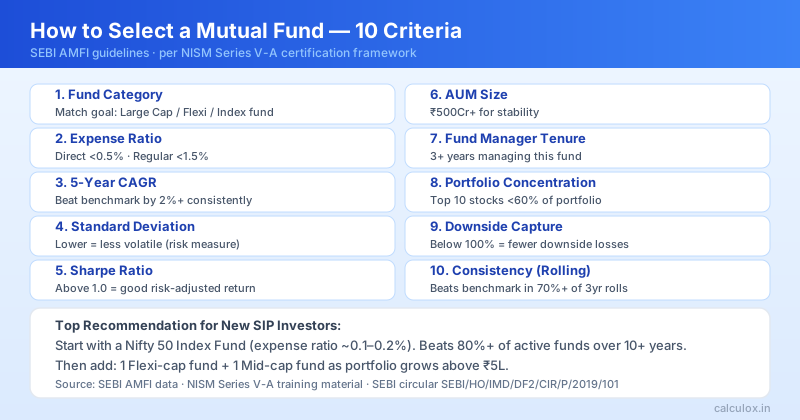
Try it yourself →
Use our free SIP Calculator for instant results
Why Mutual Fund Selection Matters
Most Indian mutual funds underperform due to: High expense ratios (1.5-2.5% annually), poor fund manager, wrong asset allocation. Example: ₹5L SIP over 25 years at 12% = ₹2.5Cr. Same SIP at 11% (1% lower due to high fees) = ₹2.1Cr. Cost difference: ₹40L! Selecting right fund saves hundreds of thousands. Use this 10-point checklist.
Criteria 1: Fund Category & Goal Match
Match fund type to goal timeline. Long-term (10+ years): Large-cap or mid-cap equity funds (12-15% CAGR). Medium-term (5-10 years): Balanced/hybrid funds (10-12% CAGR). Short-term (1-3 years): Debt or liquid funds (6-7% CAGR). ELSS for tax-saving (₹1.5L 80C deduction, 3-year lock, 12%+ returns). Don't match long-term goals with debt funds (returns only 6%, undershoots inflation).
Criteria 2: Fund Manager Track Record
Check: How long has fund manager managed this fund? (Minimum 3 years). Have they performed in bull and bear markets? Compare performance against benchmark AND peer group. Example: HDFC Large Cap Fund vs ICICI Large Cap Fund (both track SENSEX 50). Choose fund where manager added 2-3% alpha (extra returns) consistently. Long-tenure fund managers are more reliable than recent changes.
Criteria 3: Expense Ratio (TER)
Expense Ratio = annual cost as % of assets. Lower is better. Benchmarks: Index funds 0.1-0.3%, Large-cap 0.8-1.2%, Mid-cap 1.0-1.5%, Sector funds 1.5-2.0%. Example: ₹5L SIP, same 12% fund, Expense Ratio 2% vs 0.5% = ₹25L difference in 25 years! Preference: Index funds (lowest cost), then large-cap (lower cost), avoid sector funds (expensive). SIP amplifies cost advantage over time.
Criteria 4: Consistency of Returns (3, 5, 10-year)
Don't look at 1-year returns (too volatile, luck-based). Evaluate: 5-year CAGR (most important), 10-year CAGR (best). Is fund consistently top-quartile? (Compare to peer group, not just returns).
Example: Fund A: 10-year CAGR 14%, always in top 25%. Fund B: 10-year CAGR 14%, sometimes 50th percentile. Choose Fund A (consistent).
Consistency beats peak performance (peak returns often due to concentrated bets, risky).
Criteria 5: Assets Under Management (AUM)
Sweet spot: ₹500Cr - ₹10,000Cr. Very small AUM (<₹100Cr): Risk of fund closure. Very large AUM (>₹20,000Cr): Size can limit flexibility (difficult to move large positions). Moderate AUM (₹1,000-5,000Cr): Enough scale for economies, flexible for active management. New fund launches with ₹1Cr AUM risky (too small, fund closure risk).
Criteria 6-10: Checklist Summary
Criteria 6: Fund house reputation (HDFC, ICICI, Axis, Vanguard trusted). Criteria 7: Portfolio volatility (prefer funds with lower standard deviation = safer). Criteria 8: Holdings quality (check if fund holds good-quality companies).
Criteria 9: Exit load (prefer zero exit load, or minimal <1%). Criteria 10: Switchability (can you switch within same fund house at no cost?). Use: Morning Star, Value Research ratings to evaluate funds easily.
Frequently Asked Questions
Is HDFC or ICICI mutual fund better?▸
Both are reputable fund houses. Compare specific funds: HDFC Large Cap vs ICICI Large Cap (not fund house overall). Select fund with better 5-year CAGR, lower expense ratio, and more consistent performance. Fund quality varies within each house.
What is a good mutual fund return?▸
Equity funds: 12-15% CAGR is good (5-year view). Debt funds: 5-7% CAGR. Below-benchmark returns for 2+ consecutive years = underperformance, consider switching.
Should I invest in 5 different funds or 1 fund?▸
2-3 diversified funds ideal: Large-cap (₹5K/month), Mid-cap (₹3K/month), Balanced (₹2K/month) = ₹10K total. Don't need 10 funds (excess overlap, difficult to track). Too few funds = concentration risk.
When should I exit a mutual fund?▸
Exit reasons: (1) Fund underperforming benchmark 2+ years, (2) Fund manager changed and new manager underperforms, (3) Expense ratio increased significantly, (4) Goal achieved (need funds for withdrawal). Don't exit due to 1-2 bad quarters (normal volatility).
Are index funds better than active funds?▸
Index funds: Lower cost (0.1-0.3%), consistent with market. Active funds: Higher cost (1-1.5%), beat market only if manager skilled (rare). For SIP: Index funds statistically better for most investors. Active funds only if manager has 5+ year alpha (consistent outperformance).
How do I invest in mutual funds? What is the first step?▸
Step 1: Open account with mutual fund app (MoneControl, Kuvera, ET Money) or bank/broker. Step 2: Choose fund (use 10-point checklist), select SIP amount (₹500/month minimum). Step 3: Link bank account for auto-debit. Step 4: Start SIP (automatic debit every month). Step 5: Review quarterly (but don't panic during downturns). Most fund houses make it 5-minute process nowadays.
Should I diversify across fund categories (large-cap, mid-cap, small-cap)?▸
Yes, diversification within equity funds is smart. Example ₹20K/month SIP split: ₹10K large-cap (stable), ₹6K mid-cap (growth), ₹4K small-cap (high growth, high risk). For conservative: 100% large-cap. For balanced: 60% large-cap, 40% mid-cap. Avoid >20% in small-cap (too risky concentration). Diversification prevents being stuck in one segment if sector underperforms.
What is a fund's direct plan vs regular plan and which should I choose?▸
Direct Plan: Lower expense ratio (0.2-0.5% less). You buy directly from fund company (no middleman). Regular Plan: Higher expense ratio. You buy through agent/distributor who gets commission. Difference impact: ₹5L SIP at 12% return. Direct plan (0.5% expense) = ₹2.85Cr final. Regular plan (1.2% expense) = ₹2.45Cr final. Difference: ₹40L over 20 years! Recommendation: ALWAYS choose direct plan. Buy directly via: (1) Fund house website (HDFC, ICICI, Axis), (2) Aggregators (MoneControl, Kuvera, ET Money, Groww). Avoid regular plans - the middleman commission (0.5-1% annually) costs you hundreds of lakhs over 20 years.
How do I know if a fund manager has truly outperformed or if it's just luck?▸
Statistically, if manager outperformed for 2-3 years by luck, probability is low. Key metrics: (1) 5-year CAGR vs benchmark (fund should beat by 2-3% consistently). (2) Alpha = fund return minus benchmark return (positive alpha = outperformance). (3) Consistency: Top-quartile in at least 3 of last 5 years. (4) Downside capture ratio: In down years, fund should fall LESS than market (good manager minimizes losses). Example: Market down 20%, fund down 15% = better fund. Historical data: Only 10-15% of fund managers consistently outperform over 10+ years. Most underperform due to high fees. Result: Index funds with passive management often beat 85% of active managers!
What is STP and when should I use it?▸
STP = Systematic Transfer Plan (transfer money from debt fund to equity fund monthly). Useful for: Large lump sum (₹10L+) to reduce timing risk. Transfer systematically over 12 months to equity. Example: ₹10L in debt fund earning 6%, transfer ₹85K monthly to equity fund for 12 months = Rs 1L finally in equity, averaging costs. Prevents all money entering market at peak prices.
How do I compare mutual funds using Value Research or Morningstar ratings?▸
Value Research and Morningstar rate funds 1-5 stars (5 = best). Use ratings to: (1) Filter top-rated funds in category (3+ stars minimum), (2) Compare 5-year CAGR (available on their sites), (3) Check expense ratio (TER), (4) Read analyst summary. But don't blindly follow stars - 5-star fund today might become 3-star tomorrow if manager changes. Use ratings as starting point, then apply 10-point checklist for final selection.
Should I invest in sector funds or stick to diversified funds?▸
Sector funds (IT, pharma, banking) have higher returns but extreme volatility. ₹5L at 20% CAGR in good years, -30% in bad years. Stressful! Better for beginners: Diversified large-cap or balanced funds (more stable, 12-15% CAGR, lower volatility). Once experienced: Can allocate 10-20% to sector funds for growth. Avoid >20% in sector funds - concentration risk too high. Most wealth built through boring, diversified funds consistently, not exciting sector bets.
What is exit load in mutual funds and should I worry about it?▸
Exit load = fee charged when you redeem/sell mutual fund units before holding period (typically 1 year). Rates: 0.5-2% of redemption value. Example: ₹10L mutual fund with 1% exit load = ₹1L fee if you sell within 1 year. Recommendation: Always choose 0% exit load funds (most funds available now offer this). If exit load present: Only invest if you plan to hold 2-3+ years. Exit load is irrelevant for long-term SIP investors (never plan to exit). Modern funds: Almost all mutual funds now have zero exit load, so this is becoming non-issue. When choosing funds, prioritize exit load = 0 and expense ratio <1%.
How should I rebalance my portfolio as I get older?▸
Rebalancing by age: Age 20-30 (Aggressive): 80% equity, 15% debt, 5% gold. Age 30-40 (Moderate): 65% equity, 20% debt, 15% gold. Age 40-50 (Conservative): 50% equity, 30% debt, 20% gold. Age 50+ (Capital Preservation): 30% equity, 50% debt, 20% gold. Rebalance annually: If portfolio drifted (due to market growth), buy underweighted asset, sell overweighted asset. This forces "buy low, sell high" discipline automatically. Example: You target 50% equity but market boom pushed it to 65%. Rebalance by selling ₹10L equity, buying ₹10L debt bonds. This locks in profits while reducing risk appropriately. Rebalancing every year for 30 years of investing = difference between ₹1Cr and ₹2Cr final portfolio (100% growth!).
Related Articles
Try Our Free SIP Calculator
Get instant, accurate results without any registration required.
Open SIP Calculator →